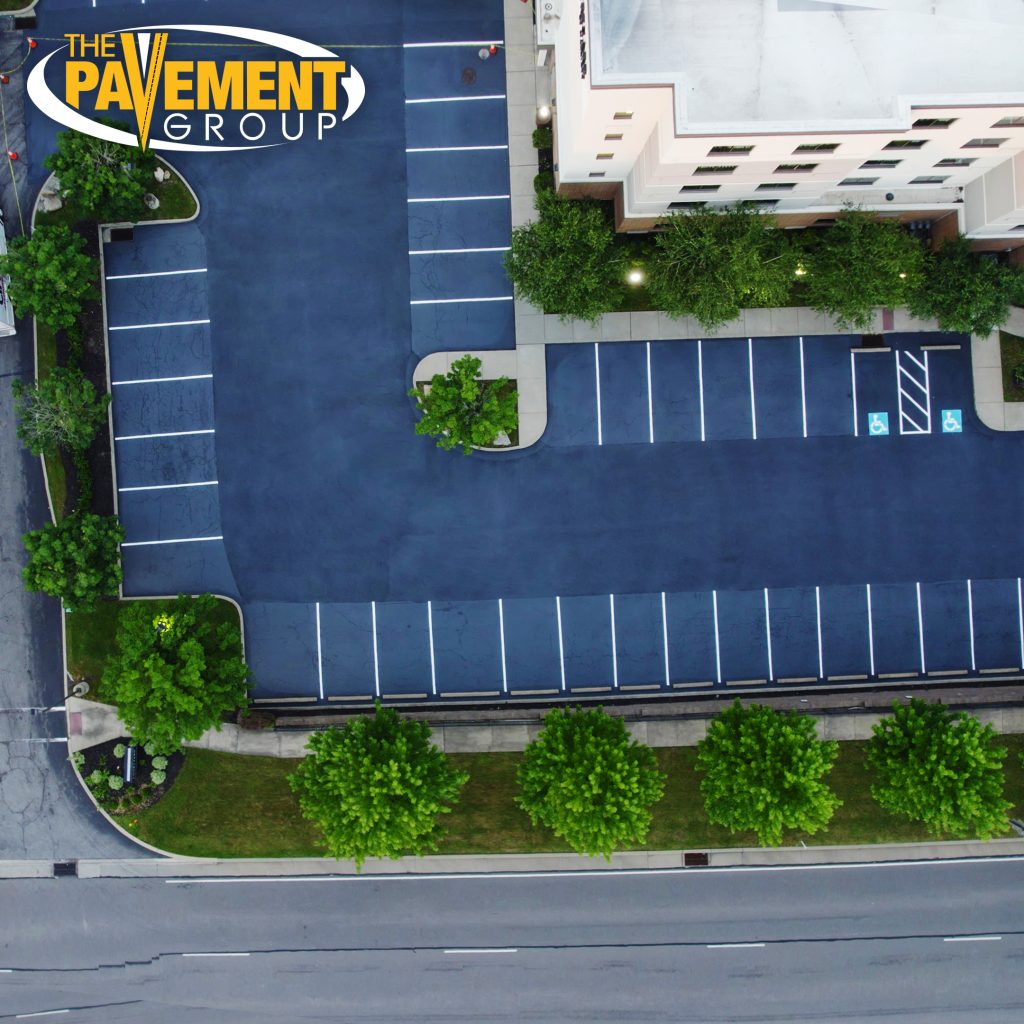
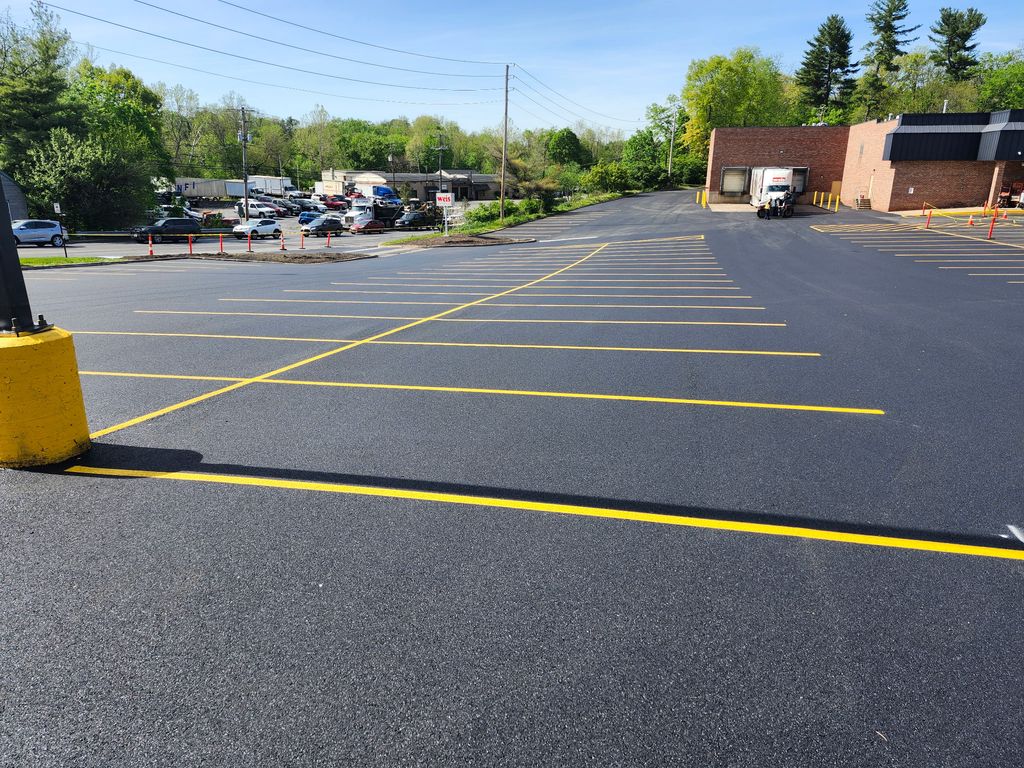
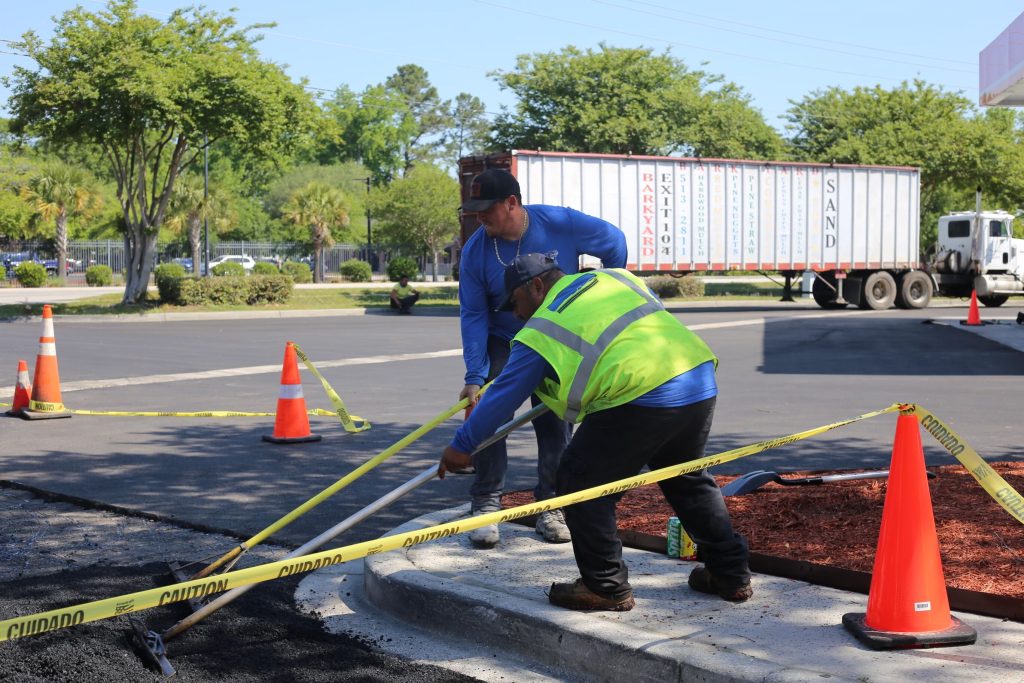
The Asphalt Institute, in its position paper on scuffing, states that scuff marks on new asphalt are generally a minor cosmetic issue and don’t reduce the life of the pavement. That’s a bit of a shocker for many property managers, since a lot full of those curved black smears looks like a lot that’s going to fail. Some scuff marks aren’t at all cosmetic, though. A shiny, sticky patch in a wheel path or a smooth, dull strip at the entrance clearly indicates a surface that is losing grip or binder. That’s how we start every inspection at The Pavement Group. We inspect apartment parking lots across the country, and the first thing we do is separate harmless marks from the wear and tear that actually costs owners money.
Overview
- Tire marks come from softer asphalt and the way the residents steer and park.
- Surface wear comes from binder loss, polished stone, and excess asphalt reaching the surface.
- Where the mark is on the property tells us what caused it.
- Cosmetic scuffs require patience; skid and binder issues require a repair.
- A quick walk-through with a trained eye will prevent overspending and missed damage.
Reading the Lot by Location
Most contractors describe tire marks in general terms. We describe them by where they are, as the apartment site has such a concentrated set of behaviors. Residents all turn into the same stalls every evening, swing around the same light-pole islands, brake at the same entrance, and idle at the same mail kiosk. Each habit leaves a mark on the surface.
Stall entries pick up curved smears as drivers turn the wheel while the car creeps into the space. Turnaround areas in the dead-end drive aisles accumulate tight arcs of scuffing. The leasing office loading bays and the move-in staging areas will have gouges from the heavy trucks and rental vans. The garage ramp aprons will have the rubber streaks from acceleration and braking. We map these areas on every property, and the map tells you so much more than a generic ‘heavy traffic’ comment.
What Makes Asphalt Mark So Easily
Asphalt marks because it softens in the heat. The Minnesota Asphalt Pavement Association states that scuffing and indenting are most common when new pavement is opened up to early traffic and is made worse by hot or humid weather. They identify several factors: the use of softer asphalt cement in many modern mixes, the fact that many vehicles put more weight on the front wheels, and the use of low-profile tires, which run at higher pressure and therefore have a greater concentration of stress. They also note that tires that have just come off the highway in summer will be hot and will mark a warm surface.
Parking lot mixes add to the problem. The Asphalt Institute points out that lot mixes tend to have more sand and fine aggregate, which produces a tighter, more attractive surface that also scuffs more readily when warm. We see this most clearly in warm markets like Phoenix, Dallas, and Atlanta, where a lot can sit above comfortable temperatures for months. In Minneapolis and Chicago, the same marks appear in the first hot week of summer and then disappear as the weather cools.
Steering is the culprit in most of the damage. If you turn the wheel with the car stationary, you twist the tire against the surface and push the fine aggregate aside, creating a ridge or smear. Apartment residents do this several times a day when they pull into the same space, so you end up with marks concentrated in the same places.
Surface Wear That Looks Like Tire Marks
Some marks look like tire damage, but they actually originate in the pavement itself. We distinguish three types of wear that are worth looking at.
The first is bleeding (also known as flushing). Pavement Interactive defines bleeding, or flushing, as a film of binder on the surface that is shiny and glassy and can become sticky in warm weather. It doesn’t reverse in cold weather, so the binder just builds up over time. Asphalt Magazine says it can be caused by too much asphalt in the mix, excess tack coat, or a poor-quality sealcoat, and traffic can actually force the binder up through a weak mix. We see it most often in wheel paths and in stalls that sit in the sun all afternoon.
The second is polished aggregate. Some stone will, of course, wear smooth from traffic, and Asphalt Magazine points out that polished aggregate reduces roughness and will require restoring the surface texture. We look for it at the entrance, the exit, and the main drive aisle, where the volume of traffic is very high (in the order of thousands of tires per month). A polished surface will look clean and dark but will have reduced grip, particularly when wet.
The third is weathering. In the FHWA glossary, weathering is defined as the wearing away of the surface through loss of asphalt binder. It starts as a faded grey surface with the stone edges showing and can progress to raveling if not addressed. People often confuse it with age, but it’s actually a sign that the surface has lost its binder film.
How We Sort Marks by Severity
The table below is the system we use for on-site walks. It links the visible mark to the likely cause, severity, and recommended response.
| Mark or wear | Where we find it | Likely cause | Cosmetic or functional | Our response |
| Curved scuffs and ridges | Stall entries, turnarounds, light pole islands | Wheels turning while stopped on warm asphalt | Cosmetic | Monitor and ask residents to avoid stationary steering |
| Black rubber streaks | Entrance, brake zones, garage ramp aprons | Hard braking and acceleration | Cosmetic | Sweep and rinse |
| Shiny, sticky patches | Wheel paths, sunny stalls | Bleeding from excess binder or soft mix | Functional, loses skid resistance | Mill and resurface the affected area |
| Smooth, dull stone texture | Entrance lanes, main drive aisle | Polished aggregate from repeated traffic | Functional, loses grip when wet | Resurface with a coarser, abrasion-resistant mix |
| Gray, fading, rough surface | Entire lot, stall edges | Weathering and binder loss | Early structural warning | Patch, treat, or overlay depending on severity |
| Circular dents | Stalls with trailers, jacks, or kickstands | Static load on hot asphalt | Localized | Patch if the dent holds water |
This table saves the owner money in two ways. It stops them from paying for repairs that do nothing and catches functional problems residents don’t report until someone slips. For example, on a recent property walk in Atlanta, using this approach helped a manager avoid spending over $6,000 on unnecessary scuff repairs that turned out to be purely cosmetic. Instead, they focused their budget on addressing worn areas in high-traffic lanes that actually needed repair, preventing much costlier damage down the line.
When Marks Point to a Deeper Problem
Sometimes a mark doesn’t just sit on the surface. You can have a shallow wavy deformation that runs across a lane, a dip that holds water in the wheel track, or a patch that keeps pushing out right at the same stall. That’s all a sign that the layers underneath have moved. That’s usually due to poor support, as our article on poor subgrade preparation explains in detail.
Fixed objects create their own pattern. The driver will steer tightly around the light poles, bollards, and landscape islands, and the same sharp turn will produce the same wear in the same ring. Our guide to light pole asphalt damage shows how those fixed points end up with both the turning stress and the water.
Why This Matters for Your Property
Residents will form an opinion of a community based on its parking lot long before they form an opinion of its amenities. A parking lot full of scuffs looks neglected, and a very slick, polished entrance is actually quite a hazard in the rain. Owners who don’t appreciate the difference either go overboard on the cosmetic bits or underspend on the bits that actually wear. We help our clients avoid both pitfalls by doing a proper inspection, producing a written map of where each scuff is located, and then producing a priority list that tells you which items are “wait and see” and which are “fix this season.”
Protect Your Apartment Parking Lot From Premature Surface Wear
Frequent vehicle turning, heavy traffic, and repeated tire friction can leave visible marks and gradually wear down asphalt surfaces in apartment parking lots. At The Pavement Group, we help property managers assess pavement conditions and recommend effective maintenance solutions, including sealcoating, asphalt repairs, and resurfacing when necessary. Let us help you maintain a durable, well-kept parking lot that stands up to daily vehicle traffic.
Contact UsFrequently Asked Questions
How long do tire scuffs take to fade on a newly paved apartment lot?
Most scuffs will disappear within about a month on a new surface (timing, of course, will vary by temperature, traffic, and mix). As the asphalt cures and the weather cools, the surface hardens, and traffic works the displaced sand back into the surface. We advise owners that the worst marking will be seen during the first hot spell after paving, and it will generally improve from there. If scuffs are still deep or spreading across the lot after a few months, we’ll look at the mix and compaction, as persistent marking can indicate a different problem.
What methods can we use to remove or reduce existing tire marks?
Rubber transfer streaks can generally be dealt with by sweeping and a light-pressure rinse using a mild, pavement-safe cleaner. True scuffs in the asphalt itself won’t come off, as they physically displace the surface. We don’t recommend any harsh solvents, as they can soften the binder and cause further damage. Aggressive pressure washing can also remove fine aggregate from a worn surface. For marks that bother residents, time and normal traffic will usually do the job better than chemicals, and resurfacing is the right solution when the marks are due to actual wear.
What lease or community rules help reduce tire marking and wear?
Clear, simple rules work, since most people will want to protect their lot once they understand why. We’d suggest a short notice asking residents not to turn the steering wheel when the vehicle is parked and not to leave trailers, jacks, or kickstands on the pavement in hot weather. Property managers can also post a reminder after any new paving or resurfacing work, as new asphalt is most prone to marking in the first few weeks. A friendly notice in the resident portal is generally more effective than a penalty and much cheaper than patching.
Do electric vehicles and heavier vehicles increase surface wear in a lot?
Heavier vehicles put more load on each tire, and many EVs are heavier than their petrol equivalent due to the battery pack. That extra weight puts more stress on warm, soft asphalt at stall entries and in turning areas, so marking will appear earlier and last longer in a lot with many EV stalls. The instant torque of some EVs can also increase tire scrub at launch. We don’t see EVs as a reason to panic, but we do recommend a more durable surface mix and good compaction at the charging stalls, where the same vehicles will be turning and parking over and over again.
Should we apply a surface treatment over tire marks and worn areas?
It depends on what the mark represents. Cosmetic scuffs don’t require treatment, and covering them rarely lasts because the coating can mark the same way. Surface treatments make sense when the pavement shows weathering and binder loss, because they replace the protective film before raveling begins. They don’t fix bleeding, polished aggregate, or damage rooted below the surface, which need milling and resurfacing. We always confirm the cause first so the treatment matches the problem instead of hiding it for a season.
About the Author
The Pavement Group specializes in asphalt engineering, pavement maintenance solutions, and data-driven asset management for commercial, retail, and multi-family residential properties. Utilizing advanced structural pavement evaluations and capital planning transparency, The Pavement Group works directly with property managers to extend pavement lifecycles, eliminate liability risks, and optimize long-term infrastructure investments.