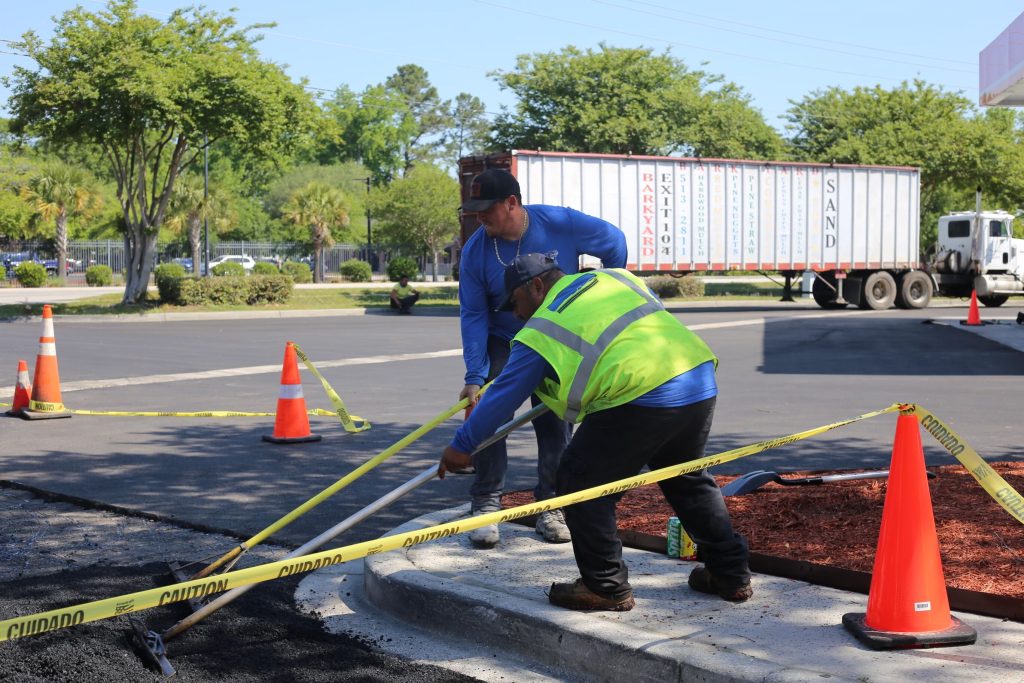
Each winter, up to 32 million tons of salt are spread across roads, sidewalks, and parking lots in the U.S. A large share lands on apartment parking lots, where crews spread it by the bagful because nobody wants a slip-and-fall claim. The Pavement Group is a national commercial pavement company, and we see the results every spring: crumbling concrete edges, widened cracks, and potholes along drive aisles. This guide shows property managers how to limit deicing salt damage to apartment parking lot pavement without putting residents at risk.
What Salt Does to Pavement
Salt doesn’t eat asphalt. It keeps water liquid at freezing temperatures, and it’s that liquid water that causes the problem. The TRB researchers report that this is the effect that is said to accelerate moisture damage and pothole formation in asphalt. A UND study has found that the use of deicers in conjunction with freeze/thaw cycles leads to durability problems and premature pavement failure.
Concrete gets a different battering. One coatings company tells us that melting ice at 20 degrees leaves liquid water in the concrete pores at a temperature at which it will refreeze. The FHWA has also noted a recent increase in deterioration in the vicinity of concrete joints. If you’ve got failing seams on your lot, have a look at what causes asphalt to crack along the edges of apartment parking lot paving seams, as salty water will collect there first.
Control the Dose
More salt doesn’t mean faster melting. The University of Minnesota’s Smart Winter Salt guide for property managers states that you should apply approximately 1 lb of salt per 250 sq ft after snow has been cleared and there are patches of ice left. Extra salt will not hasten the melting process. The Minnesota Pollution Control Agency also points out that if you remove more of the snow and ice by shoveling or scraping, then you will need less salt. Training makes a difference too, as smart salting seminars have been shown to reduce sodium chloride usage by 30 to 70%. Plow first, then salt only what remains. Also see how apartment communities can avoid pavement damage from snowplow operations (i.e., the blade doesn’t just undo all your pavement work).
Where Salt Hurts Your Lot Most
| Area | Main salt risk | How we protect it |
| Asphalt drive aisles and stalls | Water and salt enter cracks, freeze, and widen them | We seal open cracks before the first freeze |
| Concrete curbs and gutters | Freeze-thaw cycling flakes the surface | We recommend a sound surface, a sealer, and lower salt rates near edges |
| Concrete walks, ramps, and dumpster pads | Heavy foot traffic leads to heavy salting | We suggest shoveling first and spot treating |
| Joints and paving seams | Salty meltwater collects and weakens the edge | We seal seams and repair failed sections |
| Low spots and drains | Brine pools and refreezes | We fix ponding areas and clear drains |
Lab work does support the use of sealing. A study of five film-forming sealers found that they reduced the initial rate of water absorption by at least 68% and improved scaling resistance in the presence of sodium chloride. The same study points out that the sealer film has to remain intact in order to provide protection. That is why we do the scaling repair prior to recommending any sealer.
Your Pre-Winter Protection Checklist
Work through these steps in the fall, before the first forecast freeze:
- Seal open cracks and failed joints
- Fix low spots where water and salt pool
- Repair scaled concrete, then consider a sealer on sound flatwork
- Give your snow vendor a written maximum rate and approved product list
- Require the vendor to log product, rate, and date after every visit
- Photograph pavement condition each fall for year-to-year comparison
Match the Move to the Situation
| Situation | Better move | Why it works |
| Snow cleared, scattered ice remains | Spot treat at roughly 1 pound per 250 square feet | The MN LTAP guide sets this as a typical rate for cleared surfaces |
| Pavement below about 15°F | Use sand or grit for traction | A Rice Creek Watershed guide notes that salt does not melt ice below 15 degrees |
| White salt crust visible the next day | Cut the rate on the next visit | Leftover granules show you over-applied |
| Ice reforms at one drain | Fix the grading or drain | Chemicals cannot solve a drainage problem |
| Heavy snow still on the pavement | Plow or shovel first | Less snow means less salt needed |
How The Pavement Group Helps
The Pavement Group do asphalt paving, overlays, sealcoating, crack repair, and line striping for commercial clients all over the country. We begin with a written condition survey and photos and then prioritize the repairs by risk. Just ask us for references from some of the property managers we work for.
Protect Your Apartment Parking Lot From Deicing Salt Damage
Deicing salt helps keep apartment parking lots safer during icy conditions, but repeated exposure can contribute to pavement deterioration, surface wear, and damage around existing cracks. Without proper maintenance, winter-related moisture and freeze-thaw cycles can make these problems worse, leading to costly asphalt repairs.
At The Pavement Group, we provide professional asphalt maintenance, crack sealing, pavement repairs, and other pavement services to help apartment communities protect their parking lot investments. Let our team help identify pavement concerns and develop a maintenance plan to keep your property’s asphalt in better condition throughout the winter and beyond.
Contact Us TodayFrequently Asked Questions
Is calcium chloride or magnesium chloride safer for pavement than rock salt?
Neither one is automatically the safer option, and it comes down to your surface. The calcium and magnesium products work at colder temperatures, but Wisconsin DOT research has shown they do more damage to concrete than rock salt. The Minnesota Pollution Control Agency has stated that there are no environmentally acceptable alternatives to de-icing salt at this time. The objective is to pick a product that will melt at your pavement temperature and to apply it at the lowest effective rate. We’ll go through your vendor’s product list and flag any blends that are going to come into contact with new or damaged concrete.
Does sealcoating protect asphalt from deicing salt?
Sealcoating adds a protective surface layer, and we provide it as part of our commercial pavement package. There’s very limited independent research on sealcoat specifically in relation to deicing salt. We regard it as one element of a preservation strategy rather than a salt shield. It won’t repair any open cracks, so we crack seal first and then sealcoat. If you have widespread alligator cracking or loose aggregate, then you need patching or an overlay prior to sealcoat making any sense at all. We’ll inspect the site, take photos, and let you know what the best option is.
Do we need to sweep or wash salt off the lot in the spring?
You should sweep up leftover granules once the ice clears, because loose salt stays on the pavement and wears under tires. Smart salting programs also tell crews to sweep up and reuse leftover salt. Washing with water is a different matter, since runoff carries chloride into storm drains. Chloride keeps accumulating in water with no practical way to remove it, so check your local stormwater rules before you wash. We recommend dry sweeping first and spot washing only where heavy residue remains, and local rules allow it.
How do we write salt limits into our snow removal contract?
Put the approved products, the max application rate, and a logging requirement in writing. The MPCA recommends that businesses employ trained and certified smart salting contractors, and there are a number of regions that run similar training, so you should ask your vendor what program their crews have completed. A lot of the over-salting is driven by fear of slip-and-fall litigation (Star Tribune article). Ask your attorney and your insurer how a documented, rate-based plan supports your safety obligation. We can also assist you in adding blade rules that are in line with our guide on preventing pavement damage from snowplow operations.
Can we use deicer on newly paved asphalt or newly poured concrete?
New concrete is the biggest risk, and one coating company will have you keep deicer off any concrete placed in the last year. Other sources are suggesting shorter waiting periods, so get the exact timing from your concrete contractor and your engineer on the mix. With fresh asphalt, you’ll want to check with the paving contractor as to any curing or traffic restrictions prior to winter. The MPCA’s advice is to shovel first and then use sand or grit for traction. We schedule our new paving and concrete early in the season so that the surfaces have a chance to cure prior to the first salt truck coming down.
About the Author
The Pavement Group specializes in asphalt engineering, pavement maintenance solutions, and data-driven asset management for commercial, retail, and multi-family residential properties. Utilizing advanced structural pavement evaluations and capital planning transparency, The Pavement Group works directly with property managers to extend pavement lifecycles, eliminate liability risks, and optimize long-term infrastructure investments.