Pavement engineers have long known that asphalt damage increases with the fourth power of axle weight. A single axle of a heavily loaded garbage truck can therefore do as much damage as thousands of passenger car axles. In apartment parking lots, this effect is amplified in several high-wear zones that often fail first. The most common problem areas are entrances and exits where vehicles brake and turn, drive aisles that turn, dumpster pads and approaches, and fire lanes. That’s why you see the asphalt in these high-traffic areas wearing out so much faster than the rest of the lot, even if the rest of the lot is perfectly fine. That’s the math that underpins the damage we see at The Pavement Group.
We’re a national contractor that works on apartment communities across the country (Phoenix, Dallas, Atlanta, Chicago, etc.), and we find the same few spots on pretty much every property are the worst for wear. This guide shows you where those spots are, what is destroying the asphalt there, and how we fix each one so it lasts.
Overview
- Heavy goods vehicles and the associated braking and cornering are the main cause of high-traffic wear, rather than passenger car volume.
- Entrances, drive aisle turns, dumpster approaches, and fire lanes all fail first.
- Water, heat, and fluids all exacerbate the mechanical damage.
- Each zone has its own repair method, and the table below sets out our approach.
- Targeted maintenance will look after the busiest areas for years.
How Heavy Loads Overpower Apartment Asphalt
Most apartment developments are designed around the passenger car. The asphalt is a certain thickness, and the stone base is a certain depth to accommodate that expected load. Then you add the trash truck, the moving van, the delivery truck, and the fire department truck all using the same lanes. All of those vehicles are well beyond the load the pavement section was designed to carry, so every pass by any of them takes a bit of life out of the pavement.
Frequency is the real problem. A resident will drive the same entrance and the same aisle twice a day, 365 days a year. On a property with 200 units, you can easily have 400 trips through the main gate a day, and each trip involves braking on approach and accelerating on exit. Over a year, that’s well over 100,000 repetitions of the same stress on the same few square yards.
Turning, Braking, and Standing Loads
Straight-line driving is kind to asphalt. Turning is not. When the vehicle is moving slowly or is stationary, and the driver turns, the tire pivots on the surface and drags the top layer sideways. You see that as scuffing first, then raveling, and then loose stone along the turn. It gets much worse in hot weather as the warm asphalt softens and tears more easily.
Braking creates a different type of failure. At gate entries and at stop signs, you get shoving where the braking vehicle pushes the asphalt forward and creates ripples. A parked or idling heavy vehicle will create a completely different pattern known as rutting, where the wheel paths sink into the surface. Both shoving and rutting are types of pavement deterioration described in the pavement deterioration catalog, and we find both at pretty much every apartment entrance we look at.
Water, Heat, and Fluids Multiply the Damage
Traffic rarely works on its own. Water gets in through the tiniest of surface cracks and starts to erode the base. The base can’t take the load, so the next vehicle drives into the weakened area, and the crack widens. Facility managers know that water damage in a parking lot erodes the base and subbase and ultimately leads to potholes.
Climate affects how the cycle plays out. In Minneapolis, Chicago, and Denver, moisture trapped in the asphalt freezes, expands, and literally cracks the asphalt each winter. In Phoenix, Dallas, and Houston, sustained heat softens the binder, which in turn leads to rutting under braking trucks. Fluids add a third dimension to the problem. Oil, fuel, and hydraulic fluid all leak at the same stopping points, and petroleum can dissolve the asphalt binder. Industry coverage of the role of sealcoats in protecting asphalt confirms that parking lot surfaces are constantly attacked by oil, gasoline, de-icing salts, water, and the sun.
Where Wear Starts First on an Apartment Property
Every property has a different layout, but the failure map is very consistent. The table below shows the high-traffic areas we look at first and the repair we apply to each.
| Zone | What Traffic Does There | First Warning Sign | Repair We Use |
| Main entrance and gate | Hard braking and acceleration by every vehicle | Ripples, shoving, linear cracks | Mill and replace with a stable mix, restore stop bar |
| Drive aisle turns | Tires pivot under load | Scuffing, raveling, loose stone | Mill, tack, and inlay, then restripe |
| Dumpster approach | Heavy axle loads and fluid drips | Rutting, alligator cracking | Full-depth repair with reinforced base |
| Fire lane | Rare but extreme loads | Edge breakup, sunken wheel paths | Edge rebuild, base repair, compaction in lifts |
| Leasing office and mailbox pull-in | Short stops, constant starts | Polished surface, cracked patches | Surface treatment or thin overlay |
| Curb line and inlet | Water collects and traffic crosses it | Depressions, standing water | Regrade, patch to correct slope |
We also look at the bonding between the asphalt layers in these areas. The Asphalt Institute states that dirt, oil, and other contaminants prevent the layers from bonding and can cause slippage failures. Our team follows that Asphalt Institute guidance by cleaning and drying the surface before applying the tack and new asphalt.
Repairing High-Traffic Wear the Right Way
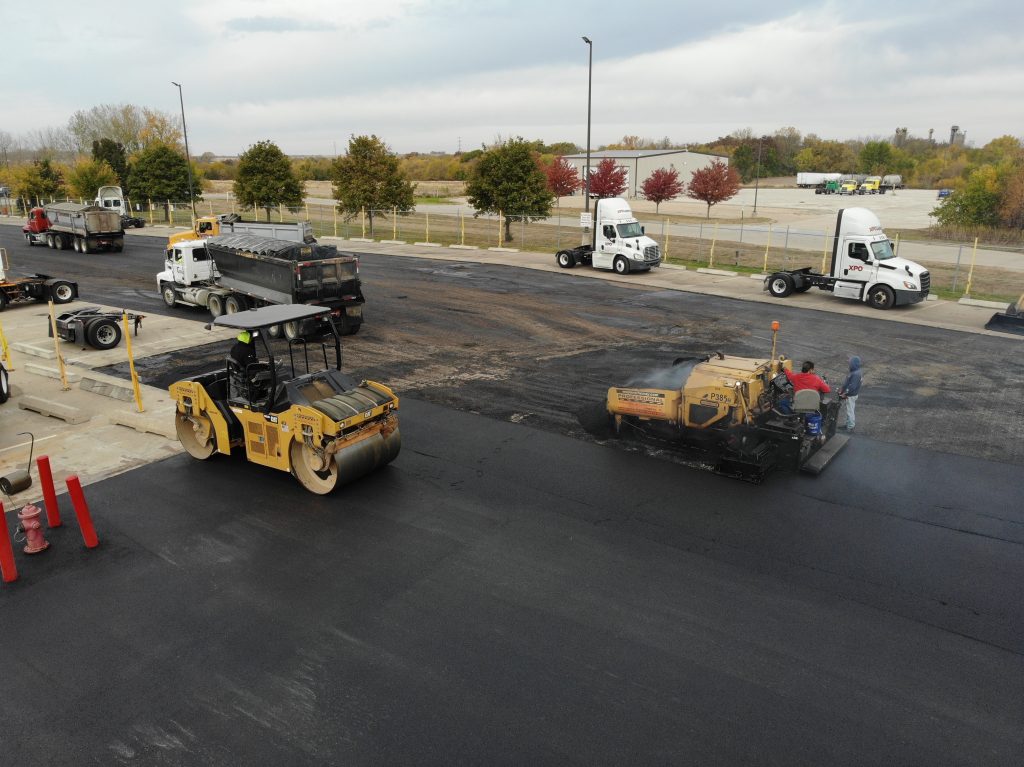
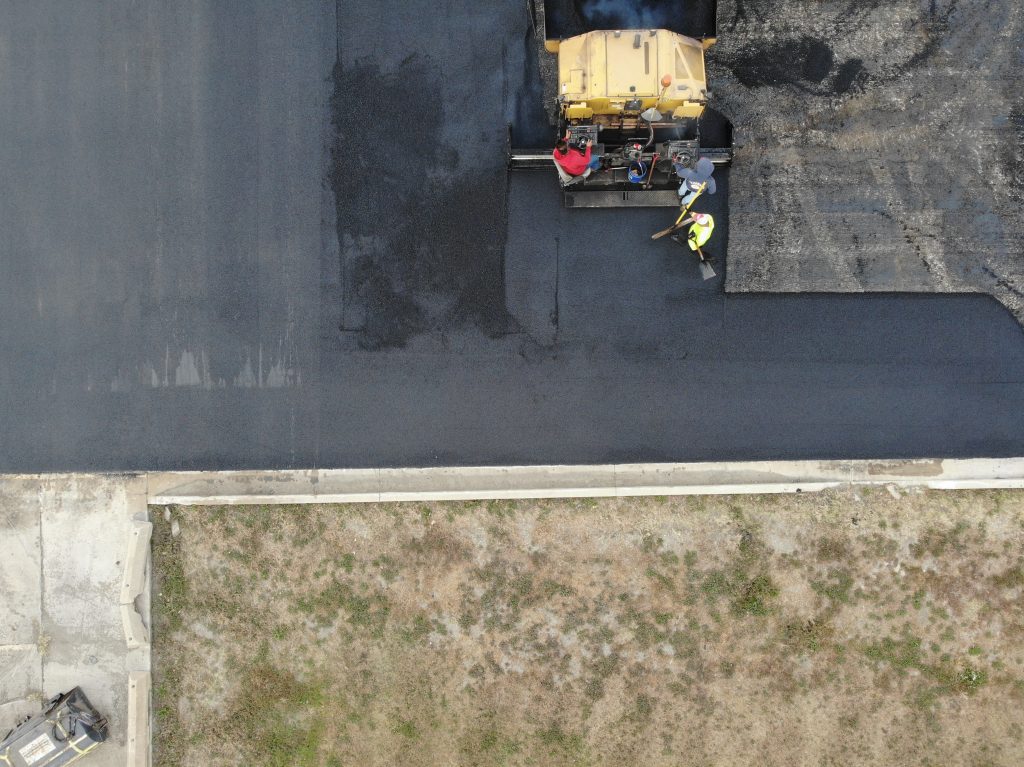
A permanent repair starts with removing the failed material. A patch placed over ruts and ravelled pavements will fail within a season, so we cut square edges around the damage and extend the limits well beyond what is actually there. We then restore the base if it’s softened, apply the tack coat, and place the new asphalt in lifts, compacting each one. Compaction determines how long the repair will last, as a poorly compacted patch will ravel again and allow water back in.
After the repair, we check that the surface drains. We confirm the grades still carry the water towards the inlet, as a patch that holds a puddle is the start of the next failure. If the damage is due to surface loss rather than structural failure, our guide to asphalt surface erosion explains how raveling develops and what can slow it down. For lots under 3 years old, read why premature asphalt failure occurs, since many early failures stem from density, bonding, and base issues.
Protect Your Busiest Pavement Before It Fails
High-traffic areas make or break the appearance and performance of your parking lot. A failed entrance tells your residents and prospects the property isn’t being looked after, and a failed dumpster approach becomes a liability and a repair bill. The Pavement Group will thoroughly assess each area. Our assessment includes a guided site walk to inspect all high-traffic zones, detailed photographs to document existing conditions, and a written report outlining causes of failure and our recommendations. This clear, step-by-step process makes it easy for property managers to see what needs attention and prepare for next steps. Call us to arrange a high-traffic area assessment and get a full written plan for your community.
Protect High-Traffic Areas of Your Apartment Parking Lot
High-traffic areas of apartment parking lots experience constant vehicle movement, repeated turning, and heavy loads that can accelerate asphalt deterioration. Without proper maintenance, these areas may develop cracks, potholes, surface wear, and other pavement problems that affect safety and accessibility. At The Pavement Group, we help property managers protect their parking areas through professional asphalt repair, milling and paving, crack sealing, and sealcoating services. We provide pavement solutions designed to address wear and extend the service life of apartment parking lots.
Contact Us TodayFrequently Asked Questions
How often should we inspect the busiest areas of our lot?
We’d recommend a quick property team walk each quarter and a professional assessment at least once a year. A walk after every major storm and after the first hard freeze in the northern markets would be useful. High-traffic areas change much faster than the rest of the property, so a small crack at an entrance can easily widen over a season. Dated photos from each walk are very useful for seeing how quickly the damage progresses.
Can we reroute trash trucks to reduce wear?
Often yes. Moving the pickup path away from the weak pavement, or having the trucks approach the dumpster pad from a different angle, spreads the load over a greater area of asphalt. Some communities time pickups to occur when the pavement is cooler, since hot asphalt is more prone to rutting. We review the site plan and the truck’s actual route and will always suggest changes that cost nothing before recommending any construction. Rerouting is most effective when combined with a more robust repair at the original approach.
Do electric vehicles wear asphalt faster?
EVs are heavier than their petrol equivalent because of the battery pack, and the instant torque they produce can increase tire scrub through corners and at gate exits. The effect of a single EV won’t be very noticeable, but with a community of EVs and a number of chargers, that scrub is concentrated around the charging stalls. We’re already seeing some scuffing and raveling around the charging points, and we’d recommend a more robust surface treatment in that area. The added weight over time also makes good base support and good drainage even more important.
How does snow plowing affect high-traffic areas?
In Minneapolis, Chicago, and Denver, the plow blades scrape over lots that are already fairly low density. The blade will catch on raised areas, loose stone, and manhole frames and will, in fact, tear the surface right open at those points. We recommend that property teams stake out any raised features before the season and use plow shoes that lift the blade a bit. Patching the weak spots before winter also gives the plow less to catch.
When can we use an overlay instead of milling?
An overlay is only appropriate when the pavement is structurally sound, and the damage is fairly superficial (e.g., light raveling, surface fatigue with no base movement). If the cracks are deep, you’ve got ruts that hold water, or the base has softened, the old defects will simply come through the new surface in a year or two. We always check the pavement and slope before recommending an overlay. Where an overlay is appropriate, we normally mill the edges so the new surface is flush with the existing curbs, gutters, and utility covers.
How should we prioritize repairs if our budget is limited?
We prioritize repairs by safety risk first, then by how rapidly the damage spreads, then by visibility to the residents. Entrances, fire lanes and any area where water pools will invariably be at the top of the list as they are safety critical and spread very quickly. We then group the smaller repairs together to allow for a single visit and thus reduce mobilization costs. A written priority list allows the managers to spread the work across budget cycles without any of the safety-critical areas being left to fail.
How do we measure and track wear over time?
Rutting is the easiest wear to measure. We lay a straightedge across the wheel path and measure the gap at the deepest point, and depths of about a half inch or more deserve attention because they hold water. We also photograph cracks and mark them with dated paint so we can see growth between visits. Recording these numbers each year turns guesswork into a trend line that supports budgeting.
What should we ask a contractor before repairing a high-traffic area?
Ask what mix the crew will use, how deep they will remove the failed material, and how they will check compaction. Ask whether the scope includes base repair and drainage corrections, since a surface-only patch rarely lasts in a heavy-load zone. Request a written warranty that names the repair areas and the covered failure types. We answer each of these questions in writing before we start work.
Does The Pavement Group serve apartment communities in every state?
We serve apartment owners and management companies nationwide. One team can assess several properties, apply the same diagnostic process at each, and adjust for local climate and soil. That helps portfolio managers compare conditions and plan budgets across sites. Send us your list of communities, and we will build a prioritized plan for the high-traffic zones at each one.
About the Author
The Pavement Group specializes in asphalt engineering, pavement maintenance solutions, and data-driven asset management for commercial, retail, and multi-family residential properties. Utilizing advanced structural pavement evaluations and capital planning transparency, The Pavement Group works directly with property managers to extend pavement lifecycles, eliminate liability risks, and optimize long-term infrastructure investments.