Pavement people have reported that for every 1% increase in air voids above a 7% baseline, you lose approximately 10% of the pavement’s life. So one poor roller pass can cost an apartment owner many years of service. You see it all over the country in the freeze-thaw areas of Pittsburgh and Boston and in the clay soils around Dallas and Atlanta. You’ve got an owner who’s paid a fortune for a new lot who’s looking at 20 years of life from it. Then you’ve got an alligator cracking and raveling appearing in two or three years’ time. Those failures almost never relate to age at all. They’re invariably the result of decisions made prior to paving, during paving, and immediately after paving.
Overview
- Low density and weak joints allow water to get into the new asphalt in the first winter.
- A thin or inadequately prepared base will crack under normal apartment usage, whatever the appearance of the finished surface.
- Missing a tack coat or prime coat means the layers aren’t bonded, so the surface just peels off.
- Cold, windy, or late-season paving means the crews can’t get to the required compaction.
- Construction traffic, utility trenches, and the early oil drips all damage the new pavement before the residents even move in.
Failure Rarely Starts at the Surface
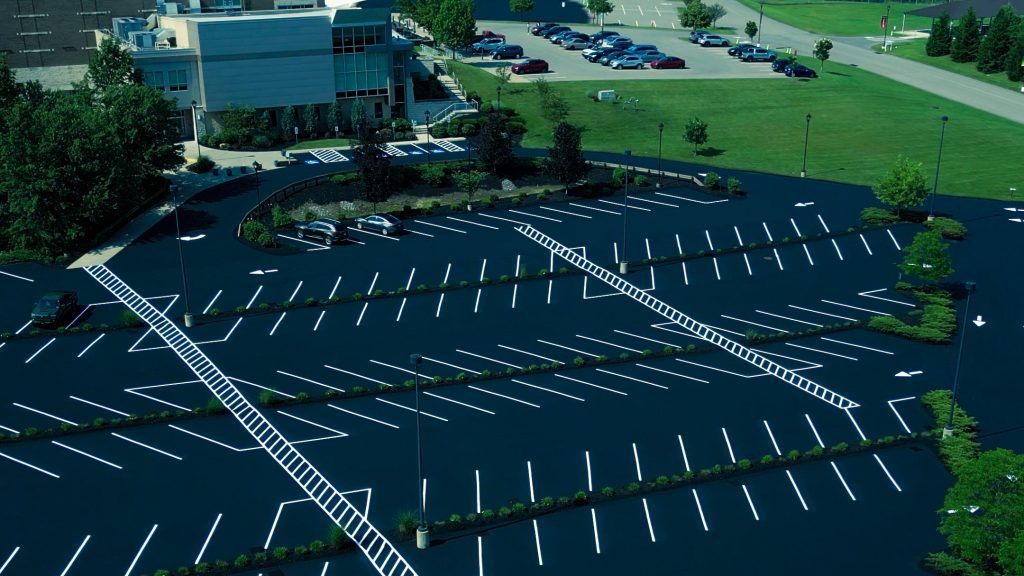
A new lot looks absolutely spotless on the day the crew leave. Black asphalt, clean stripes, and clean curbs. That’s the impression you get. It’s a very dangerous one, as the layers that actually determine performance are the ones the owner will never see. When you go to look at a lot that’s failed and is only a few years old, you go through the same sequence every time: density, base, bond, and drainage. The surface will always be the symptom of a problem that’s been there for months.
Low Density and Weak Joints
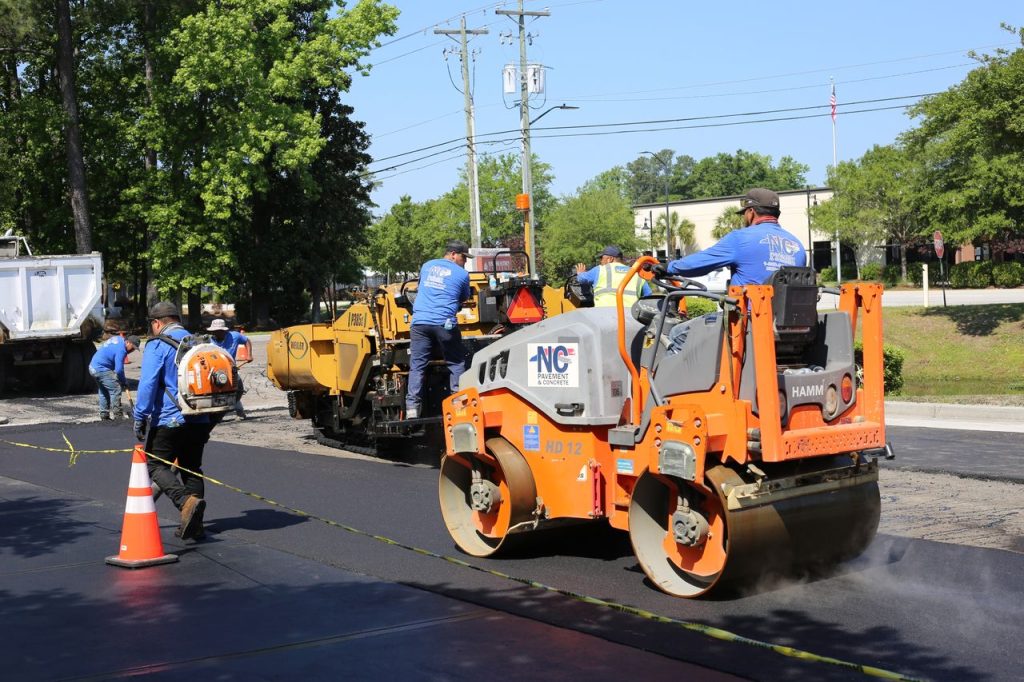
Compaction is number one on our list, as it’s the step that has the most direct impact on life span. Dense-graded mixes will perform their best when the air voids are in the 3-8% range. Raveling becomes a real issue when the voids get above about 8%. Interconnected voids also provide a route for water to get through the mat, which leads to stripping and potholes.
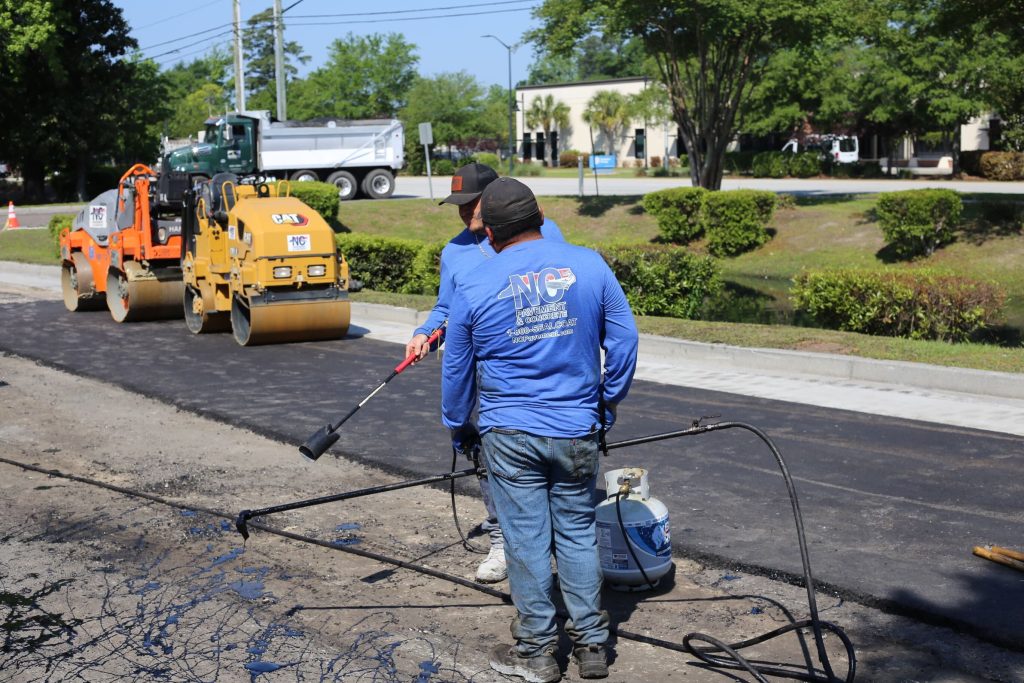
Joints are the thing to look at on an apartment lot, as you’ve got crews paving in very narrow lanes around the buildings, the islands, and the dumpster enclosures. That layout produces a lot of joints. The National Center for Asphalt Technology points out that a lot of the premature failures actually start with low density at the joints (where one lane meets the next). A joint that opens up in year two allows water to get to the base. The damage then spreads from there.
Weather and mat temperature are the two primary factors that determine how much density a crew can achieve. The industry guidance is that there are five factors that affect density: mix temperature, mat thickness, base temperature, air temperature, and wind. Paving late in the season in places like Minneapolis, Boston, or Pittsburgh is a case in point where several of those factors are stacked against the crew as you’re trying to get the job done. You’ve got a thin mat on a cold base, and it will lose all that heat very quickly. We will not pave thin lifts under poor conditions as the benefit of getting the job done on time simply vanishes in a few winters.
Base and Subgrade Problems
Asphalt carries the load, but the base and the soil underneath it carry the load path. Illinois asphalt industry guidance states that drainage issues are a common enough cause of failure to warrant special design attention and that light-duty pavement in high-stress areas is prone to early failure. On apartment sites the high-stress areas are the fire lanes, the dumpster approaches, the entrances, and the move-in loading zones. They are often treated as just ordinary stalls, and the pavement fails as a result.
Soil conditions add another dimension of risk. The expansive clays in and around Dallas and Atlanta move with the moisture content and can heave or settle a thin section quite unevenly. New apartment communities face a risk older lots don’t: a network of utility trenches running across the site. If the crews don’t properly compact the backfill in those trenches, then you’ll end up with a visible strip of settlement in the asphalt within a year or two. The Asphalt Institute says alligator cracking results from weak subgrade, insufficient thickness, excessive loading, or some combination of those. Patching the surface will do nothing until you fix what’s below.
Bond, Mix, and Placement Errors
Asphalt layers have to act as one structure. If the crews skip the tack coat between lifts or skip the prime coat over a stone base, then the layers slide on one another and the top course peels or shoves. The same Asphalt Institute source states that lack of bond can be the result of either skipping the tack coat or the prime coat. We see this type of failure most frequently when a contractor is rushing the schedule and putting a second lift on a dusty surface. A surface that peels away in sheets is almost always a bond problem rather than a wear problem.
Mix quality adds another variable. A truck that’s been sitting too long on site will have a cold mix, and that cold mix simply won’t achieve the target density no matter how hard the roller works. We look at the delivery tickets, we monitor the screen temperature. We will reject any load that’s outside of our acceptable range. That discipline is far more valuable to the owner than any warranty clause.
Causes at a Glance
The table below shows how we link each cause to a symptom and a checkpoint an owner can check during construction.
| Cause | What Owners Eventually See | What Owners Can Check at Paving Time |
| Low density | Raveling, loose stone, early cracking | Mix delivery tickets and roller patterns |
| Weak joints | Cracks along lane seams | Joint overlap and edge compaction |
| Thin base or section | Alligator cracking in fire lanes and entrances | Stated thickness by area on the plans |
| Poor drainage | Puddles, stripping, pothole clusters | Grading and inlet elevations before paving |
| Missing tack or prime coat | Peeling or shoving surface | Evidence of tack application between lifts |
| Trench settlement | Linear dips across stalls and aisles | Compaction records for utility backfill |
Stresses Unique to New Apartment Communities
Apartment sites get the new pavement working almost straight away. Concrete trucks, moving vans, skip haulers, and fire apparatus all go over it in the first few months, and each is a heavy, slowly moving load on asphalt that is still curing. The same corners are subjected to shear stress again and again through tight turning movements at entrances and around buildings.
Oil drips present another early problem. Fuel and oil soften the binder, and the new asphalt initially has a lot of exposed binder. Industry contractors will tell you to seal coat within 12 months of paving to protect against that kind of damage. We do the first protective treatment while the site still looks perfect, because prevention is a heck of a lot cheaper than patching oil-degraded stalls later on.
Protecting Your Investment Before and After Paving
Owners have more sway than they think. Before paving, we strongly encourage the owner to request the thickness design by area, the drainage grading plan, the joint layout, and the paving schedule with expected air temperatures. During paving, an owner or their monitor can track mat temperature, roller passes, and tack application. After paving, we monitor early and seal cracks quickly to catch small issues before winter opens them up.
The environment still plays a part in a new lot. Our article on the deterioration of shaded asphalt explains why moisture stays in shaded stalls and accelerates failure, even in good asphalt. If you’re already seeing surface loss, our article on why asphalt peels in an apartment lot covers the next steps.
Premature failure is preventable, and early intervention will keep it small. The Pavement Group works with apartment communities, HOAs, and commercial properties across the country and can come in to review your design, your paving, or a lot that has already started to fail. Just get in touch, and we’ll explain what happened, what it will cost to fix, and how you can protect the lot going forward.
Frequently Asked Questions
How long should new asphalt cure before residents drive and park on it?
Fresh asphalt gains strength as it cools, so the time you have to wait before you can use it depends mainly on the temperature and the mix. In mild weather, many areas can usually take light passenger vehicles within a day or two; in hot summer weather, the surface will remain soft for longer. We advise against using any heavy vehicles (i.e., moving trucks, dumpster haulers, etc.) on the new surface for as long as the contractor recommends. Residents should also avoid turning their steering wheels when stationary, as that movement will scar and tear warm asphalt. Owners should ask the contractor for a written opening time for each phase, and the contractor should post barricades and notices to let residents know what’s going on. A little patience in the first week will go a long way to protecting the finish for years.
What does a typical warranty cover on a newly paved apartment lot, and what usually voids it?
Warranties vary enormously, so it is essential that the owner reads the written contract before signing. Many cover defects in workmanship or materials for a specified number of years but often exclude damage caused by oil spills, heavy construction traffic, settlement of utility trenches, and drainage problems outside the paved area. Some will even require the owner to do certain maintenance (e.g., crack sealing) within a certain timeframe. We advise you to ask the contractor to explain, in plain English, what each exclusion means and how the claims process works. Terms and legal rights vary by state and contract, so it is always wise to seek legal advice from an attorney. Good records (photos taken after paving and after each maintenance visit) make any warranty discussion much easier.
How do we tell normal new-asphalt behavior from real early failure?
New asphalt behaves differently from aged asphalt, and some changes look alarming without being harmful. Tire scuffs, light surface marks from turning wheels, and a small amount of loose stone in the first weeks are common and usually stop on their own. Real failure shows up as repeating patterns: cracks that follow lane seams, shiny or oily bleeding in hot weather, soft rutting in wheel paths, or sheets of surface material lifting away. We recommend photographing the lot after rain, because puddles reveal low spots, and again after the first cold snap, because new cracks often appear then. If a defect grows week after week or spreads across a whole row, the owner should contact the contractor in writing and request an inspection. Early, documented concern protects the owner far better than waiting for a full season.
How do contractors diagnose a failing new lot without tearing it up?
We begin with a visual survey and a map of every crack, depression, and wet area, since patterns point to the cause. Our crew take small core samples to confirm actual thickness, layer bonding, and base condition. We then density-test the cores to confirm the original compaction met the specification. GPR can detect moisture-related stripping in pavement layers where damage is moderate to severe. We then combine that with the drainage grading and the original plans so the report tells you why the lot failed rather than just where. A clear diagnosis stops the very common mistake of paying twice, once for the patch and once again for a failure that the patch never actually fixed.
Can a failed new lot be repaired, or does it need replacement?
The answer depends on how deep the damage goes and how widespread it is. Isolated failures, such as a trench settlement or a single weak joint, often respond to cut-out and patch repairs with proper compaction and tack coat. Widespread raveling or bond failure in the surface course often calls for milling the top layer and placing a new one. Base failures or drainage defects usually require removing the pavement in that area, correcting the soil or stone base, and rebuilding the section. We provide owners with scope options by cost, so they can compare a targeted repair with a larger rehabilitation. Responsibility for the cost may rest with the original contractor, the designer, or the owner, so we recommend documenting the findings before any repair starts.
How can owners schedule paving to limit disruption for residents?
Phasing is the most effective tool, because it keeps most parking available while crews work on one section at a time. We divide the lot into zones, post notices in advance, and tell residents exactly where to park each day. Crews also finish each phase with striping and barricades, so residents do not drive across fresh asphalt by mistake. Scheduling around the weather matters too, because rain delays can extend a phase and strand vehicles in the next one. We recommend choosing a primary point of contact for resident questions and sending reminders the day before each phase. Clear communication reduces complaints and protects the new pavement from early traffic that causes avoidable damage.
About the Author
The Pavement Group specializes in asphalt engineering, pavement maintenance solutions, and data-driven asset management for commercial, retail, and multi-family residential properties. Utilizing advanced structural pavement evaluations and capital planning transparency, The Pavement Group works directly with property managers to extend pavement lifecycles, eliminate liability risks, and optimize long-term infrastructure investments.