Repairing damaged pavement around mail kiosks and package lockers directly addresses key risks for both property managers and residents. The main risks include trip hazards that can cause injury or liability claims, water damage that quickly undermines repairs, and ADA accessibility violations that can lead to compliance issues.
Federal accessibility standards cap the cross slope of a walking surface at 1:48 (approximately 2%) and allow only a quarter inch of vertical change before a bevel is required. A mail kiosk or package locker bank sits right on the edge of those specifications. People stand there every day; delivery drivers stop there multiple times an hour. Believe us one cracked edge or sunken corner can turn a useful piece of infrastructure into a trip hazard. That’s why, at The Pavement Group, we repair these areas differently than a standard parking stall. All the loads, water, and accessibility requirements come together in that one small area.
Overview
- The mail kiosk and locker areas deteriorate faster than the adjacent parking stalls because vehicles stop, idle, and turn in the same few square feet.
- The majority of the damage starts right at the base, at the base of the pad or at the joint between the concrete pad and the asphalt.
- A permanent repair requires a saw-cut boundary, base correction, tack coat, compacted lifts, and a transition that meets accessibility requirements.
- Drainage correction is as important as patching, as standing water will destroy the repair from below.
- Sealcoating, striping and traffic control all form part of the protection of the finished work.
Why Pavement Fails Around Mail Kiosks and Package Lockers
Most apartment communities place their cluster box units and parcel lockers at the entrance, adjacent to the leasing office, or along a central drive lane so residents can reach them without walking too far. This results in a very predictable traffic pattern. Residents pull up, brake hard, idle with the engine running, and then pull away. The delivery vans come in waves (often several in the same hour during peak shopping periods). The same shear stress we talk about in our article on damage at speed bumps is produced here, just in the case of the lockers rather than a speed hump.
The second driver of failure is the pad itself. The concrete pad and the asphalt around it expand and contract at different rates and will settle at different rates over time. After a few seasons, you end up with a gap along the pad edge. Rain and irrigation water get into that gap, wash the fines out of the base, and leave a void under the asphalt. The next vehicle to roll over that void breaks the surface, and the crack then spreads out in a ring.
Fluid leaks add a third issue. Residents are in the same spot every day, so oil and fuel seep out, and the asphalt binder softens until the surface pits and ravels. That damage is initially purely cosmetic, but it does allow water in.
What We Look for During the Site Assessment
Before we cut or patch anything, we walk the area at the pad, the approach lane, and the path that the residents use to get to the boxes. We look for soft spots, measure slopes with a digital level, and take photos of where water pools after rain or a hose test. The table below shows how we link what we see to what we recommend.
| Visible sign | Likely cause | Repair we recommend |
| Alligator cracking in the approach lane | Base fatigue from repeated van stops and turns | Full-depth saw-cut patch with base repair |
| Ring crack along the pad edge | Pad and asphalt moving at different rates, open joint | Cut back past the damage, repatch, and seal the joint |
| Bowl-shaped dip near the lockers | Settled base or washed-out fines | Remove the asphalt, rebuild the base in lifts, repave |
| Ponding after rain | Flat grade or a low spot | Regrade or mill and overlay to restore positive drainage |
| Soft, pitted asphalt at idle spots | Oil and fuel drips | Partial-depth patch, then sealcoat |
| Lip between pad and asphalt over a quarter inch | Settlement at the pad edge | Grind a bevel or lift and rebuild the transition |
This diagnosis step saves money. A surface patch over a washed-out base will fail in the first season. We establish the cause before we do the repair.
How We Repair the Damaged Asphalt
We start by establishing a clean rectangular boundary (which will extend well beyond the visible damage). Our crews will saw-cut that boundary so the new asphalt meets a vertical, clean edge rather than a ragged one. University construction standards (this patching specification is a case in point) require clean saw cuts, a tack coat on the cut faces, and a finished surface that will not pond water. The same principles apply on the apartment side.
Next, we remove the failed material and check the base. If the base is wet, soft, or contaminated, we excavate it and replace it with compacted aggregate. The new asphalt won’t last on that type of support. National research guidance states that fatigue cracking in the wheel paths requires full-depth patching. Raveling is appropriate for partial-depth work, and the NCHRP patching guidance details both approaches. We choose one or the other based on what the probe shows us, not which one is cheapest that day.
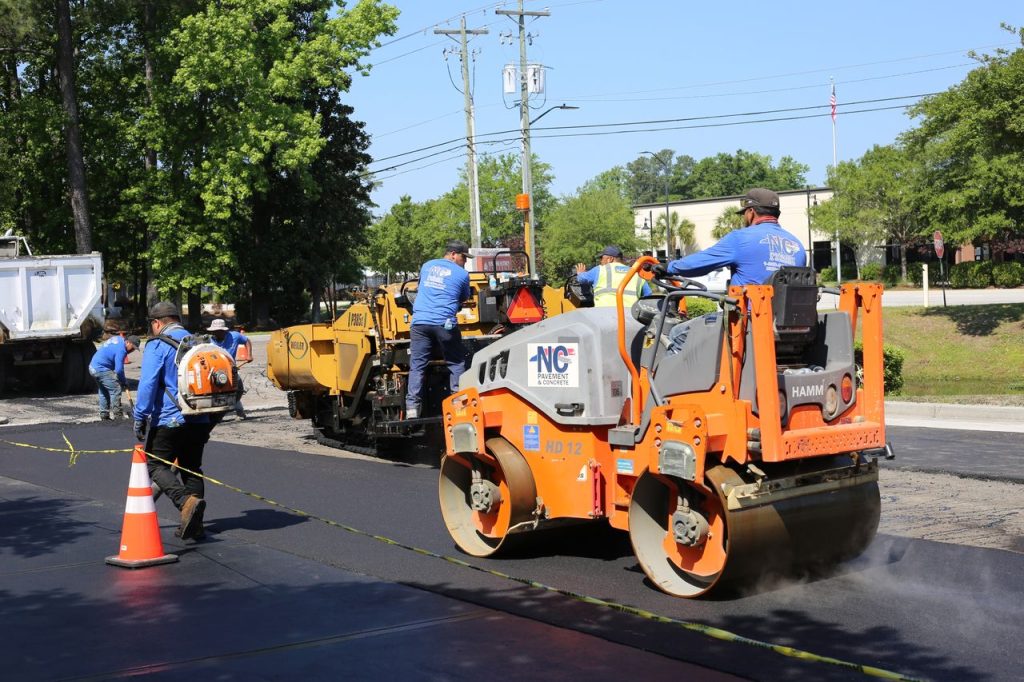
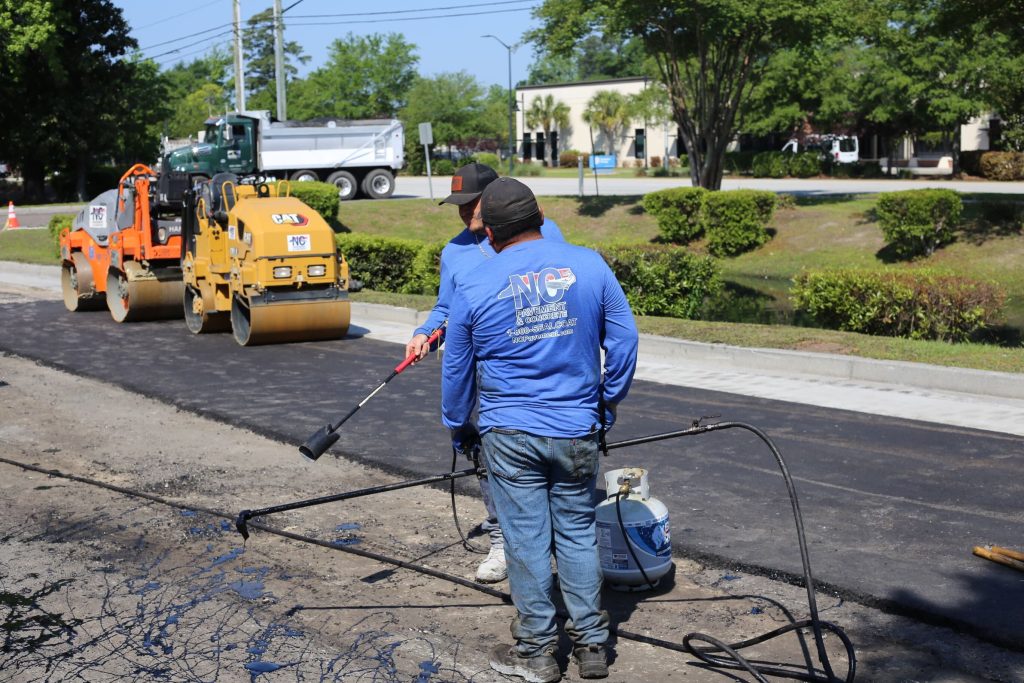
We then apply a tack coat to the cut faces and the cleaned surface, place the hot mix asphalt in compacted lifts, and roll each lift to density. Thin lifts compact better than one thick pour, and so many rushed repairs go wrong because of compaction. We finally seal the joint between the new asphalt and the existing pavement so that water can’t get underneath the patch.
Restoring the Pad Edge and the Accessible Route
The pad edge gets the most use because that’s where people walk, push strollers, and roll wheelchairs. Our crews will check the finished transition with a straightedge and a level. If the asphalt is more than 1/4″ above or below the pad, it gets ground or rebuilt. A change between 1/4″ and 1/2″ requires a bevel. Anything above that requires a proper ramp or a full rebuild.
We also protect the maneuvering space around the units. USPS publishes clearance diagrams for the cluster box units in their builder’s guidelines. We ensure every repair, striping layout, and grade change stays within those clearances so carriers can open the doors and residents can access their compartments. If there’s any doubt in a community about where the pad boundary or clearance lines are, we recommend a quick call to the local postmaster before work begins.
Drainage and Grading Corrections
Water is the bigger cause of repeat failures than traffic. The locker pad normally sits a bit higher than the surrounding road. The low edge behind it is a natural place for water to collect. We regrade the approach so that water runs off the pad and the walking route is on a very gentle, consistent slope. We also redirect the downspouts and irrigation heads that spray onto the pad edge. A sprinkler hitting the joint every morning will completely negate the best patch.
When the existing pavement is otherwise in good condition, a local mill and overlay will get the grade back without the need for full reconstruction. Where the base has failed, we rebuild it so the new slope will stay.
Protecting the Finished Repair
Once the asphalt has cooled and cured, we protect it. Hot mix asphalt gets on the road sooner than you’d think, but it continues to harden for weeks, so we advise people not to park in the same spot for any length of time and not to leave their wheels turning while stopped during that first month. After the cure period, the surface is sealcoated to protect it from the elements (UV, water, drips, etc). Fresh striping then establishes a designated stopping zone so the vehicles stop in the lane rather than cutting across the pad.
Wheel stops or bollards provide another level of protection against vehicles creeping up on the units. We also work with landscapers, as string trimmers, edging tools, and root growth are all potential threats to the pad edge. Our guidance to property managers on landscaping work covers how they can ensure the landscaping crews don’t damage the freshly repaired pad.
Take the Next Step
A cracked pad edge or sunken locker approach doesn’t repair itself, and the cost will only increase with each season. The Pavement Group works with apartment communities across the country and can assess your mail kiosk and package locker areas to determine the actual cause and provide a repair that will last. Call us to arrange an on-site inspection before the next freeze, heat wave, or rainy season makes the damage worse.
Keep Mail Kiosks and Package Locker Areas Safe and Accessible
Cracked asphalt, potholes, and uneven pavement around mail kiosks and package lockers can create hazards for residents and delivery personnel. At The Pavement Group, we help apartment communities restore damaged pavement with professional asphalt repairs, concrete solutions, and drainage improvements. Let us help you maintain smooth, accessible surfaces in these high-traffic areas.
Contact UsFrequently Asked Questions
Should the pavement around a kiosk be asphalt or concrete?
Concrete handles the concentrated stopping and turning loads better than asphalt (it doesn’t rut and it doesn’t move under the repeated braking). That performance comes at a higher initial cost and a longer cure time, so many communities will only use concrete on the busiest of the approach areas and go with asphalt elsewhere. We look at traffic volume, truck access, budget, and the existing pavement before we make a recommendation as to which material to use. If the kiosk is at a main entrance with a lot of van and moving truck traffic, then a concrete apron will often pay for itself, whereas a kiosk in a low-traffic area will generally do just fine with properly constructed asphalt.
How should we coordinate mail delivery and package pickup during the repair?
Start by contacting the local postmaster before work begins, as the USPS will determine how carriers deliver during a temporary closure and can advise on interim arrangements. The package locker vendors and property staff should also be aware of the schedule so carriers don’t arrive to find the area blocked. We recommend putting up notices at the kiosk, in the resident portal, and by email at least a week in advance. Our crews will also plan the repair in stages where possible so that part of the area remains accessible whilst the rest is under construction.
How often should we inspect the pavement around our lockers?
We recommend a walk-through at least twice a year (once in spring after winter damage and once in autumn before cold weather) and an additional one after any major storm. Walk-throughs should check the pad edge, the approach lane, the drainage path, and the surface itself. Property staff can photograph the same areas each time, making it easy to spot small changes. A professional assessment every few years provides a structural perspective that a visual walk-through can’t and helps the property to budget for repairs before they become major emergencies.
Who pays for the repair: the property, USPS, or the locker vendor?
Responsibility varies by location depending on who owns the equipment, who owns the pad, and what the local agreement or ordinance states. Local codes differ, and some assign pad maintenance to the property owner or users, while others assign it to USPS. So there isn’t a one-size-fits-all answer. Package locker vendors generally cover the lockers themselves, not the pavement around them. We recommend checking the management agreement, any installation agreement, and local requirements before approving a repair, and our team can document the damage so the correct party gets a clear, accurate scope.
Can pavement repair near the units damage the lockers or kiosks themselves?
Careless work can, which is why our crews plan the repair around the equipment. We keep the heavy plant away from the unit, use hand tools and smaller compaction equipment right up on the pad, and shield the boxes from asphalt splatter and dust. If the work involves removing or lifting the unit, then the property will need to coordinate that with the equipment owner and the postmaster. We will confirm exactly where the cuts will stop before our crew begins so the repair doesn’t cut into any anchors, conduit, or lighting power lines.
About the Author
The Pavement Group specializes in asphalt engineering, pavement maintenance solutions, and data-driven asset management for commercial, retail, and multi-family residential properties. Utilizing advanced structural pavement evaluations and capital planning transparency, The Pavement Group works directly with property managers to extend pavement lifecycles, eliminate liability risks, and optimize long-term infrastructure investments.