The paving itself almost never causes the complaint. The surprise does. A resident who comes home to find their usual spot gone, no signage, no notice, and no idea where to park for the next three days is going to call the office angry, even if the work crew did everything right. Most friction in paving projects stems from communication failures while wearing construction costumes. In this guide, let us discuss planning an apartment parking lot paving project without disrupting residents.
TL;DR
- Phasing the lot so it’s never fully closed at once keeps residents parking somewhere close to the whole project.
- Notice timing matters more than notice length: residents need to hear it more than once, through multiple channels.
- A clear answer to “where do I park” has to be in place before the first cone goes down, not after the first complaint comes in.
- Season and time of day choices affect cure time and resident disruption just as much as they affect the contractor’s schedule.
- A short post-project walkthrough catches issues while they’re still cheap to fix and signals that the disruption was worth it.
Why Paving Projects Go Wrong From a Resident’s Perspective, Not the Crew’s
A paving crew measures success by schedule and surface quality. Residents measure it by a much simpler question: Did I know this was happening, and did anyone make it easier on me? A technically flawless repave can still generate a wave of complaints if residents feel ambushed by it.
The fix isn’t a better paving crew; most projects already have one. It’s planning the resident-facing side of the project with the same seriousness as the construction side: phasing, notice, and alternate parking, decided before the contract is signed, not improvised once the crew shows up.
Phasing the Project So You’re Never Closing the Whole Lot at Once
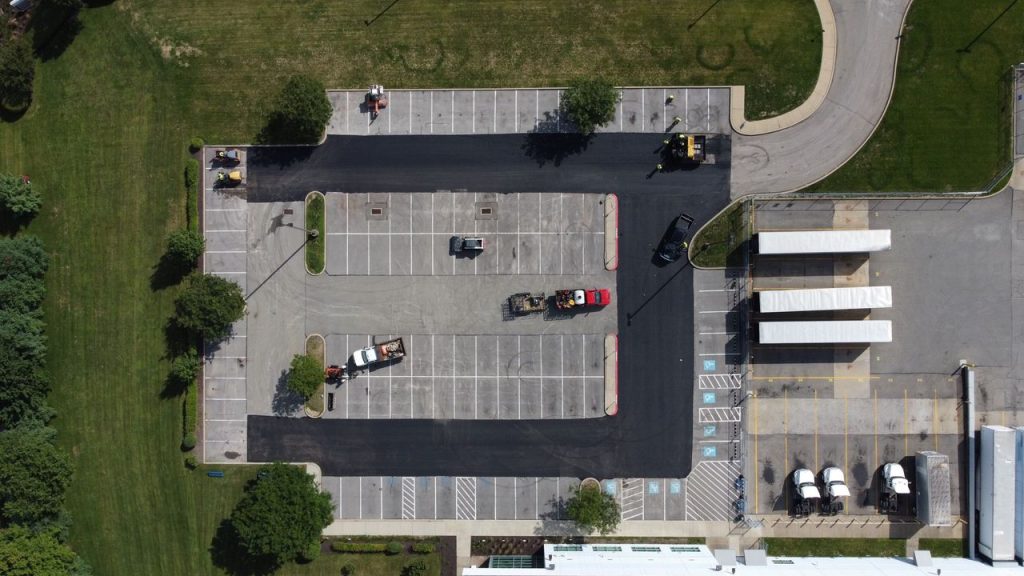
Closing an entire lot at once is usually faster and cheaper for the contractor but is often the worst option for residents. Splitting the project into sections, paving one zone while keeping others open, takes longer overall but means residents always have somewhere to park that isn’t a fifteen-minute walk away.
A typical apartment parking lot paving phased approach breaks the lot into two to four sections based on resident density and existing traffic patterns, sequencing the work so no single phase displaces more than a portion of the property’s parking at once. The right number of phases depends on lot size and total unit count; a 40-unit lot doesn’t need the same phasing plan as a 300-unit complex.
Poorly scheduled paving triggers massive tenant backlash. Discover how phased scheduling keeps cars moving.
Communicating Timeline and Closures to Residents During Apartment Parking Lot Paving
One notice posted on a bulletin board is not a communication plan. Residents need to hear about an apartment parking lot paving project more than once, through multiple channels, with enough lead time to actually plan around it.
A workable notice cadence:
- 3–4 weeks out: initial notice with project overview, estimated dates, and a high-level explanation of phasing.
- 1 week out: reminder with specific dates for each phase and a map showing where to park during each one.
- 24–48 hours out: final reminder, ideally through whatever channel gets the highest open rate for the property (text, email, app notification, posted signage at building entrances).
- Day-of: physical signage at the affected lot section and at building entries closest to it.
Where Do Residents Park During Construction
This question has to be answered before the apartment parking lot paving project starts, not improvised once cones go up. Common solutions, often combined:
- Overflow into open phases: if the project is properly phased, the simplest answer is often “park in the section that isn’t closed this week.”
- Off-site overflow parking: a nearby lot, arranged in advance, for residents displaced during the heaviest closure days.
- Temporary shuttle service: for properties using off-site overflow that isn’t within easy walking distance.
- Designated visitor and accessible parking: These need a clearly marked, ADA-compliant alternate location for the duration of any phase that closes the standard accessible spaces. This isn’t optional; accessible parking has to remain available and compliant throughout the project, not just before and after it.
Choosing the Right Season and Time Window for Minimal Disruption
Asphalt paving has specific weather and temperature requirements, and ignoring them to rush a project usually backfires, leading to a surface that fails early. Most paving needs dry conditions and temperatures within the asphalt manufacturer’s recommended range, which generally rules out the coldest months in most climates.
Beyond weather, timing the project around the property’s own calendar matters just as much. Scheduling around move-in and move-out spikes, school years for family-heavy properties, or major local events reduces the number of residents who experience both a personal and a parking disruption at the same time.
Worried about towing logistics, community notices, and parking overflow during construction?
Request a Frictionless Project AssessmentProject Timeline for Apartment Parking Lot Paving: What Happens at Each Phase
The table below shows a general phase breakdown for a full repave of an apartment parking lot paving project.
| Phase | What Happens | Typical Duration | Resident-Facing Impact |
|---|---|---|---|
| Milling | Removing the old asphalt surface | 1–2 days per section | Full closure of the active section, loud equipment |
| Base repair | Fixing damaged sub-base before repaving | 1–3 days per section | Continued closure, may include excavation |
| Paving | Laying new asphalt surface | 1 day per section | Full closure, no vehicle access at all |
| Cure time | Surface hardening before striping and traffic | 2–3 days minimum | No parking on new surface; foot traffic typically still restricted |
| Striping | Painting stall lines and markings | 1 day per section | Section nearly ready, still closed during application |
Each phase typically applies to one section of a phased project at a time, which is why the total project length is usually longer than the sum of the single-phase timelines multiplied by the number of sections. Overlap and sequencing buffer add a few days to the timeline.
Handling Move-In/Move-Out, Visitors, and Accessible Parking Mid-Project
Construction timelines don’t pause for lease turnover, so move-in and move-out logistics need a specific plan, not a generic “see the overflow lot” answer. New residents moving in during an active phase need clear instructions before move-in day, not a surprise when the moving truck arrives. Visitor parking needs a temporary, clearly marked alternate for the duration of any phase that closes the regular visitor spaces.
Accessible parking deserves its own explicit plan rather than being lumped into general overflow. A temporary accessible space needs to meet the same basic accessibility standards as the permanent space it replaces. Confirm specifics with current ADA and local code requirements before finalizing a construction parking plan.
Budgeting for Disruption Costs, Not Just Paving Costs
The paving contract covers the paving. It usually doesn’t cover temporary signage, off-site overflow parking arrangements, shuttle service, or the additional security or staff time needed to manage a multi-week project. Building these into the project budget upfront avoids a scramble for unplanned spending once the project is already underway.
Post-Project Walkthrough and Resident Follow-Up After Apartment Parking Lot Paving
A short walkthrough after the final phase wraps catches striping errors, drainage issues, or rough transitions while they’re still easy to fix. Following up with residents, even a brief “Thank you for your patience; here’s what’s new” notice, closes the loop on a project that disrupted their daily routine and reinforces that the disruption produced something worth the inconvenience.
Zero Chaos. Maximum Infrastructure Value.
The Pavement Group delivers real-time project transparency, offering precise engineering timelines and structural data updates so multi-family managers can execute large-scale paving with minimal resident friction.
Consult Our Logistics ExpertsFrequently Asked Questions
How long does it take to repave a full apartment parking lot?
A full repave typically takes 1 to 3 weeks, depending on lot size, the number of phases, and weather conditions. Phased projects take longer overall than an unphased closure but keep more parking available throughout.
Can residents park on the lot during paving?
Not during the active phase being worked on. Milling, base repair, and paving all require a fully cleared section, and freshly paved asphalt needs a cure time before any vehicle traffic, including parking, is safe.
How much advance notice should residents get before a paving project starts?
A workable cadence is an initial notice three to four weeks out, a detailed reminder one week out, and a final reminder 24 to 48 hours before each phase begins. Multiple notices through multiple channels reduce the chance that residents miss it.
What happens to assigned or reserved parking spots during the project?
Assigned spots in an active phase typically shift to a temporary overflow or alternate section for the duration of that phase, then return to normal once the section reopens. This should be communicated by unit or spot number, not just a general notice.
Does apartment parking lot paving happen at night to reduce resident disruption?
It can, depending on local noise ordinances and contractor availability, but night paving isn’t always available or cost-effective. Daytime paving with clear phasing and notice is the more common approach for apartment properties.
How is accessible parking handled during construction?
Accessible spaces need a temporary, clearly marked, compliant alternate location for the duration of any phase that closes the standard accessible spots. This should be planned and confirmed against current ADA and local code requirements before the project begins, not arranged after the fact.
See also: Apartment Parking Lot Striping Best Practices for Safety and Traffic Flow | The True Cost of Ignoring Apartment Parking Lot Cracks and Potholes
About the Author
The Pavement Group specializes in asphalt engineering, pavement maintenance solutions, and data-driven asset management for commercial, retail, and multi-family residential properties. Utilizing advanced structural pavement evaluations and capital planning transparency, The Pavement Group works directly with property managers to extend pavement lifecycles, eliminate liability risks, and optimize long-term infrastructure investments.