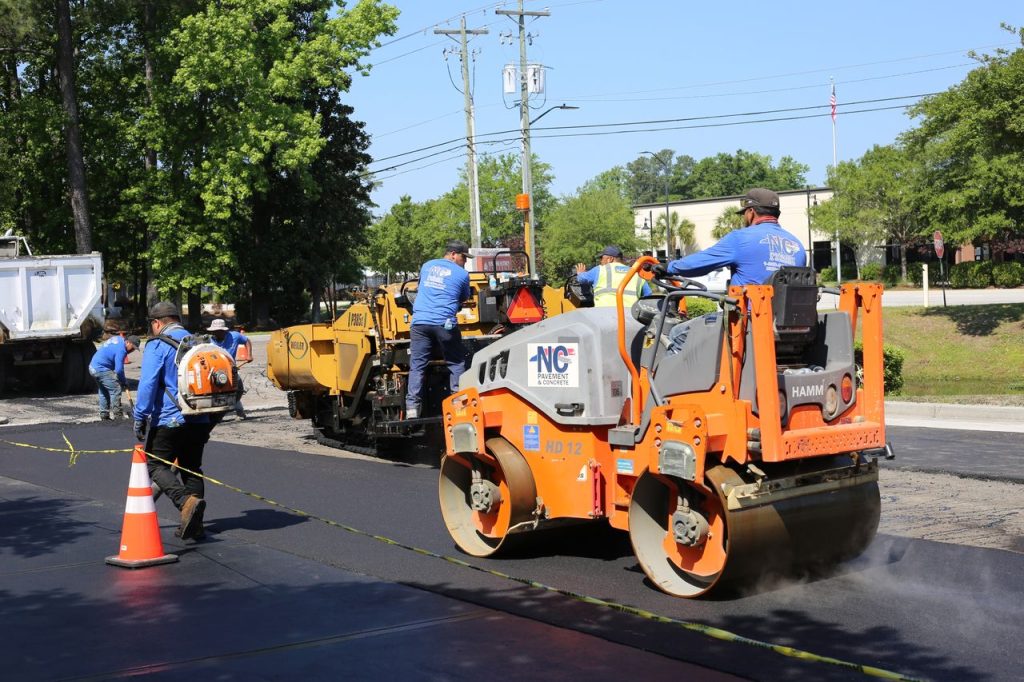
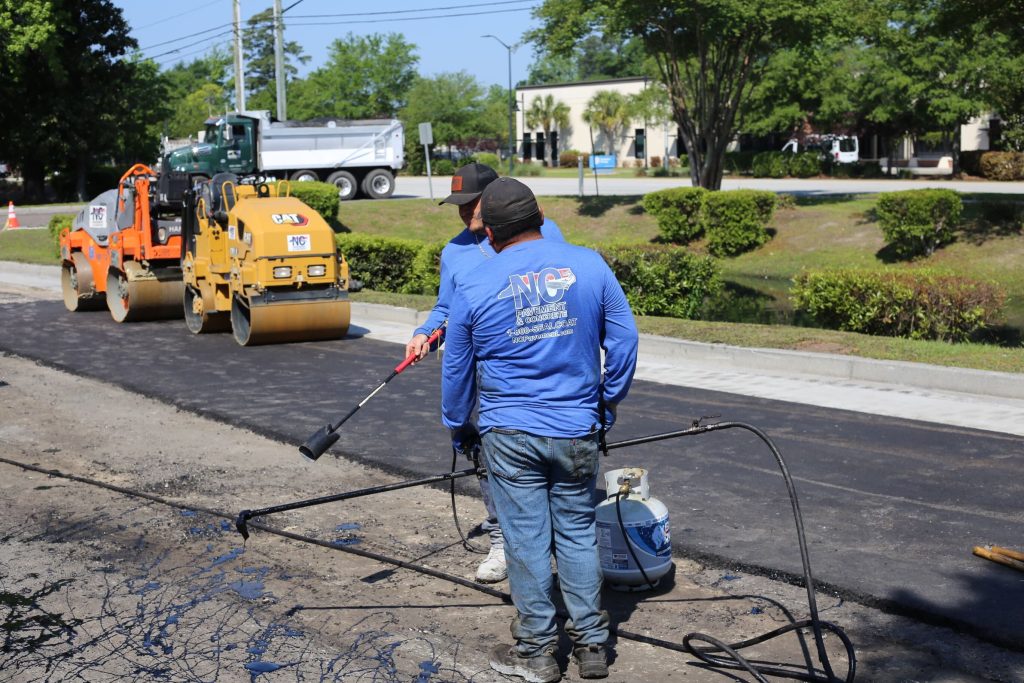
One geotechnical report from Washington State suggests using 2 inches of asphalt over 4 inches of crushed rock where light traffic is expected and 3 inches of asphalt over 6 inches of crushed rock for areas with garbage trucks; in both cases, it specifies the need for a dense, unyielding subgrade. This subgrade requirement determines whether a new parking lot will last 20 years or begin to fail after three years. Although residents never see the subgrade, they feel the consequences of any error in its construction.
We construct and repair parking areas for property managers, owners, and HOAs across the country and find that most early problems stem from the ground beneath the asphalt. The following article outlines the effects that inadequate subgrade preparation has on a parking lot, explains why the schedules involved in apartment building projects lead to these issues, and describes how we properly prepare the subgrade.
Overview
- Because the subgrade supports all the layers above it, poor soil weakens the entire pavement.
- Poor compaction, trapped water, and leftover organic material are the top three causes of pavement failure.
- Apartment construction schedules and trash-truck routes worsen the problem.
- The damage shows up as sagging, ruts, alligator cracking, and ponding.
- Teams use proof rolling, density testing, and drainage control to prevent this damage.
Why the Subgrade Controls Everything Above It
The parking lot functions like a stack: asphalt sits over a layer of crushed stone, which in turn rests on the natural or artificially laid soil, known as the subgrade. Although the asphalt and base distribute each wheel load over a larger area, the soil still carries the final load.
The Washington geotechnical report also states that pavement performance depends entirely on the condition of the subgrade beneath it and that, regardless of the pavement section placed on top, an unsuitable subgrade can cause settlement and alligatoring at the surface. This matters because some owners, when dealing with a failing property, request more asphalt. Applying a thicker layer of asphalt over weak soil may delay but will not prevent failure.
The Ohio DOT makes the same argument from a construction perspective.It confirms that proper subgrade treatment supports pavement construction, boosts long-term performance, and ensures the finished site fully reflects the original design intent.
What Poor Preparation Looks Like Underground
The majority of subgrade failures begin with a kind of shortcut that goes unnoticed once the asphalt is in place. The following table lists the common ones and the results they cause.
| Preparation shortcut | What happens underground | What you see on the surface |
| Topsoil or organic material left in place | The material decays and compresses over time | Dips and sags that deepen each year |
| Fill placed in thick, uncompacted layers | The fill settles unevenly under load | Depressions and cracks across drive aisles |
| Compaction on wet or muddy soil | The soil cannot reach its target density | Spongy areas and ruts in the first seasons |
| Proof rolling skipped | Weak pockets stay hidden | Isolated failures within a few years |
| Thin base over weak soil | The soil overstresses under wheel loads | Alligator cracking in wheel paths |
| No drainage for the subgrade | Water collects under the pavement | Ponding, edge failure, and soft zones |
The Asphalt Institute refers to alligator cracking as a form of fatigue crack that may be caused by weak areas in the subgrade, insufficient pavement thickness, or overloading; on an apartment site, we often find all three factors acting together.
How Apartment Construction Schedules Create Problems
Apartment developments move quickly, and the parking area is usually the last item on a busy schedule. Workers excavate utilities over the future site of the parking lot, build buildings alongside it, and heavy construction traffic continues over the uncovered soil for several months. When it rains, the exposed soil turns into mud, and at times crews lay down paving to meet the certificate-of-occupancy deadline.
We see four recurring problems on these properties:
- Utility trenches that crews backfill without compacting each lift
- Excavated soil from foundations that crews spread across the lot as fill
- Subgrade that sits exposed through a wet season and absorbs water
- Paving that starts before anyone proof rolls the final grade
Trash and delivery trucks then reveal each flaw; a refuse truck stops on the same pad every week, and the repeated heavy load discovers the soft spot the schedule had hidden.
Water and the Waterbed Effect
Water aggravates every kind of subgrade problem. The Ohio Department of Transportation advises that when water is under the pavement, and there is no way to drain it, the subgrade behaves like a waterbed; each wheel load then pumps the soft soil, and the pavement flexes with every pass.
The apartment plots supply water to the waterbed from several sources, including roof downspouts, the irrigation system, landscape islands, and low areas that collect rain. With each subgrade repair, we adjust the slope and the inlets and outlets, since even well-compacted soil weakens if it stays saturated.
The Timeline of Damage
Poor preparation always follows a predictable sequence. During the first season, you might see shallow birdbaths because the subgrade has settled. Early on—within the first few years—ruts develop at the dumpster pad and in the main drive aisle, the areas where the heaviest vehicles go. Alligator cracking then occurs, causing the asphalt to break into pieces under traffic. Potholes form when water gets into those cracks and washes out the weak base.
The cost of repairing each stage is greater than the previous one: something minor requires only a patch, ruts need removal and rebuilding, and severe alligator cracking requires full reconstruction. We advise managers to act as soon as they notice any settlement, since the damage always increases.
How We Prepare a Subgrade Correctly
The subgrade exhibits a well-defined sequence, and we record each stage. The following table illustrates how we handle it.
| Step | What we do | Why it matters |
| Investigate the soil | Review soil data, borings, and site history | Identifies weak, organic, or wet soil before design |
| Strip and undercut | Remove topsoil, organics, and unsuitable soil | Eliminates material that compresses |
| Condition and compact | Adjust moisture and compact in thin lifts | Builds uniform density |
| Proof roll | Run a loaded, heavy roller or truck over the grade | Reveals soft spots before paving |
| Correct weak areas | Undercut, stabilize, or replace unstable soil | Fixes problems while access stays easy |
| Test density | Measure compaction against the lab target | Confirms the soil meets the design |
| Control drainage | Set slopes, inlets, and underdrains | Keeps water away from the subgrade |
These procedures follow standards from public agencies; one municipal specification requires the subgrade to be compacted to 95 percent of the Modified Proctor density and includes proof rolling before the base course is placed. A specification issued by a city in Missouri mandates using a heavy rubber-tired roller for proof rolling after the team has achieved the required compaction. The Ohio Department of Transportation also directs crews to perform proof rolling when soil moisture levels match those used during compaction. Soil that is too wet or too dry will produce inaccurate results.
The Washington geotechnical report suggests conducting a proof roll with a loaded dump truck and stabilizing any soft areas it identifies. For loose soil, it advises constructing the pavement over at least 2 feet of granular structural fill or crushed rock. We take the same approach: we identify poor ground early and replace or stabilize it before laying a single ton of asphalt.
If Your Lot Already Shows the Signs
Since you can’t see a property’s subgrade, the surface shows where to look. We begin by walking around the property, noting each dip, rut, and crack pattern, and taking a core sample to measure the thickness of both the asphalt and the base. If the evidence shows the soil is the issue, we carry out borings so we know what we are repairing before giving a price.
Managers frequently ask whether damage stems from how crews built the pavement or from its age. The pattern usually answers that question: if failures occur early, recur in the same places, and align along trench lines, that points to preparation issues, whereas wear across the entire area points to aging.
Build It Right or Pay for It Twice
Properly preparing a subgrade is relatively cheap, but repairing it later is very expensive. Once the asphalt is in place, any remedy requires removing it, digging down, and starting again. Residents notice dips, pooling water, and patchy surfaces long before the budget does.
When we build or repair any apartment site, the Pavement Group follows a preparation-first method and explains each step in simple language. If you contact us today to arrange an evaluation, we’ll show you what is underneath your pavement and how to make it last.
Fix Parking Lot Problems Caused by Poor Subgrade Preparation
A weak or poorly prepared subgrade can contribute to settlement, cracking, rutting, potholes, and premature asphalt failure in an apartment parking lot. If pavement problems keep returning, the issue may be beneath the asphalt rather than on the surface. We can evaluate the condition of your parking lot and help determine whether subgrade repairs, pavement reconstruction, or another solution is needed.
Contact UsFrequently Asked Questions
Who is responsible when a new lot fails because of poor subgrade preparation?
You can claim different levels of responsibility based on the contract, the cause of failure, and who controlled each work stage. The developer, general contractor, grading subcontractor, or paving contractor may each bear fault. Because many paving warranties cover asphalt workmanship but exclude subgrade issues, a limited warranty may not provide any compensation. The grading contractor or the project engineer may be responsible for compaction and testing. We advise that you collect the construction documents, the geotechnical report, and the test records, then have an attorney review the contracts and your state’s time limits. We will provide a written evaluation of the cause of the failure, along with photographs, cores, and measurements to support the course of action you decide on.
Do we need a geotechnical report before repaving?
Not every project needs a full report, but any project that involves replacing the base or addresses recurring failures should have one. A simple mill and overlay on a site with a good base and no settlement can be adequately covered with cores and a visual survey. However, if a project has sagging spots, alligator cracking, or a history of repeated patching, soil borings are needed since the conditions beneath the pavement determine the design. The report provides information on soil type, groundwater level, and bearing strength, helping you choose between undercutting, stabilization, or a thicker base. Testing costs far less than repaving twice. During our assessment,, we help you decide the appropriate extent of testing so you don’t end up paying for more than your land actually requires.
What test records should we request from a contractor?
Request the proof rolling log, since it shows where the crew rolled, what they found, and what corrections they made; for example, the Ohio DOT uses a proof rolling documentation form for this purpose. Request the field density results showing percent compaction compared with the laboratory maximum, along with the laboratory curve for the soil and base material. Obtain the moisture readings taken during compaction, as they show whether the crew worked under suitable conditions. Request photographs of each undercut, with the locations noted on a site plan. We supply these records to our clients so that they have proof of how the subgrade was constructed.
Does geotextile fabric make a weak subgrade stronger?
Although geotextile can be useful in certain cases, it doesn’t replace compaction or drainage. A separation fabric prevents the base stones from blending into the soft soil and thus helps to maintain the base’s thickness over time. Researchers tested eight 500-foot sections of State Highway 21 near Bastrop, Texas, using improved drainage geotextiles and found they could even out moisture in an expansive clay subgrade where conventional fabrics had failed. The fabric cannot remedy soil that has not been properly compacted or a site that tends to hold water. We recommend it for soft subgrades, high groundwater levels, and wet clay, and before specifying it, we compare its cost with undercutting and stabilization. The right choice depends on your soil data and your budget.
Do fire lanes need a different subgrade preparation?
Yes, fire lanes must have a higher level of structural strength. As a memo from one of New Mexico’s fire departments notes, many fire codes require access roads to support fire apparatus weighing at least 75,000 pounds. A road designed only for cars might look satisfactory on paper but still fail when a ladder truck is used if the subgrade and base aren’t strong enough. Because local amendments differ, ask your fire marshal which code edition applies and what load your property requires. When we construct fire lane sections, we follow the engineer’s design and check the soil below with proof rolling. This additional check safeguards both your pavement and your emergency access.
Do we have to replace the whole lot if only part of the subgrade failed?
Often you can replace only the failed zones. We map the failures with a survey, cores, and probing, and then draw the repair boundaries around the weak areas. Our team extend the removal limits beyond the visible damage because weak soil usually extends beyond the surface cracks. We saw-cut clean edges and bond the new asphalt to the existing pavement so the repair joins properly. If failures cover most of the lot or the main drive aisle, full reconstruction usually costs less than repeated patching. We present both options with a clear scope so you can compare them side by side.
See also: Why Is My Apartment Parking Lot Turning Gray and Cracking?, What Causes Alligator Cracking in an Apartment Parking Lot?
About the Author
The Pavement Group specializes in asphalt engineering, pavement maintenance solutions, and data-driven asset management for commercial, retail, and multi-family residential properties. Utilizing advanced structural pavement evaluations and capital planning transparency, The Pavement Group works directly with property managers to extend pavement lifecycles, eliminate liability risks, and optimize long-term infrastructure investments.
Planning a paving project? Explore The Pavement Group’s asphalt milling and paving services.