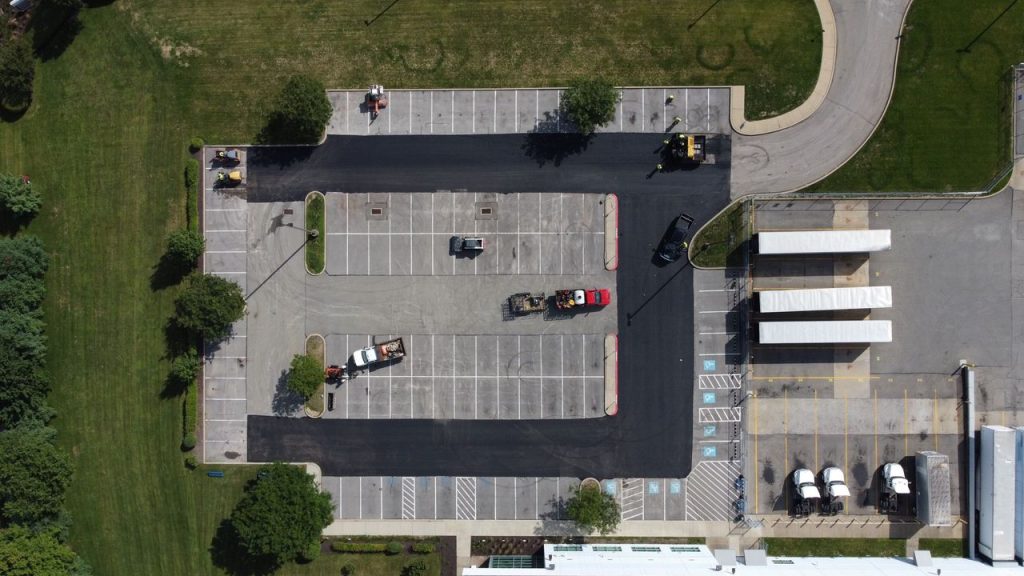
The U.S. Geological Survey states that one inch of rain falling on a single acre of land is equivalent to about 27,154 gallons of water and has a weight of approximately 113 tons. Imagine you now own an acre as your apartment yard, with only one blocked inlet and one stall that slopes very slightly the wrong way. Federal rules concerning accessibility also place restrictions on how much your accessible stalls can slope. According to the ADA parking standards, the maximum slope allowed in every direction is 1:48, which is about a quarter inch of drop for each foot. Since the water has to travel across a large amount of nearly level pavement in order to get to the drain, a minor defect in the gradient, the drainage system, or the foundation will result in a permanent puddle forming.
We are the Pavement Group, and our teams operate out of our headquarters in Wexford, Pennsylvania, near Pittsburgh, with branch offices serving Westchester County, New York, Nashville, Tennessee, Charlotte, North Carolina, West Palm Beach, Florida, and New Richmond, Wisconsin. The following guide outlines the method we use for diagnosing water pooling in an apartment complex’s parking lot so that you will know exactly what to expect before contacting us.
The Short Answer: Water Pools for Three Reasons
Every puddle we inspect traces back to one of three problems:
- The surface has insufficient slope or a depression, which means that water has no place to move to.
- Clogged, broken, or missing inlets stop water from leaving.
- The underlying soil or base beneath the asphalt has settled or become softened, causing the surface to sink and thus gather water.
The position, shape, and behavior of the puddle indicate what kind of problem we are dealing with; this is what we refer to as “reading the puddle.”
Read the Puddle: Six Patterns and What They Mean
| What you see | Likely cause | How we confirm it | Typical fix |
| Oval puddle in a wheel path, with alligator-style cracking around the edge | Base failure or soft subgrade | Probe the area and check for pavement flex under load | Remove the failed section, rebuild the base, repave |
| Water lined up against a curb or gutter line | Blocked or low flow line | Trace the gutter to the nearest inlet | Clear debris, correct the flow line, patch or mill and pave |
| Slow-draining water around a grate | Clogged grate, full sump, or damaged pipe | Camera inspection of the basin and pipe | Jet cleaning, then basin repair or replacement |
| Wide, shallow sheet of water across a flat area | Too little slope from original grading or a past overlay | Straightedge and string-line checks | Leveling course and overlay, or add an inlet or trench drain |
| Puddle where asphalt meets a concrete pad, apron, or sidewalk | Settled asphalt lip or heaved concrete | Measure the height difference at the joint | Mill and patch the asphalt, or repair the concrete |
| Same puddle returns after every thaw, with new cracks nearby | Water infiltrating through cracks and freezing | Map the cracks around the low spot | Crack seal, then patch the depression |
Run Our 48-Hour Puddle Test Before You Call Anyone
You can gather most of what we need in one rainy week:
- When the rain has stopped, outline each puddle with chalk or marking paint and then take a photograph of it alongside a tape measure.
- Take the depth of the deepest point; if it exceeds a quarter of an inch, we will flag it.
- Check again after 24 and 48 hours in dry conditions; if a puddle continues to exist beyond two dry days, then it is a sign of a genuine grade or drainage issue and not merely due to evaporation.
- Place a 10-foot straightedge or a taut string over the depressed area and indicate any gap wider than a quarter of an inch.
- When you walk over the area during the next rain, observe the place where the water goes into each puddle; the direction of the flow usually indicates the source directly.
- Check each grate from above; if you notice leaves, trash, or standing water in the basin, let us know. Don’t attempt to lift any heavy grates yourself.
If you find a puddle in an accessible stall or access aisle within the same week, if it blocks a building entrance, or if it appears beside new cracks, contact us immediately. The U.S. Access Board states that access aisles must remain almost level and that the slope exception is included to allow for drainage. By focusing on ADA compliance, we help you meet all requirements and avoid compliance concerns.
Why Apartment Lots Have Less Margin Than You Think
Apartment complexes cause puddle-related problems that retail developments almost never encounter. We keep coming across these offenders:
- Garbage trucks stop and turn in the same place every week, so the ground at the base settles exactly where the asphalt comes into contact with the concrete pad.
- Roof downspouts direct building runoff onto the pavement. This extra water enters the site, and no one anticipated this additional flow.
- The water sprayed by the sprinklers stays wet on the pavement for days, which is why a shallow dip will not dry.
- The trees cause the leaves and mulch to block the grates, which are located beside the landscaped beds.
- Speed bumps and tables: These features obstruct the flow of water and cause it to remain on the upper side.
- The old utility trenches tend to settle down over time, leaving a low line across the property.
Water causes residents more than just annoyance. When water seeps into the pavement layers, it weakens the support beneath the surface, and the freezing and thawing that takes place widens the cracks and accelerates the development of potholes following winter. Since drainage determines how long pavement lasts, the Federal Highway Administration issues engineering advice on assessing pavement drainage problems.
The Catch Basin Factor
Property managers usually fail to attend to the catch basin since the issue is below ground. Municipal stormwater programs generally rely on a straightforward trigger, which is to clean the basin before the sump reaches more than 50 percent capacity. Although a basin may appear in good condition from the surface, it can still contain a sump full of sediment.
The repair of your catch basin and our drainage service begins with a camera inspection in order to locate any blockages or damage; we then clean the basin using a high-pressure jet and carry out the repair or replacement of the structure when the damage is such that cleaning is no longer sufficient.
How Local Conditions Change the Diagnosis
| Market | Local factor | What it does to your lot |
| Pittsburgh and Wexford, PA | Hilly sites and hard winters | Runoff collects in low corners, then freezes inside cracks |
| Westchester County, NY | Freeze-thaw winters | Thaw cycles reopen cracks and deepen small depressions |
| Nashville, TN | Hilly terrain and frequent rain | Poor drainage at accessible spaces creates puddles and ice patches |
| Charlotte, NC | Piedmont red clay with minimal pore space | Lawn strips absorb less rain, so more runoff can reach your pavement |
What We Fix and How
| Problem | Repair | Our service page |
| Clogged or damaged catch basin | Camera inspection, jet cleaning, repair or replacement | Catch Basin Repair & Drainage |
| Depression or failed base | Remove, rebuild, and repave | Asphalt Repair |
| Low grade across a large area | Mill and pave to restore slope | Asphalt Milling & Paving |
| Cracks feeding water into the base | Route and seal cracks | Crack Sealing |
| Heaved or settled concrete pads and aprons | Concrete repair | Concrete Pavement & Sidewalk Repair |
| Accessible stalls that fail slope checks | Corrective work plus re-marking | ADA Parking Compliance |
What Clients Say About Working With Us
Pavement Magazine included us in its list of Top Contractors from 2021 to 2024 and we are featured on the 2024 Top 50 Paving Contractors list; our clients express their experience in their own words on Google.
“Great attention to detail. Great communication and worked with our schedule.”
Kirk Hensler, Google review
“They are wonderful group to work with and their pricing is great!”
Karen Simkowski, Google review (parking lot sealing and striping)
“Trudi is a fantastic Project Coordinator!”
JJ Letcavage, Google review
Fix Parking Lot Drainage Problems Before They Get Worse
Standing water can point to drainage problems, poor grading, surface damage, or other issues beneath an apartment parking lot. The Pavement Group can evaluate the condition of your pavement and help identify practical solutions to improve drainage and protect your property.
Contact The Pavement GroupFrequently Asked Questions
1. Can sealcoating correct the low areas where water collects?
Sealcoating applies a thin protective coating and doesn’t alter the grade of the pavement; after sealing, a low area remains low and the puddle comes back again. We first carry out repairs to the depression, the drain, or the cracks and only then sealcoat the surface, which has been repaired, so that the protection will last.
2. Might the presence of standing water in my parking lot lead to a mosquito problem?
Yes, the EPA states that female mosquitoes lay their eggs directly on or near water, and the eggs will hatch when the water covers them. The American Mosquito Control Association includes puddles and catch basins among the places where Culex mosquitoes lay their eggs. Since some species hatch within two to three days, a puddle that remains after each storm can become a breeding ground. By repairing the drainage, you eliminate the problem at its root, and your local vector control district can give advice regarding treatment in the meantime.
3. Can you repair a pooling problem in winter?
Certain repairs can be carried out during the colder months. We usually carry out a temporary repair in the winter and arrange the permanent repair for better weather conditions. The temporary repair prevents water from getting into the pavement while you are waiting for spring, and then you have the permanent repair carried out when the temperature is at the level at which the materials work best.
4. Does your work come with a warranty?
Our guarantee is ‘Results Delivered, Promises Fulfilled.’ If you employ us for the scope that our professionals suggest, we provide a 5-year maintenance plan to back the work. We advise you to go for the full scope since a partial repair leaves the original cause unresolved. Request that we put the terms of the plan in writing before you agree.
5. Can residents keep parking during the repair?
In most cases the answer is yes; the area is divided up into sections so that the residents will still have access to the open stalls, and the timetable is coordinated with your on-site manager. The fresh asphalt patches have to cool and harden, and concrete repairs take even longer, which is why we provide you with an exact closure period for each section. We suggest putting up notices for the residents several days before the work starts.
6. Is a permit required in order to alter the way my land drains?
It all varies depending on the type of repair and on the local municipality. Things such as cleaning, filling in cracks and sealing them generally do not alter your drainage system and therefore rarely lead to a need for approval. However, regrading the ground, installing inlets, or connecting to a storm sewer do usually require permission, and the regulations differ between townships and counties. Before we start the work, we check with your municipality to confirm what the local requirements are.
See also: What Causes Potholes to Keep Coming Back in an Apartment Parking Lot?, How Do You Know if an Apartment Parking Lot Needs Repaving?
About the Author
The Pavement Group specializes in asphalt engineering, pavement maintenance solutions, and data-driven asset management for commercial, retail, and multi-family residential properties. Utilizing advanced structural pavement evaluations and capital planning transparency, The Pavement Group works directly with property managers to extend pavement lifecycles, eliminate liability risks, and optimize long-term infrastructure investments.