The pavement preservation guidelines issued by the Federal Highway Administration assign a figure to something most property managers only realize afterward. A dollar spent addressing a pavement problem early saves between four and ten dollars compared with fixing the same problem after it fails. Although the most recent Infrastructure Report Card from the American Society of Civil Engineers assigned the country’s roads an overall D grade, and although that grade applies to public roads and not to private premises. The same pattern is just as applicable to private property. Pavement that appears in good condition from a distance is often already beyond the point at which a simple repair could have been effective.
At The Pavement Group, we inspect apartment sites across regions. The same thing is evident almost everywhere. The property manager does a quick visual check, misses obvious potholes, and assumes the site will be fine for another year. Yet a fine crack that went unmarked has allowed water into the base layer for two seasons running, and a repair job that originally would have cost just $200 now costs $4,000. The following is exactly what we examine on a proper inspection, room by room, so you’ll know what your own inspection should catch before it turns into a large bill.
The Inspection Isn’t One Task. It’s Eight.
Most property managers see a parking lot inspection as a single task, just walking around and looking for potholes. In fact, a proper inspection covers eight separate zones. Each zone has its own possible points of failure. Inspectors can overlook a serious problem simply because they skip one of these zones and fail to check the right area.
| Inspection Zone | What You’re Checking For |
| Pavement surface | Cracking, potholes, raveling, rutting, alligatoring |
| Striping and markings | Fade level, ghosting, ADA symbol visibility, fire lane clarity |
| ADA accessibility | Space count, access aisle width, slope, signage, curb ramps |
| Drainage | Ponding, clogged catch basins, erosion at low points |
| Curbs and wheel stops | Cracking, displacement, loose anchoring, tripping edges |
| Lighting | Dead fixtures, dark zones, pole base condition |
| Signage | Fire lane signs, stop signs, reflectivity, physical damage |
| Landscaping encroachment | Roots lifting pavement, overgrowth blocking sightlines or signage |
Reading Pavement Distress the Way We Do
Inspectors misinterpret cracking more often than any other warning sign, because not all cracks carry the same meaning. If you treat every crack identically, you either overreact to small, harmless issues or miss far more serious problems. Here’s how we categorize what we observe and what each type of crack indicates about what’s happening below the surface.
| Distress Type | What It Looks Like | What It Means | Urgency |
| Linear cracking | Single straight or slightly curved crack | Surface aging or reflective cracking from a joint below | Monitor, seal if wider than 1/4 inch |
| Block cracking | Interconnected cracks forming large rectangular sections | Asphalt binder has dried out and lost flexibility | Schedule seal coating soon |
| Alligator cracking | Tightly connected cracks resembling reptile skin | Structural failure in the base layer, not just the surface | Urgent, full repair area needed |
| Rutting | Depressions running in wheel paths | Base layer deformation under repeated heavy loads | Urgent if deeper than 1/2 inch |
| Raveling | Surface aggregate loosening and washing away | Binder has failed, surface is disintegrating | Schedule resurfacing evaluation |
| Potholes | Open, bowl-shaped voids in the surface | Water penetrated through existing cracks and undermined the base | Urgent, immediate patch required |
Property managers most frequently underestimate alligator cracking because it usually begins subtly and initially appears cosmetic. When cracking develops into that interconnected pattern, the damage is no longer merely on the surface because it has already occurred in the underlying layer. Applying a surface seal coat to an alligator-cracked area fails to address what is happening beneath.
Drainage Problems Hide in Plain Sight
Standing water after rain doesn’t just annoy people walking to their cars. It is often the clearest sign that a drainage issue is repeatedly damaging the pavement. When water can’t drain from an area in a reasonable time, it collects in low spots, seeps into existing cracks, and accelerates base failure that leads to alligator cracking and potholes. During an inspection, we check every catch basin and drain inlet for debris buildup. A blocked inlet, typically from leaves, washed-away mulch, or rubbish, can make a lot’s entire drainage system ineffective even if the grading is in order. This also ties directly to the EPA’s stormwater management guidelines, because a lot that pools rather than drains properly often doesn’t direct runoff the way its original stormwater permit assumed.
What We Check on Every ADA Space, Beyond Just Counting Them
Although most property managers know they need a certain number of accessible spaces. Counting them is only the first stage of an ADA compliance check, and it is rarely where the real issues lie. We assess the actual slope of each accessible space as well as that of its access aisle, because the U.S. Access Board’s ADA Standards allow a maximum slope of 1:48 for accessible parking surfaces in any direction. Pavement deterioration over the years can easily cause a space to exceed that limit even if it was in compliance when the lines were originally painted. We also examine the condition of curb ramps at all accessible routes. A chipped or settled curb ramp creates a real obstacle even when the parking space and its signage are technically correct.
Lighting Gets Overlooked Because It’s Invisible During a Daytime Inspection
Inspectors perform most inspections during business hours. They spot the most serious lighting issue, which is large areas going dark at night, only if they deliberately look for it after dark. The Illuminating Engineering Society provides recommended lighting levels for parking areas, expressed in footcandles, and a car park with faulty lighting, or with lights placed too far apart from the original design, can fall well below that recommended level in some areas without any obvious signs during a daytime inspection. Therefore, we advise that every property carry out at least one inspection after dark each year to catch this issue, following the same path a resident would take when walking from their car to their flat after working the evening shift.
Signage Wears Out Differently Than Paint Does
A fire lane with stripes can still appear clear even if the sign beside it has faded to the point of being unreadable. Property managers often check one without checking the other. The reflectivity of a sign decreases slowly as the reflective material breaks down due to exposure to ultraviolet radiation. The FHWA’s Manual on Uniform Traffic Control Devices has established minimum retroreflectivity standards, the reason being that a sign that is legible in daylight can become almost invisible under headlights at night when the sheeting has degraded. We inspect each fire lane, stop, and directional sign separately for physical damage, fading, and reflectivity. The two types of markings wear out at different rates, and a complete inspection must catch both.
How Often Each Zone Actually Needs a Look
You don’t need to inspect every part of a lot at the same frequency; if you inspect everything annually, you may catch rapidly changing problems too late while overchecking stable items.
- Inspect the pavement surface quarterly to assess its general condition, then check it right away after any significant storm.
- Teams apply striping and ADA markings twice a year because sunlight and traffic cause fade at greatly differing rates.
- For drainage, check before and after the two heaviest rain seasons each year, and do a spot check after any storm that brings a significant amount of rainfall over a short period.
- For lighting, check the fixtures once a year during a night walk, and carry out a more thorough inspection each time a resident reports an area as dark.
- Inspectors check signage every year for reflectivity and physical condition. They complete this review as part of the same cycle used for striping inspections.
- Twice each year, because root growth and curb movement accumulate slowly, but once they have started, they increase rapidly.
Why a Professional Inspection Catches What a Walk-Through Misses
A property manager who visits the site once every quarter provides great help and can spot many obvious issues. However, they consistently miss a few things without the right tools and trained eyes. For example, it is difficult to judge the depth of ruts merely by looking at them, and a depression that appears to be half an inch to one person could measure closer to an inch when checked with a straightedge, a difference that makes it necessary or not necessary to monitor the area or to carry out immediate repair. We also use moisture meters and can examine doubtful areas to find out if water has already reached the base layer below a crack that still looks only minor on the surface, information which a completely visual inspection cannot give even if the person carrying it out is very careful.
Ready for a Professional Lot Inspection?
If more than six months have passed since a qualified person thoroughly inspected every part of your property, we will visit your site and complete the full checklist designed for your property and climate zone. We will then give you a written report that clearly shows which items you need to address immediately and which ones you can schedule for later. The Pavement Group provides services to property managers and owners of multifamily properties all throughout North Carolina and South Carolina, whether it’s for single-property HOAs or large regional apartment complexes. Contact us for a site inspection and a written condition report.
Stay Ahead of Apartment Parking Lot Problems
The Pavement Group helps multifamily property managers identify pavement damage, drainage concerns, faded markings, surface deterioration, and other issues during parking lot inspections. From pavement assessments and routine maintenance to asphalt repairs, concrete work, drainage solutions, and pavement rehabilitation, our team can help keep your apartment parking lot safe, functional, and well maintained. Contact The Pavement Group today to schedule a professional pavement assessment for your apartment property.
Contact UsFrequently Asked Questions
What is the duration of a complete professional inspection of a standard apartment site, and is any section of the property required to be closed down during the process?
In a typical apartment complex with 100 to 200 units, a complete inspection of all eight zones generally takes 2 to 4 hours, depending on the site size and the number of buildings or parking areas. We do not close off any part of the property during the inspection. We only walk through the site and take measurements so residents can keep coming and going as normal. If you request a nighttime lighting survey, we make an extra visit after dark. Again, we do not close any areas. We follow the same route and use a light meter without blocking any space.
What kind of report or documentation should we receive after an inspection, and how detailed should it be for insurance or budgeting purposes?
A useful inspection report links specific findings to exact locations instead of listing only general impressions. You should tie every problem to a distinct spot on the property, photograph it, and rank it by urgency instead of grouping all details within one broad summary paragraph. If you need the report for insurance or budget planning, ask for a version that sorts findings into three categories. These categories cover items you must address right away, items you can schedule soon, and items you should watch over time. This clear structure lets you build your repair budget in stages so you do not face one large unexpected cost all at once. We include photos with each issue we highlight because this record matters if a resident injury claim ever arises, as it provides a dated account of the property’s condition and when a particular problem was first noticed.
Does having a documented pavement inspection history actually help if a resident is injured by a pothole or a cracked walkway?
Yes, a documented inspection history is one of the most compelling pieces of evidence that a property can have in such a case, since it demonstrates a consistent record of sensible and continuous maintenance rather than neglect. The Insurance Information Institute points out that in premises liability claims it is often a question of whether a property owner knew or should have known about a hazard, and a dated inspection report that shows when a problem was first identified and the timeline over which it was dealt with directly addresses that issue. Without such documentation, the property owner must defend their maintenance practices afterward by word of mouth, whereas a written, photographed record created before the incident carries considerably more weight.
Is there a difference between a routine visual inspection and a certified pavement condition report that a lender requires for refinancing?
Yes, they serve different purposes, even if they look similar on the surface. We conduct routine inspections every quarter or twice a year at each property. These checks help you spot emerging problems early and guide your ongoing maintenance choices. In contrast, lenders usually require a certified pavement condition report when you refinance or sell a property. Professionals prepare this report using a standard rating system such as the Pavement Condition Index. They assign a numerical score across the entire site and provide a formal written assessment. This document satisfies the underwriter’s due diligence needs rather than only listing maintenance tasks for the property manager.
Can drone or aerial imagery replace a walk-through inspection for a large multi-building apartment complex?
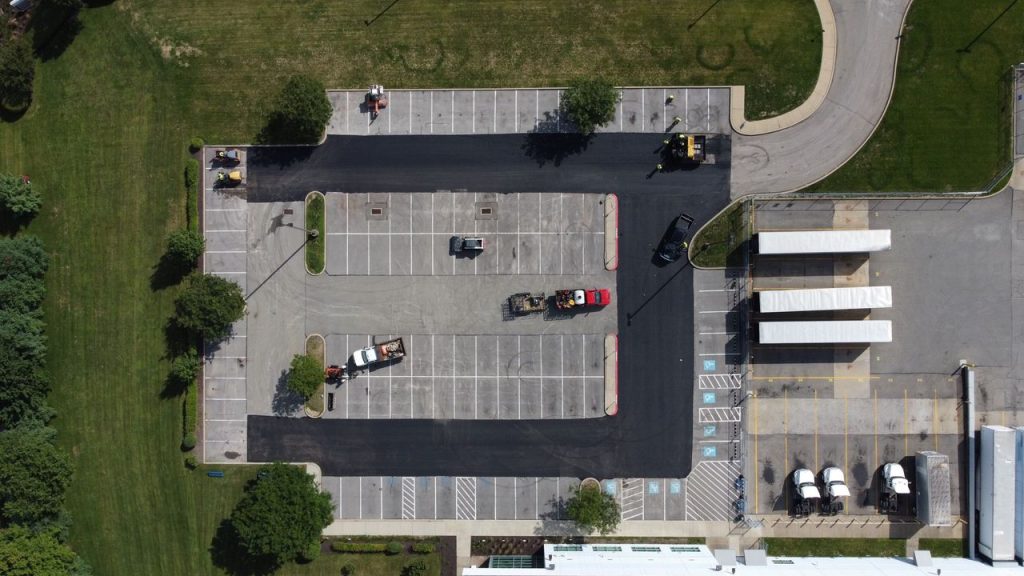
Aerial imagery is a useful addition for a large property, particularly for identifying drainage patterns, roof-level debris, or general surface wear across a wide site, since it would otherwise take a long time to cover everything on foot; however, it does not completely replace a ground inspection. A drone is unable to measure the slope of an ADA-compliant area, investigate a crack for signs of moisture ingress, or determine if a sign’s reflective coating has deteriorated, all of which need a person to be on the ground with the appropriate equipment. On large multi-building properties, we occasionally use aerial imagery to determine which sections need the most immediate ground-level attention, but we still take measurements and make observations by walking the property.
If our budget is tight, can we prioritize which inspection findings to fix first, and how should we decide?
Yes, and prioritizing findings is normal and expected, not something to feel behind on. Anything tied to safety or compliance, like an ADA space out of slope tolerance, a fire lane citation risk, or a pothole in an active drive path, should come first regardless of budget, since those carry the highest liability and the fastest-growing cost if ignored. After safety items, we generally recommend prioritizing anything showing signs of water intrusion, like a crack wider than a quarter inch or early raveling, since those are the findings that get dramatically more expensive the longer they sit, while purely cosmetic fading or minor surface wear can usually wait for the next budget cycle without meaningfully higher cost.
How soon after a hurricane or major storm should the lot get re-inspected, and what should that follow-up specifically focus on?
A subsequent inspection is advised between 48 and 72 hours after any storm that produced heavy rainfall or prolonged strong winds, as that is when it is easiest to identify storm-related damage before debris is removed or further traffic worsens the situation. The follow-up inspection should focus on drainage performance, checking whether water drained from low areas or persisted longer than it should have, and looking for new cracking or edge damage near curb lines where storm runoff concentrates. Also, properties in coastal areas near Charleston and Myrtle Beach should look for any deposits of sand or silt that can block catch basins even after storms have passed, since this buildup often leads to drainage problems weeks after the storm ends and the silt hasn’t been washed away or torn away.
See also: How Do You Fix Poor Drainage in an Apartment Parking Lot?,, What Causes Alligator Cracking in an Apartment Parking Lot?
About the Author
The Pavement Group specializes in asphalt engineering, pavement maintenance solutions, and data-driven asset management for commercial, retail, and multi-family residential properties. Utilizing advanced structural pavement evaluations and capital planning transparency, The Pavement Group works directly with property managers to extend pavement lifecycles, eliminate liability risks, and optimize long-term infrastructure investments.