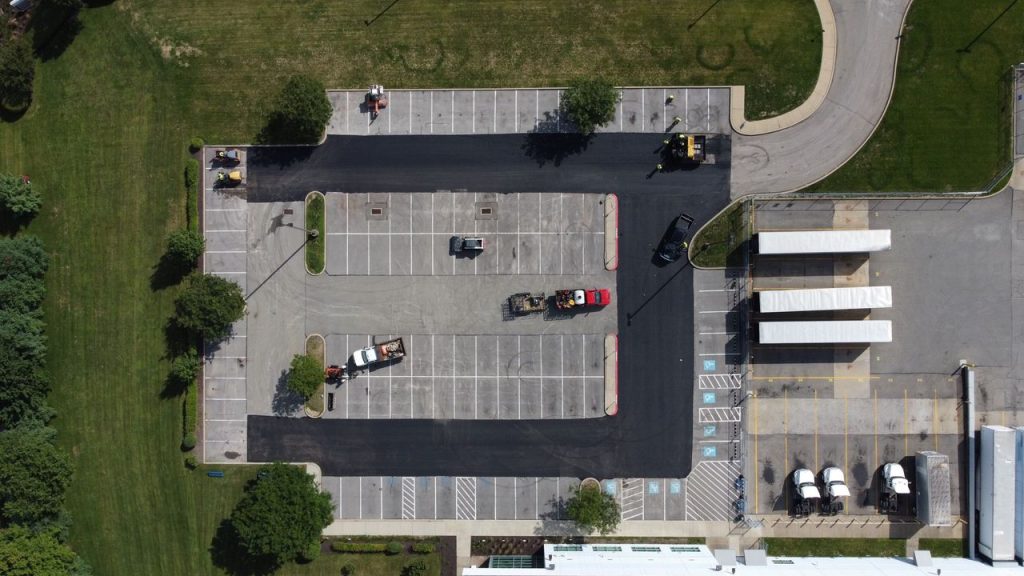
Research cited from Minnesota’s transportation research program shows that a pavement base saturated for just 10 percent of the time can shorten pavement life by more than 50 percent. Consider the area outside Building C where water collects after every storm. This pooling signals a failed layer beneath the asphalt, and the trapped water steadily worsens the damage. This guide outlines the reasons for asphalt depressions in an apartment car park, the way in which we diagnose each one, and which repair is likely to withstand a Pittsburgh winter.
TL;DR
- A depression is a low area that is usually an indication of a stable base or subgrade and not of a defect on the surface.
- Seven factors cause this condition: poor compaction, failed backfill within the trench, a saturated base, leaking storm drains, Western Pennsylvania clay combined with freeze-thaw action, repeated heavy loading, and deteriorated or failed patches.
- Overlays cover the moving base; a full-depth repair corrects it.
- Water that pools creates both a liability issue and an ADA slope issue on accessible stalls (1:48 maximum).
- Walk your property after rain and before the first freeze, and document every spot where water collects.
What Is an Asphalt Depression, and How Does It Differ From a Rut or Pothole?
Asphalt magazine refers to depressions as bird baths; it defines them as small low areas resulting from settlement or failure in the lower layers or from inadequate construction. According to the Asphalt Pavement Guide published by AsphaltWA, rain makes them noticeable since the dips fill with water.
We interpret the shape of the depression to identify the cause: a circular dip signals failure in the lower layer, a long narrow strip indicates an old trench or pipeline, and parallel twin tracks show damage from repeated wheel loads.
| Defect | What you see | Where it shows up in an apartment lot | What it signals |
| Depression (bird bath) | Low spot that holds water | Near buildings, dumpster pads, trench lines | Settled base or subgrade |
| Rutting | Channels in wheel paths | Entrances, drive lanes, turning areas | Weak mix, thin pavement, poor compaction |
| Pothole | Bowl-shaped hole through the asphalt | Along cracks after a thaw | Water entry plus traffic |
| Swelling or upheaval | Bump instead of a dip | Frost-prone spots | Subgrade expansion |
Seven Causes of Asphalt Depressions in an Apartment Parking Lot
The properties that we examine usually have more than one factor acting simultaneously. Begin with the list given below. Match each of the causes to the indications on your particular property.
1. Poor Compaction in the Subgrade or Base
Pavement Interactive attributes numerous depressions in parking lots to subgrade settlement caused by poor compaction during construction. The FHWA also agrees that such depressions result from localized settlement or from low areas formed during paving. In cases where a dip appears early on and is located a long way from any trench or drain, we believe the initial compaction was the cause.
2. Failed Utility Trench Backfill
A typical apartment building connects to water, sewer, and electric services. Crews dig a trench through the asphalt for every service line installed. The American Concrete Pavement Association’s guidelines regarding utility cuts set a standard in this regard, requiring that the backfill achieve 95% density according to either ASTM D698 or AASHTO T99 in order to avoid subsequent settlement. The guidance also warns that silt and clay soils resist proper compaction under wet conditions; these principles originate in concrete pavement standards, but the backfill rule applies equally to asphalt. Because Western Pennsylvania soils consist mostly of clay, surveyors map all trench lines first.
3. Water Saturating the Base Through Cracks
The FHWA document at geotechnical manual confirms that a pavement stable at one moisture level loses stability when its materials become saturated. Cracks open pathways for water to enter. Buddy Prather of Prather Paving in Lexington, Kentucky, stated this principle clearly in an Asphalt Magazine guide, republished with permission from the Asphalt Institute:
A depression is a low area in which water has already won. Since every unsealed crack contributes to it, we combine crack sealing with repair. Our guide on how poor drainage reduces the lifespan of apartment car parks looks at the surface aspect.
4. Leaking Catch Basins and Storm Pipe Joints
When a joint in a storm drain breaks, the water that is flowing carries the soil out of the bedding and thus creates a void. ITpipes outlines the process as follows: the ground ceases to provide support, the pavement settles in an uneven manner, and a sinkhole forms when the void has grown large enough. AQUALIS states that such failures tend to occur close to catch basins and manholes. It is at these points that the pipes meet the structures.
Treat a dip within a few feet of an inlet as a drainage issue first; patching the asphalt alone hides the underlying problem. Before any repaving begins, we inspect the structure and the pipe as outlined at our catch basin repair and drainage services.
5. Western Pennsylvania Clay and Freeze-Thaw Cycles
The bioPGH blog of the Phipps Conservatory states that the wet clay in Pittsburgh expands and contracts as it freezes and thaws, causing it to buckle upwards into the stone subbase and leaving weak spots. According to TribLive, the freeze-thaw cycle affects Western Pennsylvania severely due to the area’s wet climate and its diverse topography. WTAE meteorologist Brian Hutton Jr. explained how frequently the region crosses the freezing line:
Mild freeze-thaw cycles shift wet clay slightly each time; this movement repeats nearly every day through winter. At hillside sites, surface runoff also channels directly into the same low corner. It is this combination that causes the ground to appear satisfactory in November but to display new dips by April.
6. Repeated Heavy Loads in the Same Spots
The FHWA guidance connects pavement deformation with repeated loads that go beyond what the pavement is capable of carrying. Apartment complexes concentrate heavy loads in predictable areas. Expect pavement distress where heavy vehicles stop or turn, including dumpster pads, building entrances, and designated fire lanes. Instead, these areas should have a thicker repair layer, not just a thin patch.
7. Failed Patches and Overlays That Cover a Moving Base
According to the repair guide in Asphalt magazine, if there is a base failure, then the failed asphalt should be removed, the material beneath it stabilized, and the pavement replaced; a thin overlay omits all of these steps. The distress guide in the same magazine states that the lifespan of a patch is determined by its compaction, the materials used, and the condition of the pavement around and below it.
A thin overlay ignores all these critical steps, as noted at Asphalt magazine. The companion article at distress guide confirms that compaction, material selection, and the condition of the surrounding and underlying pavement determine how long any repair lasts.
When a repair fails and the spot gives way again within a few months or so, this shows that the previous crew had looked after the surface. We remove the soil and skip the third layer. For the point at which patching ceases to be worthwhile, refer to our guide on when a lot is beyond repair.
How Do You Find the Real Cause Before You Pay for a Repair?
According to the AsphaltWA guide, you should first investigate a depression and identify the underlying cause. For example, subgrade settlement or frost heave, before carrying out the repair. We adhere to four steps:
- Put chalk along the edge of the pond after it has rained and take a photograph of it with a tape measure included in the frame.
- Go along the outline until you reach the nearest trench, catch basin, downspout, or dumpster pad.
- Check the area by using a core sample or probe to see the thickness of the base and the moisture content.
- Check out the closest storm structure and pipe.
| Clue | Likely cause | What we check |
| Dip in a straight strip over a service line | Trench backfill settlement | Compaction records, edges of the cut |
| Dip within a few feet of an inlet or manhole | Pipe joint leak or void | Structure and pipe condition |
| Fatigue cracking inside the dip | Base or subgrade failure | Core to measure base |
| Dip at a dumpster pad or entrance | Repeated heavy loads | Pavement thickness and base |
| New dips each spring on a sloped lot | Clay and freeze-thaw movement | Drainage path and subgrade |
The AsphaltWA guide points out that parked vehicle pavement that has settled exhibits obvious fatigue cracking in the depressed area, making this sign easy to identify. Our article on the signs of a failing base explains what to look for outside of the dip.
How Much Water Does One Sunken Spot Hold?
We did the mathematical calculation: consider a ditch that is 10 feet by 10 feet in size. The volume is equal to 100 square feet multiplied by the depth in feet. Calculate total gallons by multiplying cubic feet by 7.48. Find total weight by multiplying gallons by 8.34 pounds.
| Dip depth | Volume | Water | Weight |
| 0.5 inch | 4.2 cu ft | 31 gallons | 260 lb |
| 1 inch | 8.3 cu ft | 62 gallons | 520 lb |
| 2 inches | 16.7 cu ft | 125 gallons | 1,040 lb |
This calculation is provided by The Pavement Group and involves arithmetic, not a field measurement. A bowl-shaped depression contains less than the amounts indicated by the flat-bottom figures since its average depth is below its maximum depth.
This weight concentrates on the narrowest section of your property and presses through every crack. Settlement leads to water pooling, and water pooling in turn causes more settlement.
Which Repair Fixes Each Cause?
The AsphaltWA guide recommends the basic solution, which involves removing the damaged pavement, digging out and replacing the bad subgrade, and then filling in the repaired layer.
| Cause | Repair that holds | Why it holds |
| Soft subgrade or poor compaction | Saw-cut, remove pavement, replace poor subgrade, compact in lifts, patch with hot mix | Rebuilds the layer that settled |
| Trench settlement | Remove the patch, recompact backfill or pour flowable fill, restore at full depth | Flowable backfill hardens and needs no compaction |
| Saturated base | Remove failed asphalt, stabilize the base, correct drainage, repave | Matches Asphalt magazine’s base-failure steps |
| Leaking storm structure | Inspect, repair joints or rebuild the structure, backfill, then pave | Stops soil loss at the source |
| Sound base, worn surface | Mill and overlay | Works only when the base is solid, per our repair versus replacement guide |
The most inexpensive option is the one which omits the cause and simply carries on for the following winter. Our asphalt repair service begins by carrying out a diagnosis and then determines the size of the excavation according to the failure. When many areas have failed, mill and overlay and resurfacing are included in the plan after the base has been made sound.
Does a Sunken Spot Create Liability and ADA Problems?
Yes, that is correct. Pavement Interactive cautions that depressions containing a large amount of water can lead to hydroplaning and, in Pittsburgh during winter, water that has pooled also turns into an ice sheet which people have to walk on.
The ADA introduces another point: the 2010 ADA Standards limit the slope of accessible parking spaces and access aisles to 1:48 in all directions, as stated in the ADA.gov restriping brief. This same limit is mentioned in the Access Board’s parking guide.
Let us look at the maths: a dip of 1 inch over a distance of 24 inches gives a slope of 1:24. This slope is twice as steep as the maximum allowable slope of 1:48. If you want to check a dip located within an accessible stall or aisle, use a digital level, and make sure the requirements are met by consulting your ADA consultant (since we carry out paving work, we do not provide legal advice). The aspect of complying with ADA parking regulations is managed by our ADA parking compliance team.
How Do You Keep Depressions From Coming Back?
The road crews from Pennsylvania say that their work is reactive. Eric Boozle, who is acting as highway maintenance manager for York County, told Fox43:
Freeze-thaw cycles this time of year are cracking and breaking up the pavement”Eric Boozle, acting highway maintenance manager, York County, via pennsylvania-drivers-brace-for-pothole-season-as-temperatures-fluctuate
After the damage has occurred, the agencies deal with it. Since apartment owners know where water collects, you can take action first.
| Trigger | Action | Timing |
| Before the first freeze | Walk the lot after rain, log ponding spots, seal cracks | Early fall |
| After any utility cut | Request compaction test results, then re-inspect the trench line | At handover and after the first freeze-thaw season |
| Spring thaw | Re-photograph logged spots and compare depth | After the last hard freeze |
| After heavy rain | Clear catch basin grates and check for new low spots | Each storm |
| Every year | Book a full-lot pavement assessment | Same month each year |
The twenty-year maintenance programme begins with crack sealing in year 2 for this reason. Combine this with our repair budgeting guide aimed at property managers to ensure that repairs are funded before they turn into emergencies. You can also find out how to reduce long-term maintenance costs and how long an apartment parking lot lasts.
What Do Clients Say About Working With The Pavement Group?
The two reviews mentioned below can be found on Google and are shown on our homepage; they relate to sealcoating, striping, and general servicing, not to the repair of depression.
“Great attention to detail. Great communication and worked with our schedule.” Kirk Hensler, Google review
“From start to finish the process has been seamless.” Karen Simkowski, Google review, on a sealing and striping job for Bob’s Discount Furniture
The way work is scheduled and communication is handled is important when a property is occupied. The guide on carrying out the work in phases explains how we ensure both are protected.
Frequently Asked Questions
Can I fix a sunken spot with hardware-store cold patch?
Cold patch can only be used as a temporary measure, not as a permanent solution. It remains loose underneath and the soft material below continues to move, causing the dip to reappear. In fact, even PennDOT makes use of temporary cold mix in the winter until hot mix is available for permanent repairs. You should regard cold patch as a temporary remedy for just one winter and then arrange for a full-depth repair.
How do I know a dip needs repair now instead of watching it?
Look out for three signs: water that remains once the surrounding pavement has dried, fatigue cracking within the dip, and a dip that becomes deeper over time between inspections. The AsphaltWA guide illustrates settled parking lot pavement cracking as it sinks. After every rain and every thaw, take a photograph of the area using a tape measure. If there is any increase between the photographs then the base is still moving and you should contact a contractor.
How soon after utility work can a depression show up?
It’s possible for a trench to appear perfectly filled when it was backfilled in August, yet show a noticeable dip by February. This happens because rainwater saturates the loose backfill and subsequent traffic then compacts it in an uneven manner. Before accepting the patch, ask the utility crew for the compaction test results and then go along the trench after the first freeze-thaw cycle has occurred.
Do you have to close the whole lot to repair one depression?
By no means do we carry out the work all at once, but instead carry it out in sections so that the entire area doesn’t close up simultaneously. According to our phasing guide, base repair takes between 1 and 3 days per section and paving takes 1 day per section. The new asphalt then has to cure for at least 2 to 3 days before vehicles can use it again. The only thing that residents lose is the active zone.
What time of year can you repair depressions in Western Pennsylvania?
Hot mix requires warm weather. As our repair guide points out, most asphalt work has to be carried out at temperatures above 50°F for a continuous period in order to cure properly. This means that permanent repairs can only be done from spring to fall. You should book fall repairs early so that they are completed before the first hard freeze. Work carried out in winter remains temporary.
How do I compare two contractor bids for a depression repair?
Set the same scope out in both bids. As our cost guide makes clear, a low bid that calls for thinner asphalt or no repair to the base results in a different and weaker type of project. Ask each contractor to write down the dig-out depth, the type of base material, the method of compaction, and the drainage solution. After that, go through the bids one by one and compare them.
Will sealcoating cover a depression?
Sealcoating can protect good quality asphalt from both ultraviolet and chemical damage, but it won’t cure a defective base, as our budgeting guide points out. If you apply a sealcoat over a dip, the dip will remain and any water that has collected on the surface will continue to affect the layers underneath; you should therefore repair the dip first and then seal the surrounding pavement in order to protect the repair.
About the Author
The Pavement Group specializes in asphalt engineering, pavement maintenance solutions, and data-driven asset management for commercial, retail, and multi-family residential properties. Utilizing advanced structural pavement evaluations and capital planning transparency, The Pavement Group works directly with property managers to extend pavement lifecycles, eliminate liability risks, and optimize long-term infrastructure investments.