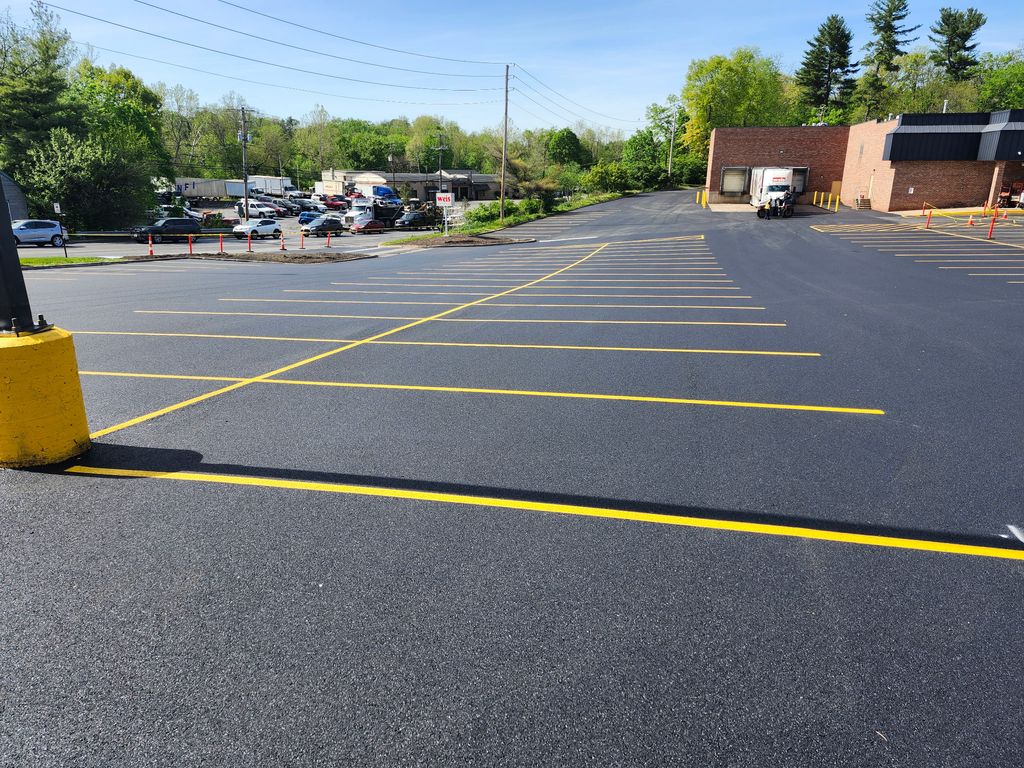
The Department of Justice frequently cites accessible parking in ADA complaints involving architectural barriers. Pavement markings that wear out lose the minimum retroreflectivity levels the Federal Highway Administration sets in its MUTCD standards. This happens faster than most property teams expect. High-traffic parking lots often see this decline in just two or three years.
For an apartment community, this situation means that faded striping is not merely a matter of curb appeal; it is a compliance and safety issue that is right in front of people, and most property managers only consider it when the lines have already faded to the point where they are no longer useful.
Restriping is also the most inexpensive and quickest method by which a property can correct layout issues that have nothing to do with painting—such as incorrect accessible space counts, the absence of fire lane markings, or a layout that has never provided for EV charging. The following are the things you should check before the team arrives.
Why Restriping Is a Compliance Checkpoint, Not Just a Repaint
- Faded accessible route markings can be a violation on their own, even when the underlying ramp slope and space dimensions are technically compliant, because residents and visitors need to be able to see where the accessible path actually is
- Restriping is the practical moment to correct outdated space counts — many apartment lots were striped decades ago under older code requirements and have never been recalculated against current standards
- It’s the lowest-cost way to add or redesignate EV-ready spaces compared to doing it as a standalone project later
- It’s an opportunity to close gaps fire marshals commonly flag — missing or faded fire lane markings, unclear turning radius for emergency vehicles
- Confusing or absent traffic flow markings are a documented liability exposure, since unclear striping contributes to parking lot fender-benders and pedestrian conflicts
The ADA Numbers Many Properties Get Wrong
The 2010 ADA Standards for Accessible Design set minimum accessible space counts based on the total number of spaces in a lot — and the van-accessible requirement (at least 1 in every 6 accessible spaces, rounded up) is the number that trips up the most properties:
| Total Parking Spaces | Minimum Accessible Spaces | Minimum Van-Accessible |
| 1–25 | 1 | 1 |
| 26–50 | 2 | 1 |
| 51–75 | 3 | 1 |
| 76–100 | 4 | 1 |
| 101–150 | 5 | 1 |
| 151–200 | 6 | 1 |
| 201–300 | 7 | 2 |
The table below simplifies ADA Standards Table 208.2 to fit typical apartment lot sizes. Owners of larger lots must apply a different calculation method. In addition, some states and municipalities require more spaces than the federal minimum mandates. It is advisable to check the exact figure with a compliance professional before finalizing a striping plan.
Beyond ADA: Other Markings That People Often Overlook
- Fire lanes — most local fire codes, often based on NFPA model codes, require fire lanes to be clearly marked (commonly red curb or red striping) with accompanying signage, and your local fire marshal’s office can confirm the exact spec for your jurisdiction
- EV charging space markings — a growing number of states and cities now require a percentage of multifamily parking to be EV-capable or EV-ready, each with its own signage and striping symbol standards
- Directional arrows and stop bars — internal traffic flow markings that reduce the odds of a fender-bender at blind corners or shared drive lanes
- Visitor and reserved space designation — often overlooked during restriping even though it’s one of the most common sources of resident complaints when it’s unclear or inconsistent
Choosing the Right Marking Material
| Material | Typical Lifespan | Best For |
| Waterborne traffic paint | 1–2 years | General space lines on standard-traffic lots |
| Thermoplastic | 4–6 years | High-traffic entrances, crosswalks, fire lanes |
| Epoxy | 3–5 years | Covered or garage parking areas |
Modern water-based paints emerged largely because of air-quality regulations. The EPA limits volatile organic compounds or VOCs in all coatings including traffic paint. These rules have therefore removed most solvent-based striping paint from the market over recent decades.
How frequently should you really restripe?
There’s no universal rule, but a few signals reliably indicate it’s time:
- Standard waterborne paint on a moderate-to-high-traffic lot typically needs refreshing every 2–3 years
- Lines that are visibly hard to see at dusk or in wet conditions have likely dropped below a reasonable retroreflectivity threshold
- Any time the lot is milled and repaved, striping is required regardless of how recently it was last done
- A fire marshal inspection or ADA complaint is its own trigger, independent of how the paint looks
Planning a Restriping Project
- Compare your current layout against current code requirements — don’t assume a decades-old configuration is still compliant
- Get a striping plan or layout drawing from your contractor before crews arrive, not after
- Schedule work during lower-occupancy hours or days where possible to minimize disruption
- Confirm with your contractor how old lines will be handled — new paint over old lines without proper removal is a common source of confusing “ghost” markings
- Loop in an electrician early if you’re adding EV-designated spaces, since that’s not a paint-only decision
Local Factors Worth Confirming Before You Start
- Local fire marshal specifications — fire lane color, width, and signage requirements vary by jurisdiction even when the underlying code is similar
- State or municipal EV-readiness mandates — several states and cities now require a set percentage of multifamily parking to be EV-capable, with requirements still evolving
- Local ADA or accessibility ordinances — some municipalities exceed the federal minimum accessible space count
- HOA or architectural review standards — some communities have specific requirements for visitor space marking, curb paint colors, or signage style
The most reliable thing you can do before finalizing the striping plan is to give your local fire marshal’s office and building department a quick call to find out what applies to your address.
The Bottom Line
Restriping seems the simplest and most cosmetic of all the property manager’s projects—until a compliance gap is discovered or is overlooked once again. The Pavement Group regards each restriping job as an opportunity to verify the layout against the current requirements, not merely as a chance to repaint what is already there.
Ensure Code Compliance and Maximum Stall Efficiency Before You Restripe
Restriping an apartment parking lot involves far more than painting fresh lines over faded ones. Property managers must account for updated ADA accessibility standards, adequate fire lane clearances, proper visitor-to-resident stall ratios, and strategic layout optimization to accommodate modern vehicle sizes without causing traffic bottlenecks.
The Pavement Group delivers high-visibility, durable line striping and complete layout re-engineering designed to keep your property fully compliant, safe, and organized.
- ADA & Municipal Compliance: Precise marking of van-accessible stalls, crosshatched loading zones, and required stenciling to prevent costly code violations.
- High-Traffic Durability: Commercial-grade, fast-drying traffic paints and thermoplastic markings engineered to resist tire wear and weathering.
Frequently Asked Questions
Does the process of restriping lead to a requirement for full ADA compliance throughout the entire parking lot or only with regard to the newly painted areas?
In most cases, restriping by itself—that is, repainting the present layout in the same arrangement—is considered to be a matter of maintenance and not an “alteration,” and therefore it doesn’t necessitate a complete review of compliance with regard to the whole property as major construction would under ADA guidelines. On the other hand, if the restriping is carried out with a repave, or if you alter the layout by adding, removing, or reconfiguring spaces, this is generally regarded as an alteration. In such cases, it is usual to bring the number of accessible spaces up to the level required by the current total space count rather than the level required when the site was first built. Since this decision depends on the project’s specific details and may differ from one situation to another, it’s best to confirm the calculation with your contractor or an ADA compliance consultant rather than assume last decade’s layout is still acceptable. This mistake is a frequent and preventable cause of future compliance complaints.
Can the crews paint over the old, faded lines, or do they need to remove the old markings first?
The decision depends entirely on whether you alter the layout. If the new lines match the existing configuration, you can often paint over the faded lines. However, the contractor will usually clean and prepare the surface first to ensure good adhesion. However, if there is any change to the layout, the old lines generally have to be removed—this can be done by grinding, media blasting, or using a blackout coating—before the new lines are installed, since having both sets of lines visible results in ‘ghosting,’ in which the original pattern is still visible, particularly at night or in wet weather. Ghosting is not only unsightly; it also undermines the reason for restriping by making drivers unsure which lines are current. Therefore, whenever a project involves a layout change, include the cost of removing the lines in the budget rather than assuming it’s already covered.
For how long after applying new striping paint can residents park on it or drive over it?
Waterborne traffic paint usually dries to the touch in between 30 minutes and a couple of hours, the exact time depending on the temperature and humidity, but complete curing—that is, the point at which the paint can cope with the car tires turning without any scuffing—typically takes about 24 hours and can take as long as 48 hours in cooler or more humid weather. Thermoplastic hardens and cools far faster. It solidifies within minutes once crews apply it. Even so, contractors still recommend waiting a short time before they reopen the area to regular traffic. Most contractors keep freshly painted areas off-limits during this period using cones, barricades, or caution tape and coordinate timing with property staff the same way they would for a small-scale paving operation. Because curing time varies by product and weather conditions, the most reliable source for an exact curing time for your project is your contractor’s paint manufacturer’s specification sheet.
Do property managers need a permit to restripe an apartment parking lot?
Most municipalities do not require a separate permit when you simply restripe to match the existing approved layout. Officials generally view that work as routine maintenance rather than new construction. You do need a permit however in two situations. The work may fall under a broader repaving or grading project that already carries one. Or you may alter the parking layout or change the number of accessible spaces enough to trigger a formal plan review. Permit rules vary widely between cities and counties. You should therefore check briefly with your local building or planning department before you begin. That quick inquiry keeps you safe from stop-work orders or fines that can follow when people overlook a requirement.
What steps should you take to add new EV charging markings to an existing striping plan?
When you decide to add EV-ready or EV-charging spaces, you do more than simply paint new lines. An electrician should first assess whether you need to install conduit and sufficient electrical capacity at those locations. You take this step even when you do not install chargers immediately. This approach prepares the space as “EV-ready” instead of “fully EV-capable.” Once you define the electrical requirements, you must stripe the spaces according to local signage and pavement symbol rules. Authorities set those standards differently across states and cities. In addition, some local bylaws count EV-designated spaces in unique ways toward total parking totals. This distinction can change your calculations for accessible parking depending on how officials classify each space. Because the work involves electrical coordination, choose EV space locations together with your electrician and paving contractor. Do not leave those decisions until the striping crew arrives.
If faded or confusing lot markings cause a resident injury or minor collision, who bears responsibility?
Liability in this situation usually relates back to the general rules on premises liability—that is, whether the property manager knew or ought to have known that the markings had deteriorated to a dangerous level and had not taken steps to deal with it within a reasonable time frame, a criterion that the Insurance Information Institute looks at when considering general liability coverage. Properties defend themselves best when they keep written records of all striping work and inspections. These records prove that owners acted reasonably and did not neglect maintenance. You should also consider another important factor. If a contractor performs striping incorrectly, liability may shift away from the property and onto the contractor. Mistakes such as wrong dimensions, missing markings, or an incorrect layout fall under the contractor’s responsibility. This serves as another strong reason to select a licensed and insured paving company instead of simply accepting the lowest bid. As in the other liability issues covered in our guides, the exact details will vary according to state law and the terms of your own policy, so it’s a good idea to go over this with your insurance broker or lawyer.
See also: Refresh Your Pavement: A Guide to Restriping Your Parking Lot, Why Fresh Parking Lot Striping Improves Apartment Community Safety
About the Author
The Pavement Group specializes in asphalt engineering, pavement maintenance solutions, and data-driven asset management for commercial, retail, and multi-family residential properties. Utilizing advanced structural pavement evaluations and capital planning transparency, The Pavement Group works directly with property managers to extend pavement lifecycles, eliminate liability risks, and optimize long-term infrastructure investments.