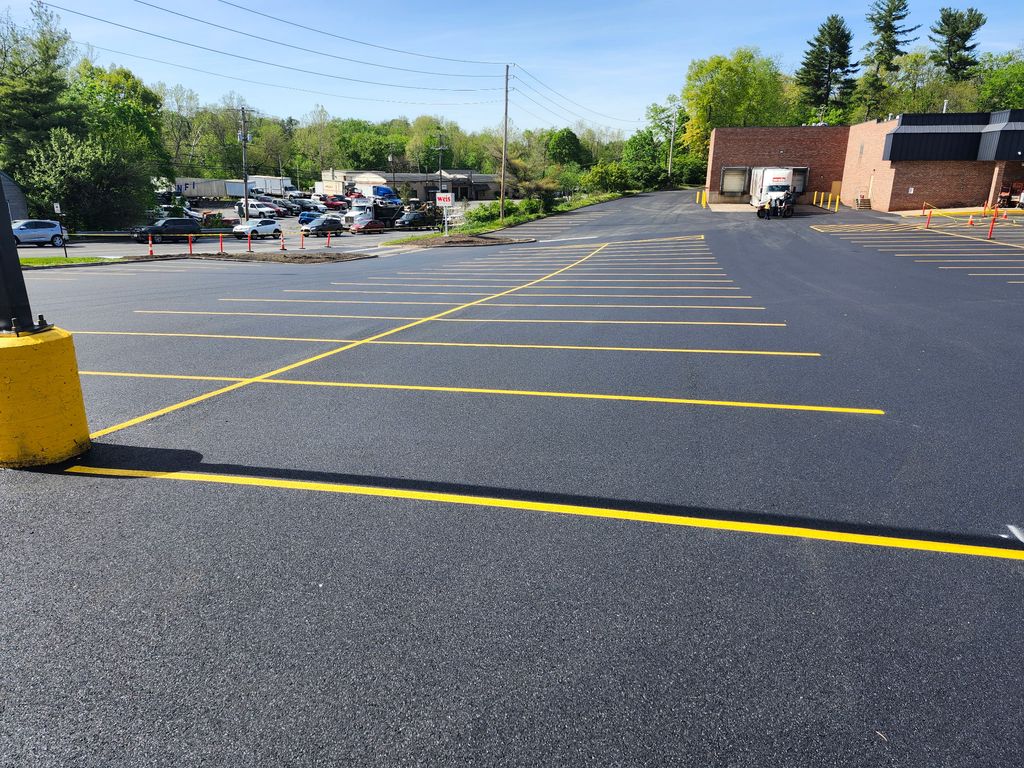
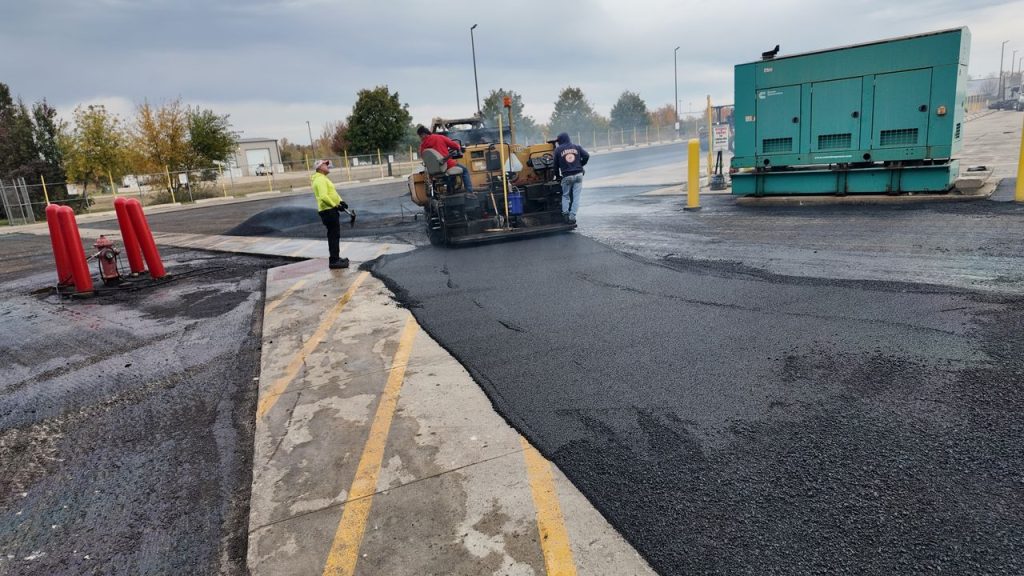
The City of Grand Junction, Colorado, suggests that a concrete dumpster pad should be at least 4 inches thick. An extra 6-foot service pad, made of 8-inch reinforced concrete, should be provided in front of the enclosure, as stated in its Grand Junction dumpster standards. The city requests double the thickness in front since front-loading trucks hit that section of pavement each time they collect the waste. Most apartment complexes pave that area with the same 2–3 inches of asphalt as the rest of the property, then find, to their surprise, that it develops ruts after only two summers.
As experts at The Pavement Group, we carry out the repair and reconstruction of apartment complexes for property owners in Atlanta, Dallas, Phoenix, Charlotte, Denver, and in many other areas.
Overview: Where Concrete Pads Pay Off
- Trash enclosure aprons where front-loading trucks stop, lift, and turn
- Entrance throats where heavy vehicles turn slowly at the same point every day
- Loading and move-in zones that carry box trucks and delivery vans
- Corners and curves on the main service route for waste haulers and fire apparatus
- Narrow concrete bands inside asphalt lots, tied in with clean saw-cut transitions
Mapping Stress Before Choosing a Material
The apartment lots do not wear evenly since a resident’s sedan drives up to a spot, parks for 14 hours, and then leaves, placing very little stress on the pavement; meanwhile, a 30-ton waste truck stops on the same 12-foot section every Tuesday and Friday, applies its brakes, and lifts a dumpster over the cab, the two vehicles using the same car park but treating it in entirely different ways.
For each project, we begin by drawing up a stress map. This process involves walking the site and observing how traffic flows throughout the property, recording where heavy vehicles enter, turn, stop, and unload. We take notes and mark these key areas on a site plan. We use this information to identify the main problem spots. Typically, the map highlights four zones that experience the most wear: the approach to the trash enclosure, the main entrance throat, the move-in loading area, and one or two tight corners on the service route. For managers who wish to perform a quick check themselves, look for signs such as rutting, frequent asphalt patches, or visible oil stains in areas where trucks often maneuver.
By noting where waste trucks, moving vans, and delivery vehicles regularly drive, stop, or turn, managers can begin to identify high-stress zones that may need stronger pavement. The pavement in these areas should be different from the rest of the property. The completed map shows precisely where upgrades would be most effective.
How Asphalt Fails Under Slow Turning Loads
Asphalt gives way under the weight and then rebounds, a feature that is suitable for cars. When a heavy truck is stationary or turning slowly, the asphalt flows. Because the binder becomes softer in the summer heat, the pressure from the wheels pushes the material sideways. As a result, the pavement develops ruts, bulges, and washboard ridges. In many areas of Phoenix, Houston, and the Atlanta suburbs, the surface temperature rises well above the air temperature every July. The problem reaches its worst at the same time as the trash trucks go on their scheduled runs.
Water completes the work; the ruts hold water, which then filters into the base. As a result, the base softens when the next wheel passes over it. We have to fix this situation frequently. The cost of repairing the same dumpster apron every two years is greater than the cost of building it properly the first time.
When Concrete Pads Earn Their Place
Concrete is able to withstand heavy and repeated loads without flowing. When a slab is properly designed, it distributes the weight of a truck over a large area of the base. Heat does not cause it to soften. Because of this, the ACI parking lot guide specifically includes multifamily housing among the types of properties for which concrete parking lots perform well with minimal maintenance.
We suggest carrying out the concrete work on the dumpster apron first, as no other area of an apartment complex wears out so quickly. The next area to treat is the main entrance throat, particularly when a waste collector or a moving truck has to turn through it on a tight radius. A move-in loading area close to the leasing office or by the building entrance should be considered if box trucks arrive every day. Lastly, we look at the fire access route. The International Fire Code mandates that fire apparatus roads must be able to carry at least 75,000 pounds. Any part of your fire lane that is built on thin, old asphalt should have a pavement assessment carried out.
Thickness and Base for Apartment Pads
The standard dumpster enclosure pad consists of 6 inches of reinforced concrete placed over a compacted aggregate base, together with an 8-inch service apron, which extends 6 feet in front of the enclosure. This is in line with the specification for the Grand Junction approach and exceeds its minimum requirement of 4 inches. In cases involving heavier or more frequent loads. A 3 cubic yard compactor or a pickup that occurs twice a week in a community consisting of 400 units. We would recommend using 8 inches throughout.
The slab is just as important as the base. In Dallas and in other areas where the soil is rich in clay, we remove the soft or wet subgrade and replace it with compacted stone before pouring. A slab placed on unstable soil will crack regardless of how thick it is. Moreover, our teams slope each pad by 1 to 2 percent towards a drain or along the existing flow pattern of the site so that water drains off the apron rather than collecting beside the enclosure.
Joint Layout and Slab Size
Cracks appear, and the issue is to determine their location. Joints introduce deliberate weak lines into the slab, which is why cracking takes the form of straight lines rather than appearing as random lightning bolts over the surface. The ASCC concrete parking FAQ states that the American Concrete Institute limits the maximum joint spacing to 15 feet no matter what the thickness is. Designers usually maintain a spacing close to twice the thickness of the slab so that a 6-inch slab has joints approximately every 12 feet.
The crews sawed through the contraction joints to a depth of one quarter of that of the slab and kept the panels as close to square as possible. For a dumpster pad measuring 12 feet by 25 feet, this involves one longitudinal joint and a few transverse cuts, not a single large slab. Panels that are more square tend to crack less, carry the load more effectively, and have a cleaner appearance after ten years of trucks having driven on them.
Tying New Concrete Into Existing Asphalt
Whether a repair appears professional or merely patched depends on the edge between the concrete and the asphalt. We made a straight saw cut in the existing asphalt, removed the damaged part down to the base, and then poured the slab so that its surface is level with the surrounding pavement. A ridge, even one as small as a half inch, causes problems for pedestrians, rubs against car bumpers, and gets caught in the snowplows used in northern areas such as Minneapolis and Chicago.
We include an expansion joint or isolation strip at the point where the concrete meets a building, a curb, or a utility structure, so that the slab is able to move without causing the fixed elements to crack. If the project involves nearby wheel stops, we inspect them during the same visit. Our guide on how to replace damaged wheel stops indicates when a cracked or tilted stop should be removed.
Concrete and Fluid Leaks Around Parking Stalls
People find that dumpster enclosures leak, and parking spaces under older vehicles leak too. Concrete does not soften when oil or hydraulic fluid strikes it, but asphalt binder dissolves instead; the surface then turns soft and sticky. This difference is why concrete is a good option for the apron, since a hydraulic truck drips oil onto the same spot every week. The article we have on oil and fluid leaks explains how these fluids damage the asphalt in the resident stalls and can therefore help you to decide if a few of the stalls should also have concrete.
Reference Table: Matching Pavement to Stress Zones
| High-Stress Area | Main Stress | Our Concrete Specification | When Asphalt Still Works |
| Dumpster enclosure pad | Static weight, fluid drips | 6 in reinforced slab on compacted base | Rarely, only for very light pickups |
| Service apron in front of enclosure | Front-loader braking and lifting | 8 in reinforced slab, 6 ft deep | Not recommended |
| Entrance throat | Slow, tight turns by heavy trucks | 6 in slab with doweled joints at turns | Low-volume entrances with no waste truck route |
| Move-in or delivery loading zone | Daily box truck stops | 6 in slab, joints at 10 to 12 ft | Occasional loading only |
| Fire access route sections | Fire apparatus load of 75,000 lb | Engineer review, often 6 to 8 in slab | Sections with proven thick asphalt and strong base |
| Resident stalls | Light cars, long parking | Not needed | Standard 2 to 3 in asphalt over good base |
When Asphalt Remains the Smarter Choice
Concrete is not suitable in all situations. Since resident stalls have light and evenly distributed loads, and as asphalt is cheaper per square foot to lay and repair, a complete concrete surface also tends to reflect more heat and cause more glare. When a utility crew digs a trench, it produces a louder sound than asphalt. We only recommend concrete to owners in those areas where the stress map indicates that it is justified. For all the other parts of the lot we use asphalt, which is properly maintained.
Put Concrete Where It Counts
A concrete pad placed at the dumpster area, at the entrance throat, or in the loading zone can put an end to the need for annual patching and provide your property with a clean and durable surface. The Pavement Group will inspect your site, create a stress map, and suggest the smallest possible area of concrete that will solve the problem. Get a free site assessment, and we’ll show you precisely where concrete is worthwhile and where asphalt is still the better choice.
Protect High-Stress Parking Areas With the Right Pavement Solution
Heavy vehicles, frequent turning movements, and repeated loading can accelerate pavement deterioration in busy apartment communities. At The Pavement Group, we help property managers evaluate high-stress areas and determine where concrete pads may provide a more durable, long-term solution.
Whether you’re dealing with recurring damage near dumpsters, loading zones, or maintenance access areas, our team can help you plan pavement improvements that support your property’s daily demands.
Contact UsFrequently Asked Questions
How much do concrete pads cost compared with asphalt in an apartment lot?
Concrete generally costs more per square foot than asphalt when it comes to installation, as it involves the use of formwork, reinforcement, a longer curing period, and more thorough base preparation. However, when the repair cycle is taken into account, an asphalt apron that has to be patched every two years can end up costing more over a ten-year period than a single concrete. Prices do differ from market to market, so places such as Phoenix, Atlanta, Denver, and Chicago all have different labor and material rates. We provide each property with a quote after carrying out a site visit. We only give prices for the concrete in the stress areas so that you can see the actual cost of the specific upgrade, not the cost of replacing the entire area.
How long before trucks and residents can use a new concrete pad?
Light foot traffic is generally able to use a newly laid slab within a day. Still, heavy trucks require a much longer time. We usually prevent waste collectors from accessing the new pad for at least seven days, although the period may be longer if the vehicles are loaded. The concrete acquires the majority of its design strength over a period of 28 days. This process is retarded by cool or wet weather. We work with your waste hauler to place the dumpster at a temporary site while the concrete is curing. We put up barricades to stop anyone driving on the pad before it is ready. Trying to speed up this procedure results in cracks and surface damage that persist for years.
Can we stripe or paint markings on new concrete?
Certainly, but it’s important to consider the timing and the amount of preparation involved. Since fresh concrete has moisture and curing agents that prevent paint from sticking, we have to wait until the slab has cured completely before cleaning the surface and then applying the markings. Concrete appears different from asphalt because white lines lack contrast on light-coloured pavements, which is why we usually select yellow or add a black border to ensure the stencils remain readable. The fire lane markings, the “No Parking” hatching, and the loading zone stencils are applied after the concrete has cured. In each case the colors are matched to the local code requirements.
How does concrete hold up in freeze-thaw climates and with de-icing salts?
Excess water or insufficient air harms concrete during freeze-thaw cycles. In cities such as Minneapolis, Chicago, Denver, and Columbus, we use air-entrained concrete with the correct water-to-cement ratio. We cure it properly to protect the surface. Since de-icing salts speed up scaling on weak surfaces, we refrain from pouring the concrete late in the season when cold weather could spoil the curing process. A well-constructed air-entrained pad is capable of withstanding both salt and freeze-thaw damage for many decades. If the pouring is rushed in November, the pavement can fail after just one winter.
What maintenance does a concrete pad need once it is in place?
Concrete needs less maintenance than asphalt, but it does need some. We inspect the joints each year and reseal them when the filler cracks or pulls away, because water that enters a joint can soften the base beneath the slab. We clean oil and hydraulic fluid spots from the surface. Stains collect dirt and attract more drips, and we repair small chips before they spread. Spalls, settled panels, and cracks wider than a quarter inch deserve prompt attention, and a short annual visit usually catches them early.
How do we handle trash service and resident access while we build a pad?
We plan the work around your waste hauler’s schedule and your residents’ routine. Most dumpster pad projects take two to four working days for demolition, base work, forming, and pouring, and the curing period follows. During that time, we set up a temporary dumpster location on a stable surface near the enclosure. We mark the route with cones and signs so the hauler and residents can find it easily. We send your manager a short notice to share with residents. Our team confirm the pickup schedule with the hauler before we begin.
About the Author
The Pavement Group specializes in asphalt engineering, pavement maintenance solutions, and data-driven asset management for commercial, retail, and multi-family residential properties. Utilizing advanced structural pavement evaluations and capital planning transparency, The Pavement Group works directly with property managers to extend pavement lifecycles, eliminate liability risks, and optimize long-term infrastructure investments.