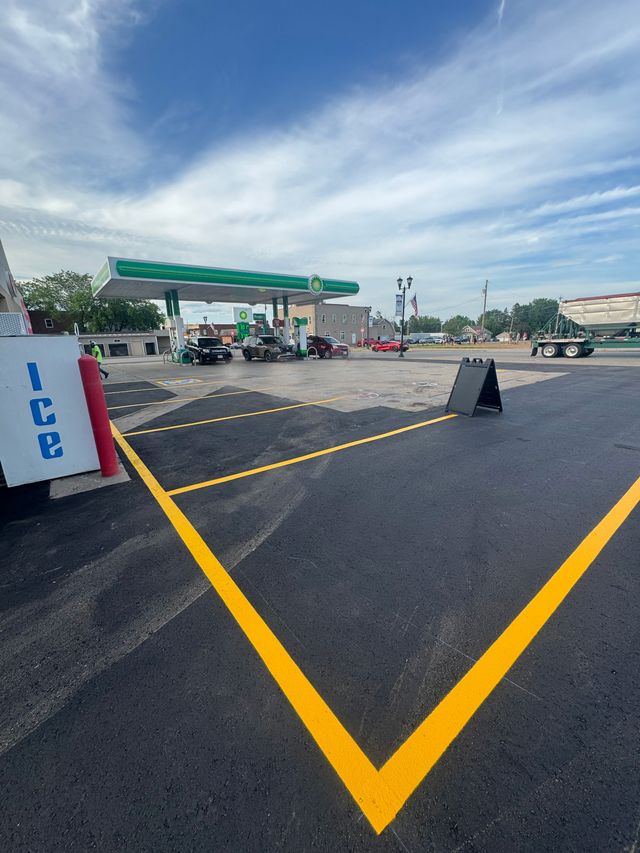
A fully loaded front-loading garbage truck has a weight of between 60,000 and 66,000 pounds. According to the AASHTO fourth power rule, which engineers apply when calculating pavement damage, the rear axle of that truck causes about 10,000 times more damage to the asphalt than a passenger car’s axle does. Now consider that this truck takes the same route to the same dumpster area twice a week, totaling 104 times each year, and does so directly over a sanitary sewer trench, which a plumber filled in back in 2003 and never compacted properly.
It isn’t bad luck. It is a failure that can be repeated and is predictable, and it is the one most common reason why we are called upon to attend apartment complexes.
The section that property managers most never come across is that sinking of the asphalt is not random. For example, when we visit a 300-unit community, we’re generally able to tell in advance where the depressions will be even before we look at the pavement itself. These depressions correspond with the pipes underneath and with the routes used by the heaviest vehicles on the property. When you learn to interpret that map, you cease guessing and begin to address the real cause.
Sinking Asphalt Follows Your Utility Map, Not the Weather
Most of the articles dealing with this subject attribute the problem to water and no more. It is true that water is an important factor, and I shall deal with it later on. However, apartment complexes have something that neither a retail strip nor an office site possesses: an extremely dense network of shallow underground utilities.
All the buildings on your site have a sanitary lateral, a domestic water supply, a gas supply, and electrical conduit leading to a main. You also have to add irrigation lines for the landscape beds, conduit for each pole light, storm laterals that connect the roof drains to the system, lines for pooling backwash, and more recently the trenches dug across your property for the fiber internet and the EV charging stations.
Each building involves hundreds of linear feet of trench. All of those trenches represent cracks in the ground caused by someone digging a hole, inserting a pipe, and then filling it with soil. If the soil is put back in 3-foot lifts rather than 8-inch lifts or if the compaction test is completely omitted, the trench will settle, and this settlement will become noticeable on the surface after five to fifteen years.
The latest version of this issue is concerning EV charging retrofits. At present we are carrying out repairs on sites where in 2023 a low-bid electrical contractor dug trenches 200 feet across a parking area, used the excavated material to backfill rather than employing clean stone, and then laid down an asphalt patch only 2 inches thick. The trenches are now beginning to sink. So, if your community installed chargers or fiber over the past three years, you should check out those areas first.
The Seven Causes We Actually Find in Apartment Lots
1. Utility Trench Settlement
The primary cause is that the backfill should be placed in controlled lifts and then compacted to a specified density, typically 95 percent of the maximum dry density determined by the standard Proctor in accordance with ASTM D698. If the crew rushes the process, air voids remain trapped in the soil. Over the years the traffic and moisture force these voids out, and the surface sinks in a long, narrow strip. In the case where the depression is between 2 and 4 feet wide and extends in a straight line, you have a trench and not a pothole.
2. Broken Pipes Washing Out the Subgrade
A broken sanitary lateral or a failed storm lateral does more than just leak. It siphons the fine soil particles from the subgrade and carries them away, leaving a hollow space beneath apparently sound pavement. We constantly observe this in apartment complexes constructed before 1985. The original laterals were made of clay tile or Orangeburg. The surface may appear normal for months before suddenly dropping by four inches over the course of one week when the hollow space collapses.
3. The Ring of Failure Around Catch Basins
Check all the storm drains on your property. In the case where the asphalt has sunk down in a ring that is between 2 and 3 feet wide around the frame, the mortar joints in that depressed area have failed, and groundwater has been moving into the structure, carrying your base material away along with it. Simply laying down new pavement will not help. We first repair the upper courses of the structure and then restore the pavement around it.
4. Repeat Heavy Loads in Fixed Paths
The extreme loads are concentrated in the narrow lanes since refuse trucks, box trucks on the first and last weekend of each month, fire engines, and delivery vans all use the same route. The problem with the code that no one talks about is that the International Fire Code mandates that roads providing access for fire apparatus must be able to support at least 75,000 pounds. Many of the apartment developments from the 1990s and 2000s were constructed with only two inches of asphalt laid over a base that was four to six inches thick. Thus, the site was inadequately designed from the very beginning for its fire lane.
5. Clay Subgrade Losing Strength When Saturated
The type of soil determines how tolerant your land is. A large part of central Ohio is underlain by Wisconsinan glacial till, which has a high clay content, and the lake plain close to Cleveland and Toledo contains lacustrine clays that are even worse. When clay becomes saturated, it loses a great deal of its load-bearing capacity, which is the reason why depressions get deeper every spring. For free you can find out the precise soil series for your property via the USDA NRCS Web Soil Survey, and I suggest that each regional manager do this once for each asset.
6. Thin or Contaminated Aggregate Base
If we dig up an apartment block and find only three inches of base instead of the six inches of ODOT Item 304 that was called for, the site is always doomed. Even worse is base contamination, in which clay has risen into the stone over the years and turned what should have been a freely draining layer into mud. FHWA guidance on the geotechnical aspects of pavements makes it clear: the base and subgrade carry the structural load, not the asphalt surface; the asphalt is merely a wearing course and not part of the structure.
7. Trapped Water and Freeze-Thaw
In winter, Ohio experiences dozens of cycles in which temperatures rise and fall above and below freezing. When water remains in a birdbath area, it filters through the asphalt, soaks the underlying material, freezes, expands, and then thaws again. With each cycle, the aggregate structure becomes a little less stable. Any flat spot that collects water will always fail before the surrounding pavement. It makes no sense to sealcoat an area where water is pooling.
How to Read Your Own Depressions
Take this table with you when you do your next inspection of the property. The shape and position of the sunken area show you the cause with remarkable accuracy.
| What You See | Most Likely Cause | What It Needs |
| Long narrow strip, 2 to 4 ft wide, straight line | Utility trench settlement | Full-depth removal, proper backfill, rebuild |
| Round bowl, 4 to 10 ft wide, deepening fast | Broken pipe washing out fines | Sewer camera inspection before any paving |
| Ring around a grate or manhole | Failed storm structure joints | Rebuild structure top, then patch |
| Rectangle at the dumpster approach | Overloaded section under refuse trucks | Concrete approach pad, 8 in. reinforced |
| Two parallel ruts in a drive lane | Underbuilt base in the wheel path | Full-depth reclamation or deep patch |
| Wide shallow dish holding water after rain | Original grading error or base pumping | Mill, re-grade, and restore positive slope |
| Sinking along a curb or building edge | Poor edge compaction or downspout discharge | Patch plus drainage correction |
| Soft spot near an old tree or removed fence | Organic material buried in subgrade | Undercut and replace with stone |
How We Confirm the Cause Before We Quote
We won’t include a value for a sunken area based on a windshield survey. If a contractor does, you should ask questions. This is the real order of procedure:
- We took core samples at the depressed area and also at a healthy control area. This allows us to determine the actual asphalt thickness, the actual base thickness, and whether or not the base is clean or contaminated.
- The Dynamic Cone Penetrometer test: according to ASTM D6951, the strength of the subgrade is assessed by depth, which tells us whether we need to undercut the ground by 12 inches or 30 inches.
- When carrying out a sewer camera inspection, if the depression is circular and increasing in size, then we will inspect the nearest lateral before working on the asphalt; paving over a leak that is still active completely wastes your money.
- We locate utilities by phoning 811, then use a private locator for lines the utilities fail to mark—on apartment buildings, this applies to most lines.
- Map of ponding areas: we go around the property during or immediately after it rains and note all places that still have water 30 minutes later.
Repair Options and What Drives the Cost
The figures given here are typical commercial prices and vary by region, quantity, and degree of mobilization. Isolated minor repairs are always more expensive per square foot than larger repairs.
| Repair | Typical Range | Lasts | Right When |
| Surface patch (mill 2 in., replace) | $3.50 to $6.00 per sq ft | 2 to 5 yrs | Base is solid, problem is surface only |
| Full-depth patch (remove 8 to 10 in., rebuild) | $7 to $14 per sq ft | 10 to 20 yrs | Base or subgrade has failed |
| Deep undercut with geogrid | $12 to $20 per sq ft | 15 to 25 yrs | Subgrade is soft or saturated |
| Concrete dumpster approach pad, 8 in. reinforced | $14 to $22 per sq ft | 25 to 30 yrs | Refuse trucks are crushing the asphalt |
| Catch basin top rebuild | $1,800 to $4,500 each | 20 plus yrs | Ring of failure around the structure |
| Sewer lateral repair under pavement | $5,000 to $20,000 plus | Decades | Camera confirms a break |
| Mobilization minimum | $2,500 to $5,000 | n/a | Any small standalone repair |
The lesson illustrated by that table is straightforward: by carrying out repairs across a portfolio or by scheduling several buildings in a single mobilization you greatly reduce your effective cost. That is why we prepare phased scopes for management companies.
Why Timing Changes the Price
Asphalt work depends on the weather. Here are two practical considerations:
- Place your bid in the winter and carry out the construction in the spring. The contractor’s schedule is usually full by March. Properties that finalize their scope in January can get better prices and better crews than those that do so in July.
- A depression that is 1 inch deep in October is generally 3 inches deep by April—Freezing and thawing speed up the process in all the voids beneath your property. If you wait a season, the repair will usually move from the surface-patch column to the full-depth column, which can double the cost.
Work With a Team That Diagnoses Before It Paves
At The Pavement Group, we handle pavement maintenance in apartment complexes and multi-site property portfolios, and rather than seeing a sunken section as a hole to be filled, we treat it as a symptom that needs diagnosis. In such cases, we bore into the area, carry out tests, and use a camera if necessary, then provide a report that identifies the real cause and explains why. If your property is sinking, send us photographs and a site plan, and we’ll let you know what we think is beneath it.
For a more detailed explanation of pavement structure and maintenance standards, the National Asphalt Pavement Association produces reliable reference material for property owners.
Address Sinking Asphalt Before It Gets Worse
The Pavement Group helps multifamily property managers identify and address the underlying causes of sinking asphalt, including drainage problems, weak subgrades, and pavement deterioration. From pavement assessments and localized repairs to drainage improvements and larger rehabilitation projects, our team can help protect your parking lot and reduce the risk of recurring damage. Contact The Pavement Group today to discuss the right repair solution for your apartment parking lot.
Contact UsFrequently Asked Questions
1. Does a sunken area in my parking lot create an ADA compliance problem?
It most certainly can, and this is the issue that is most frequently overlooked. The 2010 ADA Standards for Accessible Design set a maximum slope for accessible parking spaces and access aisles of 1:48, or about 2 percent, in every direction, and it mandates that an accessible route be firm, stable, and slip-resistant, with changes in level usually kept at no more than a quarter of an inch. A depression in an accessible parking space or along the route to a building entrance can cause you to fail the requirements even if the parking area passed inspection when it was originally constructed. Treat any sunken area in your accessible parking as a compliance repair with a deadline, not a cosmetic fix for next year’s budget.
2. Can I recover repair costs from the utility company or contractor whose trench caused the settlement?
It’s worth looking into this before you write the check; if a contractor who installed a cable, fiber, gas, or EV charging system carried out the digging in the past few years, there is typically a right-of-entry agreement, an easement, or a work permit, which includes obligations regarding restoration and a warranty on the backfill. Retrieve your files, locate the permit and the date, and take a photograph of the failure with a measuring tape included in the picture before anyone else touches it. For older trenches from the original construction, it is considerably more difficult to take action because most states have a statute of repose that extinguishes claims for construction defects after a certain number of years, meaning a trench that is 20 years old is almost always yours to repair.
3. Will my property insurance cover sinking asphalt?
Standard commercial property insurance policies do not cover this situation because insurers consider gradual settlement, wear, and deterioration part of maintenance rather than a covered risk. One exception to consider is sudden collapse caused by a specific event—for example, a break in the water main under your property—which some policies cover under a clause relating to collapse or water damage. Your best approach is usually to claim against the responsible utility, plumber, or contractor; carry out a camera inspection or obtain a core report to establish the cause before any repairs; and involve your risk manager early.
4. A resident says the depression damaged their vehicle. How should I handle that?
Document the condition immediately with dated photographs, a depth measurement, and a note of when maintenance first logged it. Premises liability generally turns on whether you knew or should have known about the hazard and had reasonable time to address it, so your inspection log and work order history become the central evidence. Report it to your carrier and regional manager the same day, avoid admitting fault or promising reimbursement on site, and cone or barricade the area until you make a permanent repair. A documented interim safety measure protects you far better than a verbal assurance to the resident.
5. Does a sinking parking lot affect refinancing or property valuation?
Yes, and the impact is usually larger than owners expect. Lenders on multifamily assets typically order a Property Condition Assessment following ASTM E2018, and the consultant walks the pavement and assigns a remaining useful life and an immediate repair cost. Documented pavement failures land in the immediate needs table, which can trigger a replacement reserve escrow or reduce loan proceeds. Appraisers also apply deferred maintenance deductions, so a $60,000 pavement problem can reduce valuation by more than the repair cost once it flows through a capitalization rate.
6. How do I repair a section without losing the parking my residents need?
Phase it, and communicate on a schedule residents can plan around. We typically break a lot into zones, keep every repair area under a set percentage of total stalls at any one time, and sequence work so no building loses access to its entrance or its dumpster on the same day. Post notices 10 to 14 days out, again at 72 hours, and again the morning of, and arrange overflow parking in a drive aisle or on a neighboring property if your stall count is tight. Full-depth repairs generally need the area closed for 48 to 72 hours between excavation and traffic, so build that into the notice rather than promising same-day reopening.
7. Should I sealcoat a lot that has sinking areas?
No, and doing so usually wastes the money. Sealcoat is a thin protective surface treatment with no structural value, so it will not lift a depression, fill a void, or stop settlement, and it will not bond well to an area that holds water. Applying it over a failing section also hides the problem from your next inspection, which is the opposite of what you want going into a budget cycle. Repair the structural failures first, let the patches cure, and then sealcoat the healthy pavement so the treatment actually protects something worth protecting.
See also: Why Do Dumpster Areas Develop Asphalt Damage Faster Than Other Parts of an Apartment Lot?, Why Does an Apartment Parking Lot Keep Developing Potholes After Repairs?
About the Author
The Pavement Group specializes in asphalt engineering, pavement maintenance solutions, and data-driven asset management for commercial, retail, and multi-family residential properties. Utilizing advanced structural pavement evaluations and capital planning transparency, The Pavement Group works directly with property managers to extend pavement lifecycles, eliminate liability risks, and optimize long-term infrastructure investments.