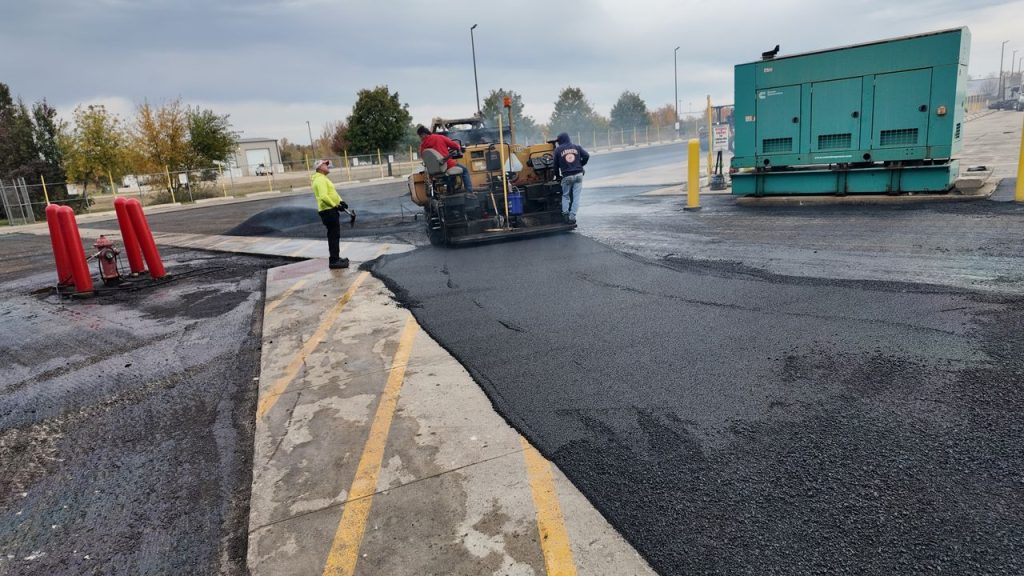
Reserve planning experts have long emphasized that many community associations fund their reserves far below the amount needed to replace major assets such as roofs, pavement, and building systems. The Community Associations Institute has documented this pattern over many years across both HOA and condominium communities. The case is especially evident in parking lots. Pavement usually doesn’t fail in the way that a water heater or a roof does. It stays in good condition for many years, then deteriorates rapidly once water gets to the base layer. Budgets based on flat, estimated figures seldom keep up with that rate of deterioration.
We are the Pavement Group and have had the opportunity to sit at the same table as a large number of owners of apartments. Members of HOA boards and property management companies have allowed us to observe the same mistake in budgeting recurring over and over again—that of treating pavement as a mere afterthought rather than as a capital asset with a proper depreciation schedule. The way we show property owners how to build a budget that actually works includes several planning tools that most other guides fail to mention.
Why a Flat Annual Number Doesn’t Work for Pavement Budgeting
Pavement deteriorates along a curve, not in a straight line. Pavement can hold nearly the same visible condition for ten years. Then it declines rapidly once moisture damages the base. This pattern means that if you set aside the same amount every year, you will allocate too much during stable periods and fall far short exactly when repairs become most urgent.
Generally, professional reserve planners deal with this by using the Pavement Condition Index (PCI), a standardized 0–100 scoring system (formalized under ASTM D6433) that municipalities, universities, and reserve study professionals use to keep track of where a particular property stands on that curve and to plan their budgets accordingly, rather than responding to whatever appears to be in poor condition that quarter.
Operating Budget vs. Capital Reserve: Where Does Pavement Belong?
A quick way to exceed your pavement budget is to place the incorrect expenses into the wrong category. In reality, most of the line items come under one of two categories:
- The annual budget (foreseeable and relatively small) covers crack sealing, pothole patching, striping touch-ups, storm debris cleanup, and minor drainage clearing.
- You should set up a capital reserve to cover sealcoating cycles, mill-and-overlay work, full-depth reclamation, and any ADA-required restriping tied to major resurfacing. These expenses happen periodically. They involve larger sums. You must save for them well ahead of time.
One of the most common reasons properties end up seeking a special assessment or an emergency loan is that they treat a major-scale project as an operating expense. For example, trying to finance a $150,000 resurfacing from this year’s maintenance budget.
A Lifecycle Budget Planning Table
Combining condition score with typical timing gives owners a single reference point for both when to expect a cost and how much it generally runs:
| Stage | Typical Timing | PCI Range | Budget Category | Relative Cost (per sq ft) |
| Preventive | Years 1–5 | 85–100 | Operating budget | $0.10–$0.30 |
| Protective | Years 3–8 (cyclical) | 70–84 | Operating / light capital | $0.15–$0.35 |
| Corrective | Years 8–15 | 55–69 | Capital reserve | $1.50–$3.50 |
| Reconstructive | Years 15–25+ | Below 55 | Major capital project | $3.00–$8.00 |
The figures given here are general and will differ by region, material costs, and lot condition. Check up-to-date figures with a local contractor before finalizing a budget.
Budgeting Looks Different Depending on Who Owns the Property
This is the part most generic budgeting articles skip entirely, and it changes the whole planning process:
- Communities owned by institutions or REITs generally include pavements in their overall capital plan, usually linked to whether they are refinancing or acquiring rather than making it a separate annual choice.
- In HOA and condominium communities, reserve studies usually determine funding levels. Regular monthly fees pay for expenses. The board must approve any budget adjustments. As a result, these communities implement increases much more slowly than individual property owners do.
- Individual and small-property owners generally pay for repairs directly from their property’s ongoing cash flow. This leaves them most exposed when a major repair becomes necessary before they have set aside any savings.
Warning Signs That Show Your Reserve Fund Is Underfunded
- You keep putting off routine maintenance quarter after quarter to stay within budget.
- You have not adjusted the amount you set aside for pavement reserves in several years even though material and labor costs keep rising.
- You financed the property’s most recent major repair on an urgent basis instead of paying from reserve funds.
- You have not performed a condition assessment in three or more years. That means your actual funding figure is essentially just a guess.
The Bottom Line
A properly planned parking lot budget does not simply copy numbers from last year’s spreadsheet. You should build it around the pavement’s actual condition. You must also split funding appropriately between operating and capital accounts. In addition, you should account for the way your ownership structure approves and pays for major expenses.
Once you have that framework in place, a major resurfacing ceases to be an emergency and becomes an item you anticipated years in advance. If you would like a clear assessment of where your property stands, we will gladly review the site. We will walk through all the figures together with you.
Optimize Your Capital Expenditure Budget for Parking Lot Maintenance
Budgeting for multi-family pavement assets requires shifting from reactive emergency fixes to a structured, multi-year preventive maintenance strategy. Spreading capital expenditures across routine sealcoating, crack sealing, and scheduled mill-and-overlay projects prevents unexpected, high-cost complete pavement overhauls while keeping your property compliant and visually appealing.
The Pavement Group builds custom 3-to-5-year pavement management plans designed to help property owners forecast capital expenses accurately, prioritize urgent safety repairs, and maximize overall ROI.
- Multi-Year Maintenance Forecasting: Priority-ranked pavement evaluations that establish clear expenditure timelines and eliminate costly emergency budgeting surprises.
- Maximizing Asset Lifespan: Low-cost preventive maintenance schedules that extend asphalt service life by up to 300% compared to deferred repair cycles.
Frequently Asked Questions
How does a parking lot’s age change the amount you should budget each year?
A lot that has just been laid or recently had its surface resurfaced generally requires only a small annual expenditure on crack sealing and striping repairs. The underlying pavement structure is in good condition and all that is needed is protective maintenance. However, when a lot reaches the ten- to twelve-year stage, the annual budget should begin to shift from purely maintenance to establishing a reserve for a mill-and-overlay or similar mid-life renewal, even if the surface still appears satisfactory. Usually, delaying a budget increase until the lot clearly needs extensive work means setting up that reserve too late. Most pavement professionals advise raising the annual contribution gradually from about the eighth or tenth year rather than waiting for a clear sign.
Should apartment owners have a professional reserve study carried out, or can property management do it itself?
Estimates prepared by a property management team help with day-to-day maintenance planning. Still, they usually aren’t based on the same engineering-based lifecycle data used in a professional reserve study to project remaining useful life and determine funding requirements. A formal reserve study—standard procedure for many HOA and condo associations and increasingly adopted by institutional apartment owners—typically includes an on-site condition assessment, a projected replacement schedule, and a funding plan intended to prevent special assessments or emergency borrowing. Although such an in-depth study might be more than needed for a single, smaller property, for any community managing multiple capital components along with the pavement. A periodic reserve study by an independent third party is generally worth the expense to avoid having to guess.
Is parking lot repair a capital improvement or a repair expense for tax purposes?
In general, routine maintenance such as crack sealing, patching potholes, and sealcoating is considered a deductible repair expense in the year it is carried out. In contrast, a complete resurfacing, overlay, or reclamation operation is more usually treated as a capital improvement and is therefore depreciated over time. The IRS has issued general guidance on how to distinguish repairs from capital improvements under its rules for tangible property. However, the exact classification depends on the scope of the work and how it is documented. Because this distinction affects depreciation schedules and possible tax treatment, apartment owners should have their CPA review any large pavement project before deciding on the budget category, rather than deciding based solely on cost.
What effect does financing a major resurfacing project have on the total budget?
It is usually the cheapest option to pay for a major resurfacing project from an already funded reserve account. It avoids interest charges and does not draw on operating cash flow. Although financing the project by means of a loan or a line of credit allows the cost to be spread out over time, it also increases the total project cost through the addition of interest, something that can make a substantial difference when the project amounts to several figures for a larger property. A special assessment—charging residents or HOA members directly for an unexpected expense—is typically the most disruptive method from the point of view of resident relations. It is generally an indication that reserve planning at some point failed, rather than something that should be regarded as a normal way of financing.
How many competitive bids should an apartment owner get before choosing a paving contractor for a large project?
Most experienced owners and asset managers request at least three bids for any project above a moderate dollar threshold. A single bid offers no real basis for comparison, and two bids can make it hard to tell whether one number is unusually high or unusually low. Bids should be compared on more than just the bottom-line price—material specifications, warranty terms, and phased traffic plans for occupied communities can vary significantly between contractors even when the total price looks similar. For very large capital projects, some owners also request a scope-of-work walkthrough with each bidder present, which tends to surface differences in approach that a written bid alone won’t reveal.
Does the size of the property change how the parking lot budget should be structured?
Larger properties generally benefit from breaking the lot into logical sections or phases for budgeting purposes. A large community’s parking area rarely deteriorates uniformly, and treating it as one giant line item can obscure which sections actually need attention first. Smaller properties, on the other hand, often see less benefit from a phased approach and can typically budget for the lot as a single unit. The coordination overhead of phasing isn’t worth it below a certain size. Regardless of property size, the per-square-foot cost of materials and labor is fairly consistent. Hence, the real difference in budgeting comes down to timing and sequencing complexity rather than the underlying unit costs.
What happens financially if a community skips saving for pavement repairs and needs emergency work?
Emergency repairs almost always cost more per square foot than planned work. A contractor brought in on short notice has less flexibility to schedule efficiently and less room to negotiate on price or timing. Beyond the direct repair cost, communities that haven’t budgeted often end up covering the gap through a special assessment, an emergency loan, or by pulling funds earmarked for another capital project, any of which can strain resident relationships or delay other planned improvements. The least visible cost is often the compounding damage that occurs while repairs are delayed for budget reasons. A lot that needed a moderate mill-and-overlay a year earlier may need a full reclamation by the time funding is finally available.
How can property owners verify that a contractor’s cost estimate is fair and accurate?
A detailed estimate should break down material type and thickness, square footage, and labor separately, rather than presenting a single lump-sum number that’s difficult to compare against other bids. Owners can cross-check pricing against general industry ranges published by paving trade associations and can ask a contractor directly how their price accounts for site-specific factors like base condition, drainage work, or ADA striping requirements. Requesting references from other apartment communities where the contractor has completed similar-sized projects, and confirming that licensing and insurance are current, is generally a faster way to catch a lowball or inflated estimate than price comparison alone.
See also: How Can You Minimize Tenant Disruption During Apartment Parking Lot Repairs?, Emergency Parking Lot Repairs for Apartment Communities: When Time Matters
About the Author
The Pavement Group specializes in asphalt engineering, pavement maintenance solutions, and data-driven asset management for commercial, retail, and multi-family residential properties. Utilizing advanced structural pavement evaluations and capital planning transparency, The Pavement Group works directly with property managers to extend pavement lifecycles, eliminate liability risks, and optimize long-term infrastructure investments.