As a winter guide for a paving contractor in Pennsylvania, it states that water expands by about nine percent when it freezes. Pennsylvania experiences a freeze-thaw cycle that occurs an estimated 25 to 35 times annually. The Pennsylvania Department of Transportation describes this cycle as aggressive and rapid. These same conditions affect your apartment property. In Wexford, these repeated freeze-thaw cycles can quickly worsen small cracks and weak spots on apartment parking lots, turning minor issues into larger potholes and pavement failures. Property managers in Wexford often notice new surface damage each winter, so it’s important to address repairs before the cycle starts again.
We’re a paving contractor, and we want to give you a straight answer. Patching works well until it doesn’t, and most property managers learn the difference after patching the same spot three times. Below, we explain exactly where that line sits for an apartment community in Wexford, Cranberry Township, Pittsburgh, and the surrounding North Hills.
The Short Answer
If the damage is minor and localized and the pavement surrounding it is still firm, then carry out patching. If the damage extends over the drive aisles, repeats in the same areas, or alters the height and slope of your property, then carry out milling and overlay. Milling involves removing the damaged top layer so that we can lay new asphalt on a clean and level surface. Our commercial milling and paving service takes this method of approach by examining the pavement, identifying the problem areas, and then matching the solution to your budget.
Patch or Mill: What We See on Apartment Lots
| What we see | Likely cause | Our call |
| A single pothole, with tight pavement around it | Local water intrusion | Patch |
| Alligator cracking in a few contained spots | Localized loss of subgrade support | Repair the subgrade, then patch |
| Alligator cracking across drive aisles and wheel paths | General structural failure | Mill and fill |
| Surface peeling or raveling from an older overlay | Poor compaction or bonding | Mill |
| Birdbaths (standing water) in several stalls | Grade and drainage problems | Mill to reshape the surface |
| Rutting at entrances and dumpster approaches | Heavy trucks on a tired surface | Mill |
| Pavement already flush with curbs and thresholds | No room for added thickness | Mill |
Six Signs Your Apartment Lot Has Passed the Patching Stage
- The alligator cracking spreads across the wheel paths or entire aisles. Pavement Interactive states that crack sealing usually fails when the alligator cracking shows up. Since potholes are generally the result of fatigue cracking, each new pothole indicates that more are coming.
- You apply a patch to the same area twice. When a patch is repeated, it means that the cause is beneath the surface; a third patch merely conceals it.
- Water collects in a number of the stalls. By milling we are able to reduce the surface to the correct level for drainage. If you patch a birdbath, you simply end up with a small bump beside it.
- The old overlay is coming apart. Since the earlier overlay peels off in large pieces, the new patches have no solid surface to bond to.
- Your curbs, garage aprons, and building thresholds leave no room for added height. We mill first so the new asphalt sits flush instead of burying the curb reveal.
- Your accessible stalls no longer comply with the slope requirements. The 2010 ADA Standards set the maximum slope for accessible stalls and the access aisles leading to them at 1:48, which is approximately 2 percent. Since parking lots are sloped in order to aid drainage, it is easy to go beyond this limit. A patch won’t solve the slope problem; milling and regrading will.
The Patch Ledger Test: A Simple Way to Decide
Most managers ask us for a number, so we give them a tracking tool instead. Keep a “patch ledger” for two to three seasons. For every patch, log the location, square footage, date, and cost. This straightforward record helps property managers spot recurring repair patterns, track cost trends, and decide clearly when to schedule more extensive fixes such as milling. A patch ledger can prevent repeated temporary fixes and show when it pays to invest in a lasting solution. Then apply these field rules of thumb:
- Finding the same spot again within 24 months: stop making fixes. We look into the root of the problem.
- Twenty percent of one drive aisle or entrance displays cracking, patches, or raveling: ask for a bid for a mill and overlay for that area.
- In one location, annual patching costs equal roughly one-third the price of a full mill and overlay for the same area. The mill and overlay become the better choice; you essentially pay for the complete fix in small payments anyway.
These guidelines reflect our practical experience in the field and do not represent official code requirements. Because every site has its own unique conditions, we recommend discussing your situation directly with our estimators, who will assess your property and provide site-specific recommendations before offering a quote.
Why Western Pennsylvania Lots Fail Faster
Freeze-thaw cycles act alone in this situation. The wet clay subgrade in Western Pennsylvania retains moisture and shifts as a result of freeze-thaw cycles, and the pavement on top picks up on each of these movements. The clay can heave up into the stone base and leave weak spots beneath the asphalt.
Winter repairs also have a disadvantage. The public works personnel in Pittsburgh use cold patch as a temporary remedy in the winter, and PennDOT refers to its winter repairs for potholes as temporary since long-lasting asphalt is not available until the temperatures rise. The same restrictions apply to your property. A patch put in in January usually requires a second visit by April.
What a Mill and Overlay Gives an Apartment Community
- It is a clean bond since milling takes off the damaged top layer and gives the new asphalt a more even surface as well as better bonding.
- We can shape the surface and connect with the curbs, ADA ramps, and other structures.
- The speed is important since many mill and overlay jobs are completed within one or two days, a factor when people live on the property.
- It is cheaper than carrying out a complete replacement; we retain the original sound part and only replace the components that have failed.
What Our Clients Say
Angela R., who is a regional property manager in Indianapolis, looks after a number of shopping centers in association with us. She says that our teams have carried out both overlays and complete resurfacing with “minimal disruption to our tenants” and commends us for our transparency regarding work carried out at multiple sites.
On our team page, a five-star review from a client states that our technology enables the company to ‘make better repair rather than replace decisions’ and to initiate a preventive maintenance program. This is the same decision that is discussed in the article. Additionally, our Facebook page shows that 100 percent of the 14 reviewers recommend us.
Know When Your Parking Lot Needs Milling
Repeated potholes, widespread surface damage, and deteriorating asphalt may indicate that patching is no longer enough. The Pavement Group can evaluate your apartment parking lot and help determine whether milling, resurfacing, or targeted repairs make the most sense for your pavement.
Frequently Asked Questions
1. What is the best time of year to mill and overlay an apartment parking lot in Western Pennsylvania?
Plan to carry out the milling in the warmer part of the year, after hot mix asphalt has become available and the ground has completely thaws. PennDOT says that permanent asphalt does not become available until the weather is warmer, and this rule also applies to your property. Although winter patching using cold mix gives you some time, we consider it to be only a temporary solution. Therefore, we suggest booking your milling and overlay several weeks before you would like it to be completed so that your crew, the materials, and the notices to residents all can be arranged.
2. How do you keep residents’ cars and daily routines in mind during the work?
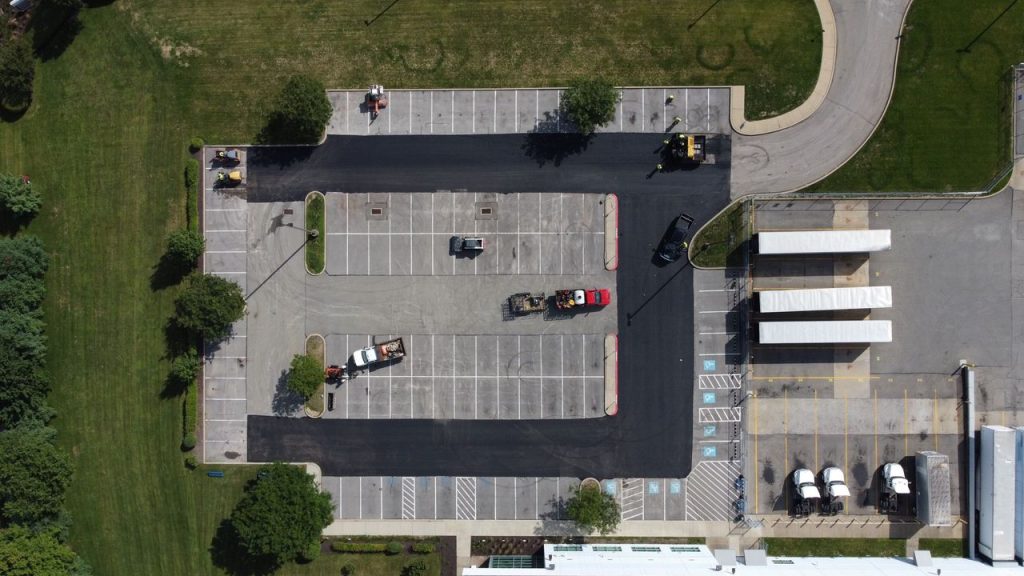
We divide the work into phases so residents always have parking and clear walking paths. We post advance notice boards, mark each section with its scheduled date, and ask residents to move vehicles from the work zone before crews arrive. Pedestrians may use the area a few hours after we lay new asphalt; vehicles may return after 24 hours. Also, as long as it is possible, the entrances to the buildings, the fire lanes, and the accessible paths remain open, and we inform your office staff about the plan before the first day.
3. What happens to the old asphalt that gets milled off?
We recycle it. The process of milling results in reclaimed asphalt pavement, which contractors then combine with new aggregate and binder to make fresh hot mix. This means that the old pavement does not end up in landfills and reduces the amount of new material required for your project. The old asphalt from your property may eventually end up in a new pavement somewhere.
4. How deep does milling go, and what if it exposes a bad base?
In most apartment block developments only a shallow layer is ground away. Normally the amount milled off is one or two inches of the existing asphalt, and a large amount of the pavement damage is confined to the top one or two inches. If the milled surface shows any areas that are soft or wet, we remove those sections, repair the base,, and then fill them in completely before carrying out the overlay. As Pavement Interactive recommends, we look for the underlying cause of a failure, usually by carrying out coring or digging a pit, rather than merely covering the problem with new asphalt.
5. Can I mill only the worst areas and patch the rest?
Certainly, a great many apartment complexes take that approach. We tend to mill the entrance drive, the main corridors, and the paths leading to the dumpsters, since it is here that trucks and everyday traffic cause the most damage, and we repair isolated stall damage in other areas. Crews complete milling in sections. The methods described at pavement milling create seamless transitions where new asphalt meets existing pavement. We map every area needing work and provide separate pricing for each, so you select which projects fit this year’s capital budget and schedule the remainder for next.
6. Does a mill and overlay change my striping and accessible parking layout?
It allows you to make the necessary corrections. We carry out the restriping after the overlay and then verify your layout against the 2010 ADA Standards, these standards requiring car stalls to be at least 96 inches wide and having a 60-inch access aisle. Parking areas with between 1 and 25 spaces must have one accessible space, those with between 26 and 50 need two, those with between 51 and 75 require three, and those with between 76 and 100 need four. If the number of stalls, the signage, or the width of the aisle is incorrect, we can correct it while the crew is still on site, which is cheaper than making a separate visit later.
About the Author
The Pavement Group specializes in asphalt engineering, pavement maintenance solutions, and data-driven asset management for commercial, retail, and multi-family residential properties. Utilizing advanced structural pavement evaluations and capital planning transparency, The Pavement Group works directly with property managers to extend pavement lifecycles, eliminate liability risks, and optimize long-term infrastructure investments.