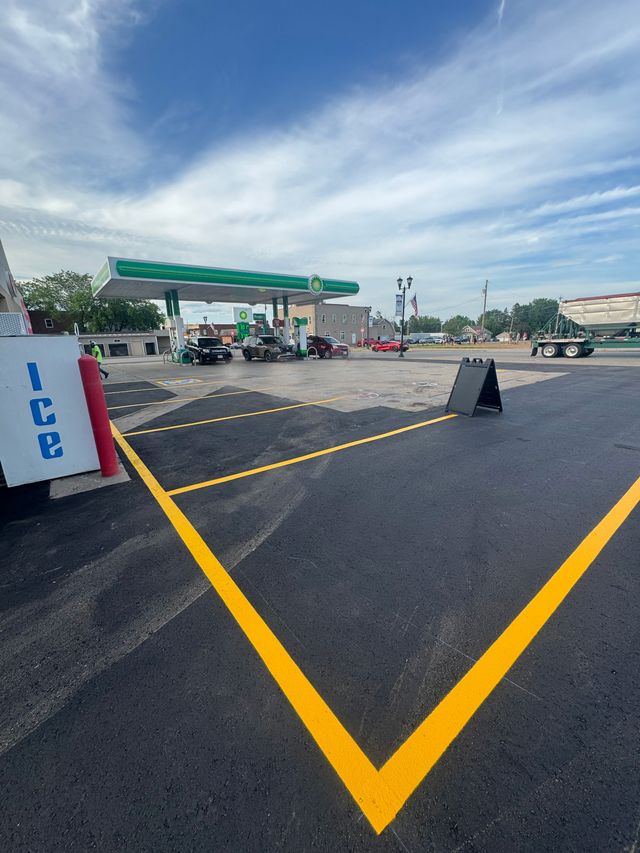
The most recent Infrastructure Report Card from the American Society of Civil Engineers rates U.S. roads a D, and the private pavement in your apartment block has to cope with the same kinds of traffic, water exposure, and freeze-thaw damage without benefiting from the public funding that is used to repair state highways. Owners and property managers usually discover this the hard way, typically when a resident trips over a raised joint in the sidewalk or a pothole eats into a tire outside the leasing office.
At The Pavement Group, we are sometimes asked to carry out two very different types of visit. One of these involves a five-minute walk during which a person points at a few cracks and gives us a rough figure. The other is a full assessment of the condition of an apartment complex car park. It is a properly documented, section-by-section examination that provides you with a report that you can actually use when planning repairs, asking for accurate quotations, and justifying an entry in next year’s capital budget. Since we work in communities all over the country, this article sets out in simple language exactly what should be included in that second type of assessment so that you know what to anticipate and what questions to ask before you agree to a contract for it.
The parking lot checklists you can find online are generally drawn up for retail centers and office parks, places where the car parks are empty every night. An apartment complex never does become empty. The same residents go in and out many times each day. The children cross the drive to get to the pool. A waste collection truck goes right up to the same dumpster area every week. This kind of repeated use affects the parts of the pavement that fail first and changes the nature of your liability. This is precisely the reason why a proper assessment of a multifamily property must consider things that a strip mall inspection will never look at.
Why a Generic Checklist Falls Short at an Apartment Community
Before looking at the checklist itself, it is useful to understand the reason why we prepare a different scope of work for apartment communities than for a commercial retail site. Several factors affect the situation:
- Occupancy is continuous. Since the residents live on the site at all times, wear and the risk of accident build up on nights, on weekends, and on holidays just as they do on a Tuesday afternoon.
- Wear occurs in certain known areas; the same households take the same routes to the same mail kiosk, dumpster corral, and building entrance each day, leading to more severe and quicker failure in those particular spots.
- Leasing revenue is directly related to a property’s curb appeal. When a potential tenant forms an opinion of the property before seeing a unit, a cracked, potholed site undermines every dollar spent staging a model apartment.
- The liability is greater because children, elderly people, and those carrying groceries or moving boxes continually cross the yard on foot, not just the occasional customer walking from a car to a shop.
- Reserve planning is usually a legal requirement, and in condominiums and communities governed by an HOA it is necessary to record the condition of the pavement as part of a formal reserve study, a requirement that is monitored by bodies such as the Community Associations Institute.
The Core Components of an Apartment Parking Lot Condition Assessment
Below is precisely how our teams record everything each time we inspect a property. In the same format as it appears in your final report.
Surface Distress & PCI Scoring
Alligator cracking, potholes, rutting, raveling, block cracking, patch failures, and edge cracking along curb lines
Why It Matters at an Apartment Community
We score every section using the ASTM D6433 pavement condition index method. You get an objective 0 to 100 number instead of someone’s opinion of “looks pretty rough.”
Drainage & Ponding
Low spots, catch basin function, curb and gutter flow lines, sheet flow toward building foundations, and tie-ins to any detention or retention pond on-site
Why It Matters at an Apartment Community
Standing water sits right next to breezeways and stairwells where residents walk daily. Trapped moisture is a leading driver of base failure under asphalt, consistent with EPA guidance on managing runoff from paved surfaces.
ADA Accessible Route Compliance
Accessible stall counts against required ratios, van-accessible aisle width, signage height and mounting, curb ramp slope, and the path of travel from parking to the leasing office and unit entrances
Why It Matters at an Apartment Community
The 2010 ADA Standards for Accessible Design set exact ratios and slope limits, and a community where residents live on site carries more ongoing exposure than a store someone visits once and leaves.
Striping, Signage & Wayfinding
Stall line visibility, fire lane markings, speed bump condition, resident-versus-guest space designation, directional arrows, and stop bar placement
Why It Matters at an Apartment Community
The FHWA’s MUTCD sets the national standard for sign and marking visibility. Faded striping at an apartment site is what generates the fender-benders and blocked fire lanes that land on the property manager’s desk as work orders.
Base & Subgrade Integrity
Test cuts or core samples in already-failed areas, alligator cracking paired with a visible depression, and edge cracking running parallel to curb lines
Why It Matters at an Apartment Community
This tells us whether a section needs a simple overlay or a full reconstruction down to the base. This is the single biggest cost swing in any repair budget.
Curb, Gutter & Concrete Flatwork
Spalling, cracking, vertical height differential at sidewalk joints, and the condition of the concrete pad under dumpster enclosures
Why It Matters at an Apartment Community
A raised sidewalk joint is one of the most common slip-and-fall claims filed against apartment ownership groups. A cracked dumpster pad fails faster than owners expect once a fully loaded collection truck rolls over it weekly.
Fire Lane & Emergency Access
Red curb or striping condition, posted fire lane signage, and clear width and turning radius for fire apparatus
Why It Matters at an Apartment Community
Local fire marshals inspect fire lane compliance at apartment communities on a schedule most retail lots never see, referencing standards like NFPA 1. A failed fire lane inspection can hold up a certificate of occupancy on a renovated building.
Lighting & Security
Pole base condition, wiring and fixture function, and light levels at building entries, mail kiosks, and walkways
Why It Matters at an Apartment Community
We benchmark findings against Illuminating Engineering Society guidance because parking lot lighting is a resident safety and crime prevention issue that shows up directly in online reviews and lease renewal rates, not just an aesthetic line item.
Utility Conflicts & Landscape Intrusion
Manhole and utility cover elevation relative to grade, tree root heaving near planted islands, and irrigation line breaks under the pavement surface
Why It Matters at an Apartment Community
Apartment sites typically carry more buried utilities per square foot than a standalone retail pad. Every conflict changes how a repair section gets priced and sequenced.
Age, Traffic Pattern & Load Analysis
Original construction or last resurfacing date, and wear concentration at entry points, mail kiosks, dumpster corrals, and the leasing office drop-off zone
Why It Matters at an Apartment Community
Apartment lots wear unevenly in predictable spots because the same residents drive the same paths daily. A different failure pattern than the more even wear across a big-box retail lot.
Photo Documentation & Location Mapping
A location-tagged photo of every deficiency, keyed to a numbered spot on your site plan
Why It Matters at an Apartment Community
This is the piece that turns a walk-through into an actual capital planning document. Not a verbal summary someone has to remember three months later when bids come in.
How We Score and Prioritize What We Find
Having a list of problems doesn’t amount to having a plan. After we have completed the walk, we convert each deficiency into two items: a condition score and a priority tier.
Condition score (simplified PCI bands):
- Good, from 85 to 100: only routine maintenance is required, and no repair budget is needed at this time.
- For ages 70 to 84, satisfactory results can be achieved with preventive treatment, crack sealing, and sealcoating, all of which help extend the surface life at a low cost.
- For ages 55 to 69, the condition is fair and requires patching and localized repair during the coming budget cycle.
- For people aged between 40 and 54, inadequate care will soon be followed by either an overlay or more extensive rehabilitation.
- For people under 40, reconstruction is generally the only real solution available for that area.
Priority tiers:
- Something that is immediately dangerous, such as a deep pothole in the drive aisle, a blocked fire lane, or an accessible route that is not in compliance.
- For the short term (1 to 2 years): sections leaning toward failure that are still less expensive to repair or seal than to rebuild.
- Over a period of three to five years, sections may still perform acceptably but be nearing the end of their service life, making them suitable for capital reserve planning.
Why Region Still Changes What We Look For
The fact that we work nationwide doesn’t mean that we apply the same checklist in all locations. A parking lot situated in a region with freeze-thaw conditions fails in a different way from one that is always under the sun. This is why we adjust the assessment to match the actual environment of your property:
- In the areas that experience freezing and thawing (such as the Northeast, the Midwest, and the mountain states), we keep a close eye on frost heave, the spreading of cracks caused by repeated freeze-thaw cycles, damage to the pavement along the curbs as a result of snowplowing, and the deterioration of concrete slabs due to winter deicing salt.
- In humid, hurricane-prone areas (the Southeast and the Gulf Coast), we place greater emphasis on drainage capacity during heavy rainfall, base saturation from extended humidity, and adequate slope to prevent hydroplaning in the drive aisles.
- In high-UV, arid areas (the Southwest and the West), we look for UV oxidation and raveling. Thermal cracking from large daily temperature swings, root intrusion from xeriscaping planted near the edges of the pavement.
No matter the region, the assessment should identify the stressors rather than simply stating that “cracking is present.”
What You Should Walk Away With
An adequate assessment of the conditions in an apartment complex’s parking lot should leave you with a document, not just a conversation. At the very least, you should expect:
- A site map with every deficiency numbered and located
- A PCI score broken out by section or zone, not just one number for the whole property
- Repair recommendations sorted into the immediate, short-term, and long-term tiers above
- A cost range attached to each tier
- A full photo log tied to the site map
- A projected remaining service life for each major section of pavement
If a proposal goes straight from one stage to a repair quote without going through any of the above steps, then you’re dealing with a sales estimate, not a condition assessment. If your community hasn’t had a documented condition assessment in the last few years, that’s usually the first sign it’s time for one. The Pavement Group walks apartment communities nationwide and hands ownership groups and property managers a report they can actually use, not just a repair quote dressed up as one. Reach out to us to schedule a walk of your property.
Need a Professional Assessment of Your Apartment Parking Lot?
A thorough parking lot evaluation goes far beyond spotting surface cracks—it identifies sub-base failure, drainage bottlenecks, ADA compliance issues, and immediate liability hazards. Identifying these hidden problems early allows property managers to plan multi-year capital budgets accurately and prevent costly structural rebuilds. The Pavement Group provides data-driven condition assessments and clear maintenance roadmaps for apartment communities. Reach out to our team to schedule your property inspection today.
Frequently Asked Questions
How frequently should an apartment community arrange a parking lot condition assessment?
Most multi-family properties should have a complete condition assessment every two to three years. Staff doing a more casual visual inspection in between. Those in areas subject to freezing and thawing, or properties more than 15 years old, often require an inspection every one to two years. Deterioration speeds up once the foundation begins to fail. Insurance renewals, refinancing, and changes in ownership also create natural opportunities for these assessments. Lenders and insurers are increasingly likely to request documented evidence of the pavement’s condition before deciding whether to lend or insure the property. Only when residents begin to file complaints does one realize the property has moved from preventive maintenance to reactive repair. This is a stage that involves significantly higher costs per square foot.
Should a property manager or a licensed paving contractor be the one to walk around the property?
A property manager can and should do regular visual inspections. A licensed paving contractor or civil engineer trained in pavement evaluation should conduct a comprehensive condition assessment. While property managers are good at identifying obvious issues such as potholes or faded lines, they are generally not trained to detect signs of subsurface failure. They are not trained to calculate a PCI score or to estimate how long the pavement will last. Assessments conducted by a contractor also carry more credibility with ownership groups, lenders, and insurers. They follow a documented methodology rather than a personal opinion gathered during a walk-through. Nevertheless, we always recommend that the property manager join us when we visit the site. No one is more familiar with the daily traffic patterns than the person who manages the property.
How long will a professional assessment take in the case of a typical apartment complex?
In a typical community with 150 to 300 parking spaces, a detailed on-site inspection generally takes half a day to a full day. It depends on the number of buildings, drive aisles, and drainage features on the site. In larger communities with multiple phases or garden-style buildings spread over several acres, it can take two full days to walk the site and properly document the area. After the site visit, the written report—which includes the PCI scoring, photo documentation, and prioritized cost estimates—usually requires another three to five business days to put together. It makes no sense to rush either of these steps. A report based on an incomplete walk will overlook precisely the defects that end up costing the most later on.
How much does a parking lot condition assessment usually cost?
The price will vary according to the size of the lot, the number of buildings, and how detailed the report has to be. Most independent assessments of apartment complexes lie between a few hundred dollars for a small property and a couple of thousand dollars for a large, multi-phase one. Several contractors, such as The Pavement Group, will apply part or all of the assessment fee towards the repair work. It’s important to consider this cost in relation to the alternative, which is to make guesses about the repairs without having an assessment. That usually means carrying out the repairs in the wrong area or failing to detect a fundamental defect that turns what should be a simple patch job into a full reconstruction a few years later.
What’s the difference between a condition assessment and a routine inspection?
A routine inspection is usually a quick visual walk that flags obvious problems. A condition assessment is a structured, documented process that scores every section of pavement, maps deficiencies to a site plan, evaluates drainage and structural integrity, and produces a prioritized, budgeted repair plan. Think of the inspection as telling you the lot looks bad today. The assessment tells you why it looks that way, how fast it’s declining, and what it will cost to fix and in what order. Most communities need both: frequent light inspections to catch new problems early and periodic full assessments to guide capital planning.
Can a condition assessment help with capital reserve budgeting?
Yes, and this is one of the most underused benefits of a proper assessment. Because the report breaks repairs into immediate, short-term, and long-term tiers with real cost ranges attached. It gives ownership groups and HOA boards a documented basis for reserve fund calculations instead of a rough guess. This matters especially for condo-owned or HOA-governed communities. Reserve studies are often required, and boards can face liability for underfunding known deficiencies. A dated, photo-backed assessment report also becomes useful backup documentation if a special assessment or reserve increase ever needs board or resident approval.
Does the assessment need to happen at a specific time of year?
Late spring through early fall is the ideal window in most climates. Dry, moderate temperatures let a contractor see the pavement’s true condition without snow, ice, or standing water masking problems. In freeze-thaw regions, scheduling shortly after winter also lets a contractor document fresh frost damage before another season buries it or a quick patch covers it up. In hot, high-UV climates, timing matters less for visibility. Repair work is usually easier to schedule outside peak summer heat. Asphalt temperature affects how well new material compacts. Whatever the season, avoid scheduling an assessment during or right after a major storm. Standing water and debris can hide the exact drainage and surface problems you’re trying to document.
See also: How Should Property Managers Prioritize Parking Lot Repairs When the Budget Is Limited?, How Do You Know When an Apartment Parking Lot Has a Failing Base?
About the Author
The Pavement Group specializes in asphalt engineering, pavement maintenance solutions, and data-driven asset management for commercial, retail, and multi-family residential properties. Utilizing advanced structural pavement evaluations and capital planning transparency, The Pavement Group works directly with property managers to extend pavement lifecycles, eliminate liability risks, and optimize long-term infrastructure investments.