Overview: key points
- Because asphalt is a thin layer, the soil and stones underneath determine whether an entrance maintains its shape.
- Entrances with slow-moving traffic often have the most loose soil on the property.
- Service lines, downspouts, and irrigation heads direct water into those same small areas.
- The concrete aprons and curb ramps produce sharp edges since the asphalt tends to drop.
- To achieve a permanent repair, you must first eliminate the cause and then reconstruct each layer using compacted lifts.
Asphalt pavement consists of about 95 percent aggregate—stone, sand, or gravel—bound together by about 5 percent asphalt binder. This ratio explains why sinkage near the entrances to apartment buildings seldom occurs in the asphalt itself. The binder keeps the stones together, but the base and the soil underneath carry the load. When that supporting structure moves, the surface moves with it. Residents notice a dip at the one spot on the property they cross each day.
The Entrance Zone Carries a Different Load Than the Rest of the Lot
Most parking spaces are used for cars that roll up, park, and then leave. The section in front of an apartment building is harder on the pavement. Residents brake and turn at low speed. Rideshare drivers wait idling at the curb. Delivery vans stop with full loads, and move-in trucks remain parked for hours, their weight on a single spot of asphalt. Slow, stationary loads stay on the surface longer than moving ones. Extra time lets a weak layer beneath compress a little more with each journey.
In places such as Texas, Arizona, and Florida, heat makes the problem worse because hot asphalt softens and is more likely to retain a wheel track. Entrances are sometimes constructed with a thinner section than the main driveway because designers generally consider the entry to be a lightly used walkway apron. According to the Asphalt Institute, insufficient foundations regarding asots, soft spots in the subgrade, and insufficient pavement thickness are among the common causes of asphalt failure, and entrances generally have both of these issues.
Backfill Beside the Foundation Settles Over Time
Laying a foundation involves the crew digging a wide trench, pouring the footings and walls, and then placing soil back against the building. The soil used for this backfill is initially less compact than the surrounding soil. Over a few years, rain and the weight of the pavement compress it, and the asphalt above sinks with it. This is the reason why we usually see a broad, shallow bowl running alongside the building wall.
Expansive clay soils make the effect worse. In areas of Texas and Colorado, the clay expands when it gets wet and contracts when it dries out, causing the ground next to the building to rise and fall each season. In Minnesota, Michigan, and the Northeast, frost raises the soil in winter and allows it to settle unevenly in spring. That is why we treat the first 6 to 10 feet from the building as its own zone and test it before estimating any repairs.
Service Trenches Run Straight Into the Entrance
The water, sewer, gas, electric, and fiber lines all need to reach the building and typically come in through the same side the residents use to enter. Each line is placed in a trench, and each trench is then backfilled by someone who has to compact the material in thin layers. If the crew omits this step or works in wet soil, the trench will end up as a long, narrow dip. Research carried out by the Iowa DOT showed that poor compaction and the wrong moisture content cause utility cut restorations to fail. A survey of public works directors, summarized by the Minnesota DOT, listed incorrect backfill and inadequate compaction as among the main complaints regarding trench repairs.
Apartment complexes introduce yet another complication. Over the years, internet service providers, irrigation contractors, and plumbers have each used the same entrance area more than once, each time adding a new boundary where fresh material meets the old. We typically find three or four overlapping patches along a single entry drive, and each settles at a different rate.
Water Collects Where Roofs, Irrigation, and Doors Meet
Downspouts, landscape beds, irrigation heads, and snowmelt from cleared paths all flow toward the entrance because the doorway is generally the lowest point between the building and the property. Any water that discovers a crack or an unsealed edge seeps into the base. As stated in the maintenance instructions from West Virginia, poor drainage causes the bases to become saturated and links to flexible pavement from consolidation below. According to the Asphalt Institute’s guide on distresses, depressions are linked to subgrade consolidation, poor construction, and poor drainage. Wheels then force the wet base upward through the cracks, and notes from Arizona State University on pavement distresses show how a pumping depression forms when saturated layers lose their fines.
Hard Edges Create Soft Spots
Entrances are seldom made of asphalt alone. Concrete aprons, curb ramps, door slabs, and gutter pans all join the asphalt at a joint. Since concrete doesn’t flex, it stays in place while the asphalt next to it compresses. This difference creates a step or a lip exactly where a stroller wheel or a walker’s tip needs a smooth surface. Water also ends up at that joint first and wears away the material at the base beside the concrete.
Reading the Sinking Pattern
The shape and position of the dip will show what we will find when we open the pavement. This table therefore serves as a quick reference for your next visit to a property.
| Where the sinking appears | Likely cause | What We usually find underneath | Our repair approach |
| Long, narrow dip running out from the building wall | Settled utility trench | Loose backfill and voids around the pipe | Cut the trench boundary, recompact in lifts, and repave |
| Wide bowl parallel to the foundation | Consolidating foundation backfill | Loose fill, sometimes with construction debris | Remove the fill and replace it with compacted granular base |
| Dip below a downspout or irrigation head | Concentrated water saturating the base | Soft, pumping base with washed-out fines | Redirect the water, replace the base, and repave |
| Step or lip along a concrete apron or curb ramp | Differential movement at a rigid edge | Gap at the slab and eroded base along the edge | Rebuild the edge support and seal the joint |
| Twin grooves in the drop-off lane | Slow, heavy wheel loads on soft mix | Rutted surface with a sound base | Mill the surface and place a mix suited to slow traffic |
How We Rebuild an Entrance So It Stays Level
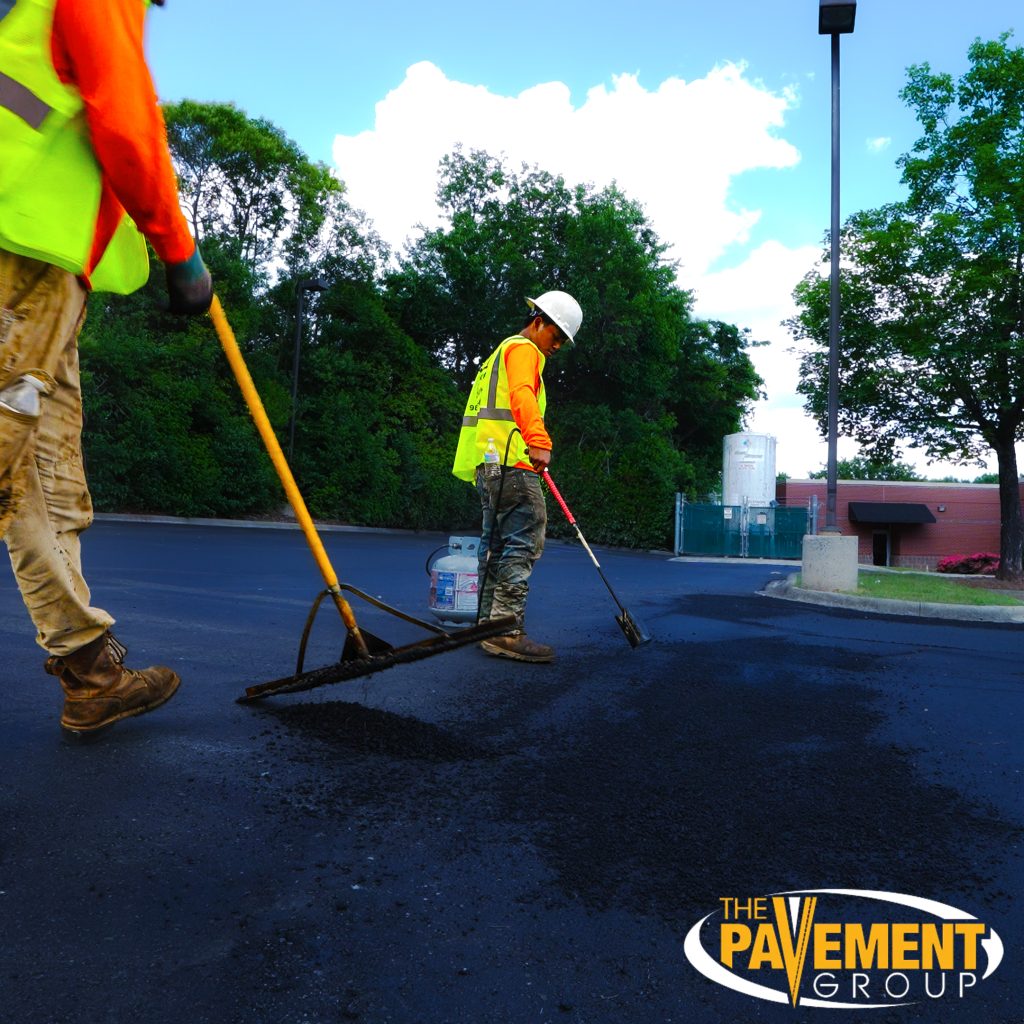
The first step is to identify the cause, which involves investigating the depression. If necessary, open a test pit to look for a wet base, loose backfill, or voids. Once we find the source, we take action to correct it. This could mean extending the downspout, regrading the landscape bed, or adjusting the irrigation head. In this case, we established a clean boundary outside the sunken area, removed both the asphalt and the defective base, and then compacted the subgrade before laying the new material. We then reconstruct the base with compacted crushed stone and install the new asphalt in lifts, each rolled or tamped to achieve density. At the concrete edges, we taper the new asphalt into the slab and seal the joint to prevent water from coming back.
This method gives you three definite advantages. It eliminates a tripping hazard for the residents, it prevents the kind of underlying damage that can lead to a complete failure, and it stops you from having to pay to fix the same dip twice since we repair the layer that has shifted rather than just the surface that shows the dip. We serve apartment complexes across the country and treat each entrance as a structural issue. Every full-depth entrance repair we perform is covered by our standard warranty. It protects your investment and gives you peace of mind that the repaired area will remain sound for years to come. If you see any dipping, a lip, or a puddle near the entrance of any building, call The Pavement Group. They will examine the area, explain the reason in simple language, and provide a written estimate before any work starts.
Address Sinking Asphalt Near Apartment Entrances
Sinking asphalt near an apartment building entrance can create uneven surfaces, drainage problems, and trip hazards. We can evaluate the affected area, identify what is causing the settlement, and recommend the right repair to restore a safer, more stable entrance.
Contact UsFrequently Asked Questions
Can a thin overlay or a skim patch fix a sunken entrance?
For a short period, a thin layer covers the depression, but it doesn’t halt the movement below. The weak base or the loosely packed backfill continues to compress, and so the new surface settles into the same shape, usually within one or two seasons. A skim patch also has a thin, feathered edge, which comes apart when tires pass over it. We advise carrying out an overlay only after we have established that the base is stable. In most sunken entrances we find that a full-depth repair is less expensive over the lifetime of the pavement.
How long until residents can use the entrance again after the repair?
Entrance repairs usually take one or two working days, depending on the extent of the damaged area and how deep the underlying work has to be. Once hot mix asphalt has cooled, which generally happens after a few hours, traffic is allowed on it, and we keep vehicles away from the repaired section until we are certain it is safe. We also arrange a safe route for pedestrians around the construction area so residents can get to the building without walking into the site. In larger communities, we repair entrances one at a time so at least one accessible path remains open throughout the project.
What drives the cost of repairing a sunken entrance?
Four factors influence the price. The first is the size of the area, since a trench-shaped depression is less expensive than a broad bowl shaped along the foundation. The second factor is depth, as a failed base that extends 12 inches or more takes longer to dig out and reconstruct than one that is only a surface issue. The third is the water source. Redirecting a downspout or regrading the bed adds work but also helps protect the new pavement. The fourth is access, which covers narrow spaces next to the building and the need to keep landscaping and walkways safe. We visit the site, assess each factor, and provide a written estimate so you can compare the various aspects item by item.
Do you need to call 811 or the utility company before digging?
Certainly. Anyone digging near a building entrance should call 811 before digging. The service is free and marks the location of buried lines, and most states require the call before any excavation. Because service lines often run directly beneath a sunken entrance, failing to mark them could damage a line, cause a service interruption, or create a safety risk. We make the request ourselves, wait for the markings to be placed, and then manually dig near any marked line. If the repair shows a leaking pipe or failed joint, we stop work and coordinate with your property team and the utility before proceeding.
How can a property manager tell whether an entrance is still sinking?
Measure the dip on a regular schedule so you can see the trend instead of guessing. Lay a 10-foot straightedge across the lowest area, measure the gap with a ruler, and mark the spot with paint so you check the same place each time. Take a photo from the same position and record the date, and repeat the check each quarter and after any heavy storm or thaw. If the gap grows by more than a quarter inch between checks, or if you see fresh cracks, pooling water, or loose stone at the edge, call us for an inspection. A clear record also helps us diagnose the cause faster and gives you documentation for your maintenance files.
About the Author
The Pavement Group specializes in asphalt engineering, pavement maintenance solutions, and data-driven asset management for commercial, retail, and multi-family residential properties. Utilizing advanced structural pavement evaluations and capital planning transparency, The Pavement Group works directly with property managers to extend pavement lifecycles, eliminate liability risks, and optimize long-term infrastructure investments.