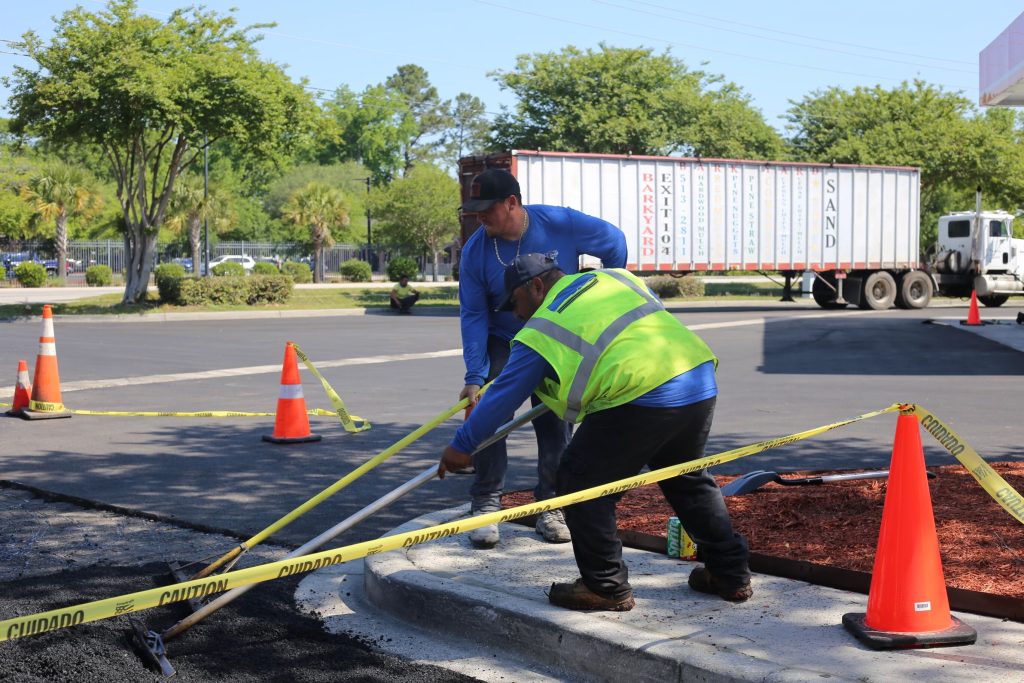
Across the country, healthcare campuses are expanding to meet rising patient demand, aging populations, and stricter compliance standards. According to the American Hospital Association, hospitals in the United States handle over 35 million admissions annually. Every one of those visits depends on safe healthcare pavement, compliant striping, accessible walkways, and clear traffic flow.
At The Pavement Group, we are not just paving contractors. We are a coordinated team that understands how healthcare facilities operate. We work around ambulance routes and phase projects to protect patient access. Our team meets ADA standards without cutting corners. And we deliver reliability because downtime in healthcare is not an option.
Why Are Specialized Paving Services Essential for Healthcare Facilities?
Healthcare facilities operate under stricter safety and compliance standards than most commercial properties.
Medical campuses must maintain:
- ADA-compliant parking and walkways
- Clearly marked fire lanes and ambulance routes
- Slip-resistant surfaces for patient safety
- Durable pavement that withstands heavy vehicle loads
- Minimal disruption during repairs or resurfacing
Every paving work must be carefully scheduled and strategically executed. A standard contractor approach simply does not work in these environments.
1. ADA Compliant Parking & Accessibility Solutions
Accessibility is federally mandated under the Americans with Disabilities Act. The Pavement Group’s healthcare facility services include ADA-compliant parking lot design, striping, signage installation, and slope correction. We evaluate cross slopes, parking dimensions, and access aisles to ensure compliance with current federal guidelines.
Improper slopes or faded markings can expose facilities to liability. We eliminate that risk with precision planning and verified layout standards.
2. Emergency Route & Ambulance Lane Marking
Ambulance bays and emergency routes must remain clearly defined at all times. We install high-visibility striping and reflective pavement markings designed for both daytime and nighttime clarity. Fire lanes are carefully measured and stenciled in accordance with local municipal code.
Our crews coordinate closely with facility managers to ensure zero interference with emergency operations. Safety and speed are balanced without compromise.
3. Infection Control & Clean Work Practices
Healthcare construction demands more than technical skill. It requires strict cleanliness standards. Dust control, debris containment, and phased scheduling are critical. Our team implements containment strategies that minimize airborne particulates during milling and resurfacing. Work zones are isolated and cleaned daily.
These procedures help facilities maintain infection prevention protocols while upgrades are underway.
4. Heavy-Duty Asphalt & Concrete Solutions
Pavement for healthcare services experiences constant traffic from ambulances, service vehicles, delivery trucks, and public visitors. We design pavement systems that support heavy axle loads without premature cracking. This includes reinforced asphalt sections, high-strength concrete pads, and proper subgrade stabilization.
5. Preventive Maintenance & Long-Term Asset Protection
Reactive repairs cost more. Preventive maintenance protects budgets. The Pavement Group’s healthcare facility services include crack sealing, sealcoating, patching, and routine pavement assessments. Regular inspections help detect minor surface damage before it becomes structural failure.
Healthcare administrators appreciate predictable maintenance schedules. Planned service reduces emergency closures and extends pavement lifespan.
6. Parking Lot Lighting Coordination & Safety Striping
We coordinate with facility teams to ensure striping aligns with lighting plans. Well-lit, clearly marked parking lots reduce trip hazards and improve overall visibility. Crosswalks are installed to facilitate pedestrian flow between parking areas and building entrances.
7. Phased Construction for Operational Continuity
Healthcare facilities cannot shut down for resurfacing. We divide projects into manageable phases, allowing portions of the parking lot or drive lanes to remain open. Temporary signage and detour markings are installed to maintain clear navigation.
This approach minimizes patient inconvenience while maintaining operational integrity.
8. Stormwater Management & Drainage Solutions
Poor drainage creates standing water, slip hazards, and long-term structural damage. We evaluate grading, catch basins, and drainage patterns before resurfacing begins. Adjustments are made to improve runoff efficiency and reduce water pooling near entrances.
Building Safer Healthcare Environments from the Ground Up
Pavement may seem like a background detail. In healthcare, it is the frontline infrastructure. The Pavement Group’s healthcare facility services are designed with that responsibility in mind. We combine technical precision with operational awareness. We plan carefully, communicate clearly, and execute reliably.
If your healthcare campus needs resurfacing, ADA corrections, striping, or preventive maintenance, let us build a safer foundation beneath every step.
Partner with The Pavement Group today and reinforce safety, compliance, and reliability across your medical facility.
Frequently Asked Questions
1. Why do healthcare facilities need specialized paving contractors?
Hospitals are not typical job sites. You cannot block an ER entrance or reroute ambulances casually. That is why healthcare paving requires planning, not just equipment. Contractors must understand ADA requirements, emergency access, and infection control. If those details are missed, patient safety is affected. Experience in medical environments truly matters here.
2. How does ADA compliance impact hospital parking lot design?
ADA rules shape everything, from parking space width to pavement slope. If the slope is off, a wheelchair may not move safely. That becomes a legal and safety issue fast. Proper striping and signage are just as important as measurements. When surfaces fade or shift, compliance can quietly disappear. That is why regular evaluations are necessary.
3. What materials are best for healthcare facility pavement?
It depends on traffic and weight. Ambulance bays take heavy, repeated loads, so they need reinforced surfaces. Standard asphalt may not always be enough in those zones. Concrete pads or thicker asphalt sections often work better. The base layer also matters more than most people realize. If the foundation fails, the surface follows.
4. How can paving projects avoid disrupting hospital operations?
The key is phasing the work carefully. You keep part of the lot open while resurfacing another section. Clear signage guides drivers and patients safely. Scheduling during lower traffic hours also helps. Communication with facility managers helps prevent surprises. When planning is tight, operations continue smoothly.
5. Why is drainage important in medical parking lots?
Standing water is more than an inconvenience. It becomes a slip hazard for patients and visitors. Over time, water also weakens the pavement structure. That leads to cracks and potholes faster than expected. Proper grading prevents those issues before they start. Good drainage protects people and the pavement itself.
6. How often should healthcare facilities inspect their pavement?
At least once a year, sometimes more. High-traffic entrances wear down faster than outer areas. Small cracks can spread quickly if ignored. Catching damage early keeps repairs simple and affordable. Waiting too long usually means larger sections need to be replaced. Routine inspections save both money and downtime.
7. What role does striping play in healthcare safety?
Striping controls movement. It tells drivers where to go and pedestrians where to cross. In a hospital setting, confusion is not acceptable. Clear fire lanes and crosswalks protect emergency access. Reflective paint also improves nighttime visibility. When markings fade, safety quietly decreases.
8. Can paving work impact infection control standards?
Yes, it absolutely can. Milling and resurfacing create dust and debris. In a healthcare setting, that must be managed carefully. Crews need containment strategies and daily cleanup routines. Work zones should stay isolated from patient areas. Clean practices are just as important as technical skills.
9. How long does healthcare pavement typically last?
With proper installation and maintenance, asphalt may last 15 to 20 years. Concrete can last longer in heavy-load zones. But climate and traffic volume matter. If maintenance is ignored, lifespan drops quickly. Crack sealing and sealcoating significantly extend durability. Pavement longevity depends on proactive care.
10. When is it better to resurface instead of repair hospital pavement?
If cracks are spreading across large sections, patching may not be enough. Frequent repairs in the same area signal deeper structural wear. Resurfacing creates a uniform, safer surface in a single step. It also restores proper striping and ADA markings. In many cases, resurfacing costs less in the long run than constant patchwork fixes.