If you manage an apartment community of any size, the parking lot is one of the largest assets on your balance sheet and one of the first things a prospective resident sees on a tour. It also tends to be the asset that gets the least planning attention until a pothole damages a resident’s car, a sealcoat cycle gets skipped, or a reserve study flags the lot as 80 percent through its useful life.
Multifamily parking lot paving is not a single service. It is a 20-year lifecycle that includes new construction or full reconstruction, sealcoating cycles, crack sealing, repairs, striping refreshes, ADA recompliance, and eventually mill-and-overlay or full repave. Every one of those services has to be scoped, sequenced, and phased around the people who live on the property. This guide walks through what the work actually involves, how the lifecycle sequences, what a property manager should demand from a paving contractor on a multifamily property, and where the common scope mistakes get made.
Why multifamily parking is a different paving job
A retail parking lot has customers. A multifamily parking lot has residents. The difference shapes every operational decision on the project.
Retail and quick-service buyers care about overnight work, blackout periods around holidays, and signage that keeps customers flowing in. Multifamily operators care about residents who are home at all hours, who park in assigned spaces, who have pets that walk through wet sealer, who need an ADA path of travel from a specific stall to a specific building entrance, and who will absolutely call the leasing office when something disrupts their routine. The National Multifamily Housing Council tracks resident satisfaction metrics closely tied to property condition and operational disruption, and pavement work touches both.
The constraints that matter on multifamily projects are not the same as commercial in general:
- Residents are home 24 hours a day. There is no clean “after hours” window the way there is on retail.
- Assigned parking, garage entries, and carports complicate routing. Closing half a lot is not the same as closing half a retail lot.
- Pet traffic and child traffic crosses paving zones daily.
- Move-ins and move-outs happen weekly and need pavement access for trucks.
- Trash and recycling pickup happens on a fixed weekly schedule that cannot reschedule.
- Emergency vehicle access (fire lanes, ambulance routes) must remain clear at all times.
- Leasing tour routes must remain attractive, which means visible construction zones cost lease conversions.
A paving contractor who works primarily on retail and warehouse jobs and then bids a multifamily project will scope around vehicle counts and lot square footage. A contractor who specializes in multifamily will scope around residents, routing, and communications. The first contractor will quote lower and finish faster. The second will finish without complaints to the leasing office. Property managers learn the difference once.
The full scope of multifamily parking lot paving services
A working multifamily parking lot needs more than asphalt. The full pavement maintenance scope on an apartment property typically includes eight distinct services, each with its own lifecycle and its own crew. Most paving contractors offer some of these. The ones that hold up at portfolio scale offer all of them under one accountability layer.
Asphalt paving and milling
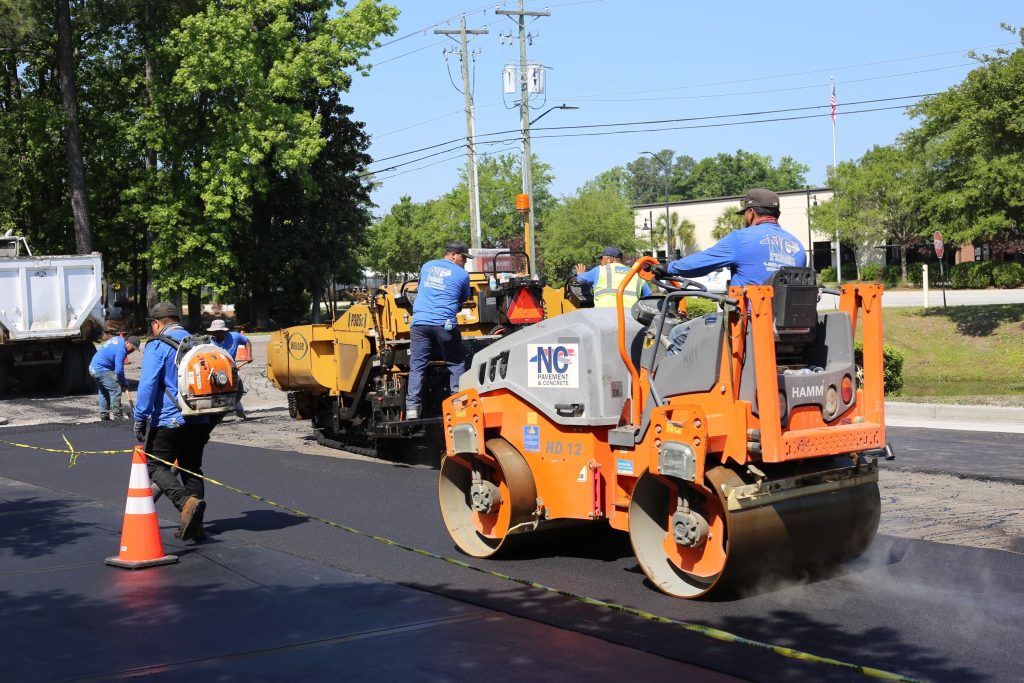
New construction or full repave of the asphalt surface. This is the highest-dollar service in the scope. It is also the one that triggers the longest disruption to residents. A typical mill-and-overlay on a 200-unit community runs four to seven working days for the asphalt portion alone, not counting striping cure time. Full-depth reconstruction runs longer.
The Federal Highway Administration publishes guidance on hot mix asphalt placement including the temperature, compaction, and joint construction standards that determine how long the new surface lasts. A property manager should ask any contractor what mix design they are using, what plant supplies the mix, and what compaction density they target. A contractor who cannot answer those questions in writing is selling tonnage, not pavement.
See our asphalt milling and paving service page for the full scope.
Sealcoating
A preservation coating applied to the asphalt surface every three to five years. Sealcoat does not add structural value to the lot. It protects the surface from UV degradation, water infiltration, and oxidation, all of which accelerate the underlying asphalt’s failure. National Asphalt Pavement Association research on pavement preservation shows that consistent preservation can extend pavement service life by 30 to 40 percent over no-preservation baselines.
On multifamily, sealcoating is the most resident-disruptive routine service in the cycle. The lot has to come out of service for 24 to 48 hours per zone for cure time. Pet traffic, stroller traffic, and car returns all have to be managed. Cover the lifecycle and resident-phasing detail in our companion piece on apartment parking lot sealcoating frequency and resident phasing.
Asphalt repairs and patching
Spot repairs that catch failure before it spreads. Potholes, alligator cracking, raveled edges, depressions, and oil-saturated soft spots all get repaired before they grow. The Asphalt Institute maintains technical guidance on patch geometry, depth, and tack coat application for durable repairs. The shorthand: a four-inch square patch fails. A two-foot square patch with proper edge cuts and tack lasts.
Repair work tends to be the least disruptive paving service to residents because crews work on small zones in sequence. It is also the highest-leverage service in the cycle because catching a failure at the patch stage protects the lot from the next stage.
Crack sealing
Hot rubberized sealant applied into surface cracks before they admit water into the base. Crack sealing is the lowest-cost, highest-leverage preservation service in the cycle. Sealing cracks at year three, before sealcoat, is the difference between a 20-year lot and a 12-year lot.
Crack types matter. Transverse cracks (running across the lot) and longitudinal cracks (running with traffic) are sealing candidates. Block cracking and alligator cracking are not. They are repair candidates. A contractor who proposes crack seal on alligator cracking is treating a structural failure as a surface problem and the failure will return within one year.
Line striping and pavement marking
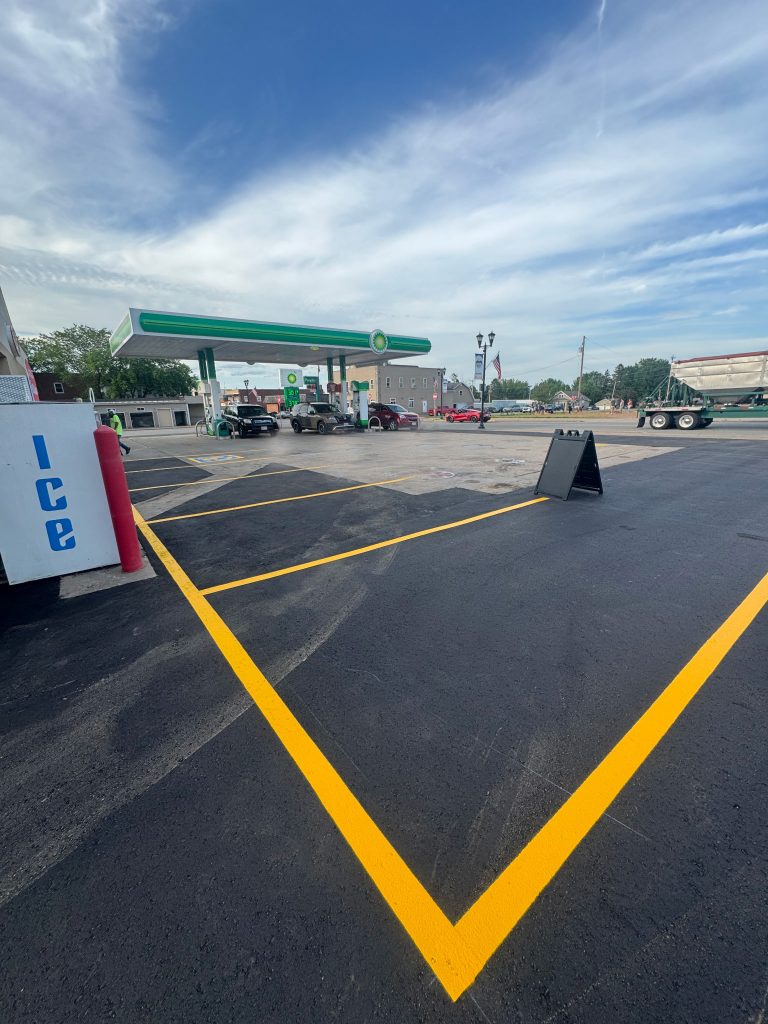
Stall lines, ADA stalls, fire lanes, directional arrows, stop bars, crosswalks, and curb paint. Striping refreshes typically run on a two-to-three-year cycle on multifamily because traffic is light compared to retail, but ADA compliance refreshes run independently and trigger a striping pass any time stall configurations or counts change. Bring a line striping and pavement marking specialist into the planning conversation early because striping schedules around sealcoat cure and asphalt cure.
ADA parking compliance
The 2010 ADA Standards for Accessible Design, codified at ADA.gov, set the rules for required stall counts, van accessible stalls, access aisle width, signage height, slope, cross slope, and the path of travel from the stall to the accessible entrance. Multifamily communities are subject to these standards. They are also subject to the Fair Housing Act’s design and construction requirements for properties built after March 13, 1991, which the HUD Fair Housing Act Design Manual governs.
A property manager taking over an existing community should assume the lot is non-compliant until proven otherwise. ADA enforcement is plaintiff-driven, and serial plaintiffs file in clusters. Detail in our companion piece on the ADA compliance audit for apartment parking lots.
Concrete repair (sidewalks, pads, curbs)
Curb and gutter, sidewalks, dumpster pads, mailbox pads, and approach aprons. Concrete is the second largest pavement asset on most multifamily properties and the one most likely to generate trip-hazard claims. Damaged sidewalks and uplifted joints from root intrusion are the most common citations on community walk-throughs. See our concrete pavement and sidewalk repair service page for the scope.
Drainage and catch basin repair
The base of the lot. Pavement fails at the surface but the failure usually starts underneath. Bad drainage, blocked catch basins, broken inlets, and ponding water all accelerate the asphalt’s failure from below. The Institute of Real Estate Management emphasizes water management as the first-order capital planning consideration on any paved asset. Our catch basin repair and drainage service covers inspection, replacement, and grading correction.
The multifamily parking lot lifecycle
A new asphalt lot, properly built and properly preserved, lasts 20 to 30 years. Skipped preservation cycles compress that to 12 to 15. Aggressive deferred maintenance can compress it below 10. The lifecycle is predictable. Here is what each phase looks like on a multifamily property.
Years 0 to 2. New construction or recent full reconstruction. The lot is in its honeymoon phase. Resident complaints are low. Striping is bright. The only paving work needed in this window is corrective: areas where the original install missed compaction or where utility crews cut and patched the lot during initial construction. Walk the lot at the one-year mark and document anything that is not behaving as expected.
Years 2 to 4. First preservation cycle. Crack sealing at year three. Sealcoating at year three or four. Striping refresh paired with the sealcoat. ADA audit if compliance has not been validated since construction. This is the cheapest cycle in the lifecycle and the one most often skipped. Skipping it costs the owner six to eight years of pavement life.
Years 5 to 8. Second preservation cycle plus first repair pass. Crack seal again. Sealcoat again. Patch any localized failures (potholes, raveling at the entrance aprons, depressions at the dumpster pad turnaround). Striping refresh. This is also the cycle where ADA non-compliance from the 2010 standards typically gets discovered, because lots built before 2010 are now under audit pressure.
Years 9 to 12. Decision point. The lot is approaching the threshold between continued preservation and a capital intervention. A pavement condition index (PCI) reading guides the call. PCI above 70: continue preservation. PCI 55 to 70: resurfacing or overlay candidate. PCI below 55: structural failure is underway and the lot needs mill-and-overlay or full reconstruction. The Asphalt Institute publishes PCI guidance and any contractor with operations credibility can run the assessment on your lot. Detail on the resurfacing call in our apartment parking lot resurfacing decision guide.
Years 12 to 18. Capital intervention. Mill and overlay on most lots that were preserved well. Full-depth reclamation or reconstruction on lots that were not. ADA recompliance triggered by any change in stall configuration. Concrete sidewalk and curb repair bundled in. Drainage correction if ponding has shown up. This is the largest capital event in the 20-year cycle.
Years 18 to 25. Reset. The new surface is in its honeymoon phase again. The cycle restarts.
The full 20-year capital planning view, with a year-by-year budget framework, lives in our companion piece on the apartment parking lot maintenance schedule.
What property managers should demand from a multifamily paving contractor
Most multifamily paving bids come in within five percent of each other on the headline numbers. The difference between bidders is not the asphalt. It is the operational layer wrapped around the asphalt. Six requirements should be in every multifamily paving RFP.
A written resident communication plan. When does work start each day, when does it stop, where are residents redirected to park, when are temporary signs installed, how are residents notified before the work begins, and who do they call when something goes wrong. A contractor without a resident communication plan will improvise on your property and your leasing office will field the calls.
A phased work plan with zone maps. Half a lot at a time at minimum. Quarter at a time on dense properties. The zone map should show resident parking redirects, ADA stall continuity, emergency vehicle routes, and trash pickup routing for the duration of the work. A contractor proposing to close an entire lot for a single workday on a multifamily property is treating the project like a retail job.
Standardized scope language. A two-inch mill and overlay is a two-inch mill and overlay everywhere. The scope template should specify mix design, compaction density, joint construction, tack coat application rate, and surface tolerances. A scope that just says “mill and overlay” is the contractor reserving the right to install whatever depth, mix, and compaction they show up with. Building Owners and Managers Association scope template guidance is the industry reference.
Insurance certificates and warranty terms in writing. General liability, workers compensation, automobile liability, and umbrella coverage at limits appropriate to the project value. Warranty held by the contractor of record, not by a subcontracted crew. Warranty duration in years, not months. Warranty obligor named on the document.
Pavement asset management reporting. Condition data captured on the property and accessible to the asset manager. The Pavement Group captures site condition into Property Technologies, our pavement asset management platform, on every job we touch. The asset manager has the condition baseline for the next reserve study before the job is invoiced.
Single-point accountability across markets. If your portfolio spans multiple states, the contractor of record needs to be a single entity. Standardized scope, standardized quality, single warranty, single insurance certificate, single project manager. The 1TEAM National Contractor Network is how The Pavement Group delivers consistent execution across markets we do not directly self-perform.
How to phase pavement work in an occupied apartment community
The phasing question is the operational hardest part of a multifamily paving project. The contractor’s job is to keep working. The property manager’s job is to keep residents housed without breaking the leasing experience. The phasing plan is where those two jobs meet.
The basic principle: never close more parking than the community can absorb, and never close access to a building entrance for longer than a workday.
A working phasing plan for a multifamily property has six elements. We cover this in operational depth in our resident-first repaving playbook, but the headline elements are:
- Zone the lot into thirds or quarters before work starts. Each zone gets a closed window, a redirect plan, and an open date.
- Notify residents in writing seven days before work, then again two days before, then again the morning of, then post zone signage on the lot.
- Maintain emergency vehicle access through the lot at all times. The fire marshal will pull a permit if access is blocked.
- Maintain ADA stall continuity. If an ADA stall is closed for paving, a temporary ADA stall must be designated and signed within the same path-of-travel radius to a building entrance.
- Coordinate with trash and recycling pickup. The phasing window must accommodate the weekly pickup route.
- Plan striping and curing windows so residents return to a clean lot. Sealcoat cure of 24 to 48 hours per zone, asphalt cure of 24 to 72 hours per zone depending on temperature and traffic load.
Common scope mistakes property managers make on multifamily paving RFPs
We have walked enough apartment community parking lots over the last decade to see the same five mistakes show up in nearly every RFP that comes from a property manager who has not done a major paving project before. None of them are catastrophic on their own. Together they cost the property six to ten years of pavement life.
Bidding “sealcoat the lot” without scoping the prep work. Sealcoat over a dirty, oil-saturated, or cracked surface fails within a year. The bid line should be sealcoat plus crack seal plus oil spot prime plus power wash. A bid that just says sealcoat is a bid that does not include preparation, and a contractor accepting that scope will sealcoat over the problems.
Asking for “patch the potholes” without a patch geometry standard. A pothole patched with a four-inch fill and no edge cut fails in one winter. A pothole patched with a saw-cut, two-foot patch with tack coat lasts the life of the surrounding asphalt. The bid should specify saw-cut and replace, not infill.
Skipping the crack seal cycle to save budget. Crack seal is the cheapest preservation service in the cycle. Skipping it does not save money. It accelerates the lot’s failure and pulls forward the mill-and-overlay decision by three to six years. Run the cycle.
Bundling sealcoat and striping into a single bid without specifying cure time between. Striping over uncured sealer pulls up paint and ruins both surfaces. The bid should specify minimum cure window between sealcoat completion and striping start. Twenty-four hours minimum in warm dry conditions, longer in humid or cool conditions.
Treating ADA compliance as a one-time check at construction. The 2010 standards are still in force in 2026. EV charging stalls added since 2024 have their own ADA requirements per DOJ technical assistance. Any time stall configuration changes, ADA recompliance is in scope. An annual ADA audit on the lot catches drift before it becomes a lawsuit.
How The Pavement Group works on multifamily properties
We operate as a national commercial paving contractor with five owned branches (Wexford PA headquarters, Wisconsin, Westchester NY, Nashville TN, West Palm Beach FL, Charlotte NC) plus the 1TEAM National Contractor Network for every market outside those branches. The model is one contract, one insurance certificate, one warranty, one project manager, and local crews who know the local plants, the local codes, and the local conditions.
On multifamily specifically, we bring four operational practices that the typical local paving contractor does not:
- A resident communication plan delivered as part of the proposal, not improvised on day one.
- A phased work plan with zone maps for every project over 100,000 square feet.
- Property condition data captured into Property Technologies so the asset manager sees the lot in the same dashboard as every other community in the portfolio.
- A single-point project manager who owns the property from kickoff to warranty.
The recognition we have earned reflects scale executed well, not scale alone. The Pavement Group has been named Pavement Magazine Top Contractor for four consecutive years (2021 through 2024) and we work with property management groups across the retail, healthcare, senior living, and homeowner association verticals on lifecycle pavement programs.
If you operate apartment communities and want a baseline assessment of every paved asset on a property or across a portfolio, we will walk every lot, document the condition, project the useful life and recommended treatment for each, and lay out a five-year capital plan that maps to your reserve study. The output is a planning document, not a bid pitch.
Frequently asked questions
How long should an apartment parking lot last?
A new commercial asphalt parking lot on a multifamily property should last 20 to 30 years with proper preservation. Skipping preservation cycles, especially crack seal and sealcoat, compresses that to 12 to 15 years. The Asphalt Institute and the Federal Highway Administration both publish lifecycle data that aligns with the 20-year baseline.
How often should we sealcoat an apartment parking lot?
Every three to five years on most multifamily properties. The exact cycle depends on traffic load, climate, base condition, and the year of the last application. Hot humid climates and freeze-thaw climates accelerate the cycle. Light-traffic age-restricted communities can stretch to five years. Heavy-traffic urban communities run three to four. Full detail in our apartment parking lot sealcoating guide.
What is the difference between resurfacing and a full repave for an apartment lot?
Resurfacing (mill and overlay) removes the top one to two inches of the existing asphalt and installs a new surface course on the existing base. It is appropriate when the base is intact and the surface has reached the end of its preservation life. Full repave (full-depth reclamation or full reconstruction) removes and rebuilds the entire pavement section including the base. It is appropriate when the base has failed. The choice is driven by core samples and pavement condition index, not by guesswork. Detail in our apartment parking lot resurfacing guide.
Can pavement work be done while residents continue to live on the property?
Yes, with phasing. A working phasing plan zones the lot into thirds or quarters, schedules each zone for a window, notifies residents in advance, maintains emergency vehicle access, preserves ADA stall continuity, and coordinates trash and recycling pickup around the work. The resident-first repaving playbook covers the operational detail.
How do we know if our apartment parking lot is ADA compliant?
Assume it is not until you have a recent audit document that says it is. The 2010 ADA Standards for Accessible Design are still in force in 2026. EV charging stalls added since 2024 have their own ADA requirements. Walk the lot annually, run an audit if you have inherited a property, and pull a stall-count check anytime configuration changes. The ADA compliance audit checklist for apartment parking lots walks through what gets checked.
Who should be the contractor of record on a portfolio paving relationship?
The national contractor that holds the insurance, the warranty, the project manager, and the asset management reporting. Subcontracting local crews is fine and often necessary for routing density and plant relationships. What matters is that the buyer signs one contract, holds one insurance certificate, calls one project manager, and pulls one warranty document. The Pavement Group operates the 1TEAM National Contractor Network on this model.
How do we plan for parking lot capital expenses across a multifamily portfolio?
Build a 20-year capital plan with year-by-year service entries (crack seal, sealcoat, repair, striping, resurfacing, replacement). Tie each entry to pavement condition index readings updated at least annually. Reserve studies should pull from the same data. The Institute of Real Estate Management and BOMA both publish capital planning frameworks. The 20-year apartment parking lot maintenance schedule covers the framework in operator-ready detail.
Schedule your multifamily parking lot assessment
If you operate an apartment community or a multifamily portfolio and want a baseline condition assessment of every paved asset, request your assessment at thepavementgroup.com/request-a-pavement-assessment/. We will walk the property, document the condition of every asset (asphalt, concrete, drainage, striping, ADA), project useful life and recommended treatment, and provide a five-year capital plan that maps to your reserve study.