The ADA Standards permit only a one-quarter-inch vertical edge along an accessible route. A sunken catch basin in an apartment parking lot usually drops far past that limit. The dip creates more than just a tripping hazard. Water leaks from the basin’s bottom and gradually washes away the soil underneath. This leaves an open hole into which the basin settles. The failing asphalt then rests on a base that running water has already washed out.
We repair asphalt damage around apartment catch basins for property managers, property owners, and HOAs nationwide. As the contractor, we will explain how we identify the failure, rebuild the structure, and restore the pavement so the repair lasts through the next rainy season
Why Apartment Catch Basins Fail Before the Rest of the Lot
Catch basins in apartment complexes suffer more than those on most commercial properties. All kinds of vehicles—such as rubbish trucks, moving vans, delivery vehicles, and fire engines. Use the same drive lanes, and those lanes usually direct the water straight into one inlet. Three main factors cause the damage.
- The base contains water, and the moisture in both the subgrade and the aggregate base reduces the strength of these layers by increasing the pore pressure and decreasing their shear resistance, which is the reason why the base is weakened by moisture more quickly than the surface indicates.
- The concrete collar around the basin wears out and breaks down. The nearby asphalt then loses support. It begins to sink and crack.
- Freezing and thawing, aging, traffic pressure, and water intrusion wear down the materials that hold the structure together.
What You See on the Surface and What We Find Underneath
| What you see | What it usually means | What we do |
| Ring of cracks around the grate | Collar or frame lost support | Saw cut, reset frame, pour a new collar |
| Bird bath or dip within 3 feet of the inlet | Eroded or poorly compacted base | Excavate and rebuild the base in compacted lifts |
| Grate sits higher than the pavement | Asphalt settled around a stable frame | Adjust with rings and rebuild the apron |
| Alligator cracking radiating outward | Saturated base under repeated loading | Full-depth patch, not a surface overlay |
| Open hole or sinkhole at the edge of the frame | Washout and void | Excavate, find the leak source, rebuild |
Our Step-by-Step Repair Process
- We should identify the area where failure occurs. We tap the pavement and search for soft spots. We then mark a square that extends to solid asphalt on all four sides. Most apartment basin repairs measure between 6 and 8 feet across. We expand the area if cracks extend further.
- We made a cut and removed the damaged section. To help the new patch bond to the solid pavement rather than irregular edges, we cut clean vertical edges.
- Dig up and examine the structure. We inspect the frame, adjusting rings, walls, and pipe connections for cracks or gaps. If needed, we repair the basin or replace it with a new precast unit.
- We will reconstruct the structure. We will reinstall the frame with new adjusting rings. We will retighten every joint with grout. We will form a reinforced concrete collar.
- We reconstruct the base. We place crushed aggregate in roughly 4‑inch batches. We compact every batch with a plate compactor. Because loose fill can settle, especially in clay soils that vary in type, we never omit this step.
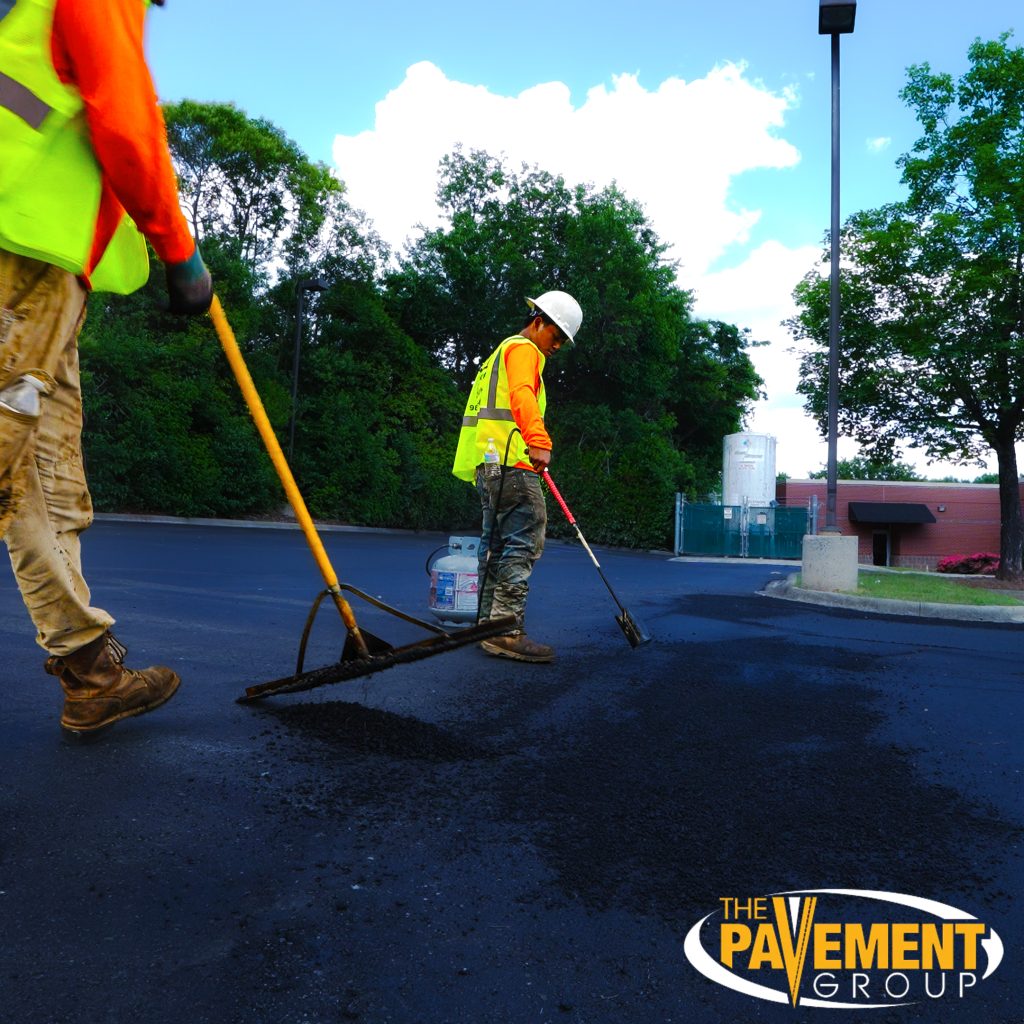
- We apply tack to the vertical edges, then lay the hot mix asphalt in lifts so the thickness matches the surrounding area, and roll it to achieve density.
- We grade the inlet and shape the apron so it slopes toward the grate at a minimum slope of 1 percent, ensuring water flows into the basin rather than around it.
- We seal the joints because the gap between the old and new pavement can let water in. Longitudinal joints are places especially prone to water getting into the pavement structure, so we seal all of them.
Specifications We Hold on Every Basin
| Item | Our standard | Why it matters |
| Frame elevation | Flush to 1/4 inch below the surrounding pavement | Water enters the grate and the edge stays within ADA changes in level limits |
| Base compaction | Plate compacted, 4 inch lifts | Stops future settlement |
| Collar | Reinforced concrete | Carries wheel loads around the frame |
| Asphalt | Hot mix, tacked edges | Bonds to existing pavement |
| Apron slope | 1 percent minimum toward the inlet | Prevents ponding |
| Return to service | Foot traffic after the asphalt cools, vehicles after the concrete gains strength, often 24 to 72 hours | Protects the new collar |
Curing time varies with the mix design and temperature, so we confirm the exact reopening time before we start.
What Apartment Property Managers Should Plan For
Apartment communities add constraints that a standard parking lot repair does not face:
- The routes should be accessible. If the basin is on a path leading to a leasing office, a mailbox cluster, or an accessible stall, the finished edge must remain within ADA limits.
- We’ll carry out the work in phases so one lane remains open, or the closure occurs outside trash collection and emergency access times.
- Liability. A sunken grate is a documented trip hazard. Repairing it quickly protects residents and reduces your exposure.
What Our Clients Say
Property managers and contractors all say the same thing: they want a team that communicates well and gets the job done. A customer left a testimonial on our client testimonials page and said TPG is one of the most professional companies in the industry. This kind of feedback reflects how we carry out our work, and we maintain the same standard on every catch basin repair.
The Mistake We Fix Most Often
Many lots have a surface patch placed directly over a deteriorating basin. The patch looks fine for a few weeks before the underlying material washes away and the dip reappears. Because it is much cheaper to address drainage problems early than to repair extensive pavement failure caused by continuous water infiltration, we rebuild the structure each time.
If your community has a sinking grate, a ring of cracks, or water pooling near an inlet, ask our team to carry out a pavement assessment. Since we serve properties across the country, we’ll provide a clear scope of work, a phasing plan, and a reopening schedule before we begin.
Repair Asphalt Damage Around Apartment Catch Basins
Asphalt damage around catch basins can be a sign of drainage problems, weakened pavement, or repeated water exposure. The longer these areas are left unrepaired, the more likely cracks, potholes, and pavement deterioration are to spread.
The Pavement Group can help apartment property managers identify the cause of the damage and determine the right repair approach. From localized asphalt repairs to drainage and pavement solutions, our team can help protect the parking lot and keep water moving where it should.
Contact UsFrequently Asked Questions
Who pays for catch basin repair on an apartment property, the owner or the city?
The ownership of an inlet depends on its location and on who is the owner. Generally, an inlet situated in your private parking area or in the drive lane is the property of the owner of the property or the HOA, covering also the frame, the collar, and the surrounding asphalt. The public stormwater sewer line that the inlet is connected to is usually the responsibility of the city once it has crossed your property boundary. We advise you to refer to your as-built drawings, look at the recorded easements and the plat map, and then verify the details with your local public works department before you approve any work. In the case of uncertainty regarding ownership, we can assist you in recording the failure using photographs and measurements so that the appropriate party can take action quickly.
How do I know whether the problem is the basin or a collapsed pipe underneath?
Basin failures generally exhibit damage near the frame, for example, in the form of ring cracks, a loose grate, or settlement occurring just a few feet from the opening. Pipe failures, on the other hand, are usually indicated by a depression that runs along a line away from the basin, or by water that continually goes missing and a hole that keeps reopening after having been patched. The two types of failure are distinguished by excavating the area, examining the connections, and then inserting a push camera into the pipe at the point where water loss is observed downstream. Since the pipe has failed, we carry out the repair or replacement of that section before reconstructing the basin and the pavement, as merely patching the surface would waste your money.
Can you repair catch basin asphalt in cold or rainy weather?
We carry out paving only when it is possible for the mix to compact properly and when the base remains stable. Since hot mix asphalt cools down rapidly in cold air, various state specifications prescribe minimum air and surface temperatures between 40 and 50 degrees Fahrenheit, the exact figures depending on the thickness of the lift. We halt work altogether when it is raining and delay action if standing water is present in the excavation, since a saturated base cannot attain the required density. If a hazard cannot be postponed, we put in place a temporary cold patch or a steel plate and arrange for the permanent repair to be carried out during the next suitable weather window so that your residents remain safe in the meantime.
Do we need a permit or stormwater approval to rebuild a catch basin?
You usually won’t need a permit when carrying out a like-for-like repair within a private property, although the requirements can differ from one city or county to another. A number of municipalities control storm inlets that connect to the public storm sewer via their stormwater permits and might ask for notice, an inspection, or a utility permit if the work alters the structure or the pipe connection. We advise you to contact your local public works or engineering department before starting the work and to find out whether the repair or replacement will lead to a review. The scope, the structural details, and the photos that you need for this discussion will be provided by us, which generally results in a quicker approval.
Should the area around the basin be asphalt or concrete?
We opt for a reinforced concrete collar placed right around the frame and use hot mix asphalt for the remainder of the apron. Concrete is able to withstand the point loads caused by tires going over the grate, and it does not soften, rut, or give way under slow, heavy trucks. Asphalt, on the other hand, matches the existing lot, remains flexible, and enables us to join the slope into the drive lane in a smooth manner. A few contractors, for example, a firm from the Twin Cities area, prefer insulated concrete for the grading around the basin, and that method is reasonable in areas with deep frosts. The type of combination we choose depends on the traffic conditions, the climate, and the existing pavement section.
How long will the repair last, and how do I protect it?
A properly rebuilt basin with a compacted base, a reinforced collar, and sealed joints can serve the lot for many years, and its life then matches the surrounding asphalt. The biggest threats after repair are clogged inlets and neglected joints, since both send water back under the pavement. We recommend clearing leaves, trash, and sediment from the grate and sump before every rainy season and again after major storms, and cleaning the sump when sediment fills about half its depth. Walk the area twice a year, look for new hairline cracks at the patch edges, and reseal them early so water never reaches the new base.
See also: Catch Basin Repair and Drainage Solutions for HOA Parking Lots, Catch Basin Repair for Hospitals: Preventing Flooding & Liability Risks
About the Author
The Pavement Group specializes in asphalt engineering, pavement maintenance solutions, and data-driven asset management for commercial, retail, and multi-family residential properties. Utilizing advanced structural pavement evaluations and capital planning transparency, The Pavement Group works directly with property managers to extend pavement lifecycles, eliminate liability risks, and optimize long-term infrastructure investments.