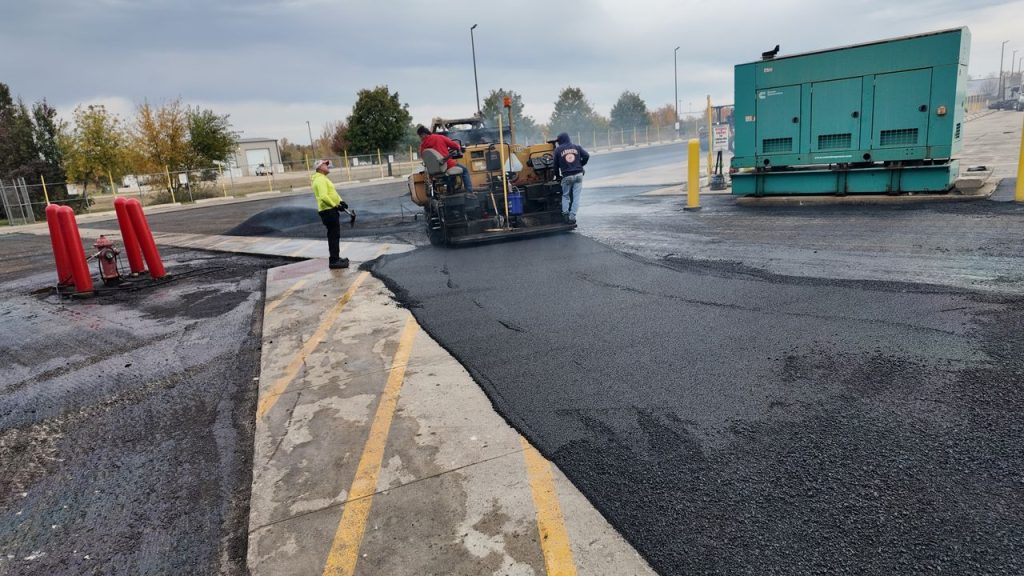
Asphalt does not suddenly fail; instead, it declines gradually. Research conducted by the Federal Highway Administration on pavement preservation shows that for every dollar you invest in crack sealing or sealcoating while pavement remains in good condition, you later save four to ten dollars on milling-and-overlay or full reconstruction. This ratio directly changes how property managers with fixed capital or CAM budgets should prioritize repairs.
The implications extend beyond cost per square foot. More than one million people visit U.S. emergency rooms annually due to slip-and-fall accidents, reports the National Floor Safety Institute. These incidents remain a leading source of general liability claims against commercial property owners. Meanwhile, the ADA Accessible Parking Guidelines consistently cite faded accessible-space markings, missing van-accessible signage, and improperly sloped curb ramps as the most common parking-lot violations. Taken together, these facts make one point clear. Property managers cannot simply address visible defects and then consider their investment well spent.
With limited funds, property managers who take good care of their properties don’t overlook this decision. They set up a system for it. This article outlines a practical, tier-based approach to prioritizing parking lot repairs when the budget isn’t enough to address everything at once.
The short answer is to rank the repairs according to their consequences rather than their appearance: address safety and those related to ADA compliance first; allocate a fixed portion of the budget to preventive crack sealing and sealcoating for the pavement, which is still in good condition; carry out structural repairs in phases according to traffic zone; and delay any purely cosmetic work until the following budget cycle.
The “Worst-First” Trap: Why Fixing the Ugliest Section First Can Waste Your Budget
Most property managers follow the approach known as “worst-first” spending among pavement engineers. They identify the part of the property that is most unattractive, has the greatest number of cracks, and is full of potholes, and then allocate the whole budget to it. This approach appears responsible, yet it usually proves the wrong decision when budgets are limited.
Asphalt deteriorates unevenly rather than in a straight line. Much pavement rated in “good” condition declines slowly year after year, typically dropping just a few points annually on the Pavement Condition Index (PCI) scale defined by ASTM D6433. When a section moves into ‘fair’ territory. It generally means a PCI between 55 and 69; the decline speeds up considerably. Damage then begins to occur to the base and subgrade. The required repair changes from a sealcoat costing $0.15 per square foot. A mill-and-overlay costs between $3 and $5 per square foot. In the worst cases, a full reconstruction for $8 to $15 per square foot.
A property manager who spends the entire year’s budget on the 10% of the property in the worst condition fails to provide preventive maintenance for the other 90%, which is still in good or fair condition. When the next budget period comes around, more square footage will have already passed the cost threshold. The same fixed amount will have to cover a smaller area. After three to four years, repeatedly prioritizing the poorest pavement conditions within a limited budget actually shrinks the total area you can maintain in acceptable condition, even though every dollar goes toward work that clearly requires repair.
How Pavement Condition Drives Repair Cost
| Condition Rating | Typical PCI Range | What It Looks Like | Cost-Effective Fix | Approx. Cost |
| Excellent/Good | 85-100 | Hairline cracking only | Crack sealing | $0.75-$2.00 per linear ft |
| Satisfactory | 70-84 | Block cracking, light raveling | Sealcoat + crack seal | $0.14-$0.25 per sq ft |
| Fair | 55-69 | Moderate alligator cracking begins | Patch + partial overlay | $3-$7 per sq ft |
| Poor | 40-54 | Heavy alligatoring, potholes forming | Mill and overlay | $3-$5 per sq ft |
| Very Poor/Failed | Below 40 | Structural or base failure | Full-depth reconstruction | $8-$15 per sq ft |
Costs will vary by region, contractor, and current material prices; treat these as approximate planning figures, not firm quotes.
A 4-Tier Framework for Prioritizing Parking Lot Repairs on a Limited Budget
A fixed budget doesn’t mean guessing; it means prioritizing repairs by their consequences rather than their appearance. The four-tier system gives property managers a consistent method to determine which repairs to fund this year and which ones they may safely postpone.
Level 1 consists of essential safety and compliance repairs
Fund this level first even if budget funds remain. Delays may lead to injury, legal action, or code violations rather than merely tenant dissatisfaction.
- Potholes or depressions deep enough to damage a vehicle or trip a pedestrian, especially along main walking paths from parking stalls to building entrances
- Accessible route violations include faded or missing van-accessible striping and curb ramps with slopes that exceed the maximum running slope permitted under U.S. accessibility standards (Access Board) and signage indicating accessible parking is missing or obscured.
- Drainage failures that pond water against a foundation, freeze into ice sheets across a walking surface, or violate a municipal stormwater permit tied to the property under the EPA’s NPDES stormwater program
- Trip hazards flagged under general walking-surface expectations described in OSHA’s walking-working surfaces standard
The second tier covers preventive maintenance applied to pavement that remains in good condition
Although this option provides the best return for each dollar, property managers tend to cut funding for it first when budgets tighten, working against their own interests. The cost of crack sealing and sealcoating on pavement that still has a good or satisfactory rating is only a small portion of structural repair. Both measures directly interrupt the deterioration curve mentioned above. The National Asphalt Pavement Association considers this preventive category the single most effective item in a pavement budget for this reason.
Tier 3 involves carrying out local structural repairs in phases according to traffic zones
Not all fair or poor sections have the same urgency. Drive aisles, entrance lanes, and loading dock areas carry a much heavier traffic load and therefore fail faster than end-of-row parking stalls, where cars park and stay for eight hours. If the budget does not allow for comprehensive structural repairs to the entire development, repair the high-traffic lanes first and address the lower-traffic stalls in next year’s plan.
Level 4 covers cosmetic items that may be postponed
Restriping falls outside compliance requirements. This category also includes decorative curbwork, logo stencils, and touch-up sealcoating applied to pavement already in good condition. Delaying these items until the next budget cycle carries nearly no risk. When funds are tight, there should be no hesitation in postponing this level.
What Each Repair Actually Buys You
| Repair Type | Typical Cost | Added Service Life | Best Timing |
| Crack sealing | $0.75-$2.00 per linear ft | 3-5 years | Before the rainy or freeze season |
| Sealcoating | $0.14-$0.25 per sq ft | 2-4 years (reapply every 2-3 yrs) | Warm, dry weather |
| Asphalt patching | $3-$7 per sq ft | 3-8 years, depending on base condition | As soon as failure appears |
| Mill and overlay | $3-$5 per sq ft | 8-12 years | Before full reconstruction becomes the only option |
| Full-depth reconstruction | $8-$15 per sq ft | 15-20 years | Last resort, Tier 3 territory |
Build a Simple Pavement Asset Log Before You Spend a Dollar
A zoning system only functions if the property manager knows which areas belong to which tier. There is no need to hire an engineer each year.
- Walk the lot once a year, ideally in spring after a freeze-thaw season and before locking in the year’s paving contracts
- Divide the lot into zones: drive aisles, standard stalls, ADA spaces, loading or dock areas, and any section with a history of flooding
- Score each zone on a simple 1-to-5 scale, with 5 marking newly paved surface and 1 marking failed pavement, rather than hand-calculating a full PCI
- Log the score, the date, and a photo for each zone, then compare the results against last year’s log
The process results in two items that a one-time engineering survey does not automatically provide. A year-on-year trend line that indicates which areas are nearing the cost cliff before they actually reach it and a record trail that supports CAM reconciliation, capital reserve studies, and budget requests to the ownership or to an HOA board.
Let Your Region’s Climate Shape the Order of Operations
Two plots in the same condition may receive different Tier 2 priorities depending on their position.
- Areas such as the Midwest, the Northeast, and the Mountain West suffer mainly from water seeping in. Seal cracks before the first hard freeze. Water that seeps in and freezes will expand the crack and accelerate deterioration beyond what traffic alone would.
- In the Sun Belt region—such as the Southwest, the Southeast, and the Gulf Coast. The main threats are UV oxidation and heat softening. Here, sealcoating roads to block UV rays and monitoring high-traffic lanes for rutting from prolonged heat matter more than concerns about frost.
- Properties in either climate with large paved areas may also fall under a municipal or federal NPDES stormwater permit, which can turn a drainage-related repair that is currently a Tier 3 preference into a Tier 1 compliance requirement.
Time Repairs to Your Budget Cycle, Not Just the Calendar
A tier list only addresses half the problem; the other half is matching it to the actual flow of money.
- For commercial properties billing CAM, schedule Tier 2 preventive work so it lands inside the current CAM reconciliation period, which keeps costs predictable and easier to justify to tenants when the annual reconciliation goes out
- For HOA and multi-family properties, treat Tier 3 structural work as part of the capital reserve study cycle instead of addressing it through unplanned special assessments. Both IREM and BOMA International publish budgeting guidance that treats preventive pavement work as an operating expense rather than a deferred capital cost, supporting Tier 2 funding even in a difficult year.
- Instead of getting an all-or-nothing quote, ask the paving contractor for a phased proposal. Schedule Phase One for this cycle and Phase Two for the next cycle. This arrangement allows the property manager to fund Tier 1 and Tier 2 immediately and include Tier 3 in the approved budget for the following year, while retaining the contractor’s pricing and scheduling priority.
When DIY Scoring Isn’t Enough: Bringing in a Professional Assessment
A yearly walk-and-score record is useful for year-to-year budget decisions, but it doesn’t show what’s happening beneath the surface. A professional condition assessment—the type that our estimators at The Pavement Group carry out before giving a repair quote. It usually involves taking core samples to examine the integrity of the base and subgrade, conducting a complete PCI survey in accordance with ASTM D6433 criteria, and preparing a phased, multi-year capital plan rather than offering a single lump-sum bid. This type of assessment finds its strongest justification when a property approaches lease renewal, a scheduled reserve study, or a sale. It also applies when annual walk-and-score records show a specific zone declining so rapidly that Tier 2 maintenance alone can no longer sustain its condition.
The Bottom Line
A low budget doesn’t have to involve guesswork. This outcome does not have to happen. You need not let the parking lot deteriorate further each year until full reconstruction becomes your only option. You should prioritize repairs by consequence. Invest in preventative work that slows deterioration. Time your spending to fit the budget cycle rather than the calendar. Property managers who prefer a step-by-step tiered repair plan aligned with their actual budget instead of submitting one single all-or-nothing bid may request an assessment from The Pavement Group. This evaluation shows exactly where their parking lot falls on the deterioration curve before the next budget cycle reaches final approval.
Stretching a Tight Maintenance Budget Across Your Properties?
When pavement capital is limited, addressing active safety hazards and preventing sub-base water damage must take priority over cosmetic fixes. Deferring critical repairs like open pothole patching or unsealed crack filling can turn a manageable maintenance item into an expensive, full-depth replacement next season. The Pavement Group partners with property managers to create phased repair plans, prioritize high-impact areas, and maximize ROI across single sites or multi-location portfolios. Contact our paving specialists today for a customized budget evaluation.
Frequently Asked Questions
How frequently should a property manager arrange for a professional pavement condition assessment if the budget is tight?
Paving contractors generally advise a full professional inspection every two or three years for a property in stable condition and recommend annual inspections for any property that has previously shown fair or poor pavement. Spring is the best time to carry out the inspection since it comes after the freeze-thaw period has completed its damage but before the contracting season becomes busy with other work. A property manager who is working with a very tight budget can extend the professional inspection to once every three years by combining it with the annual DIY walk-and-score log mentioned above and then getting a professional assessment carried out as soon as any zone’s score drops by two points or more in one year.
Can the cost of repairing the parking lot be financed rather than paid out of the current year’s maintenance budget?
Certainly, several paving contractors, such as The Pavement Group, offer payment plans that spread a major repair job over two or more budget periods rather than requiring the full amount upfront. In some cases, property owners arrange for substantial structural repairs. For example, a mill-and-overlay or a complete reconstruction by means of a property improvement loan or a capital line of credit rather than withdrawing the whole amount from the operating or CAM budget all at once. With respect to commercial and institutional properties, it is advisable to find out from a lender or the property’s accountant if the project is eligible for a regional commercial property-assessed financing scheme. Eligibility and the terms differ greatly from one state and municipality to another.
What impact does postponing the repair of the parking lot have on the insurance coverage and the cost of a property?
When underwriting or renewing a policy, insurers are more and more likely to ask for maintenance records. Having a documented record of past complaints regarding potholes or violations of the ADA can be used to back up a claim of negligence if a slip-and-fall or vehicle-damage claim eventually goes to court. Moreover, a history of delayed repairs can directly affect the result of a claim. The insurer’s investigator might cite a known and unattended hazard as proof that the property owner had not exercised reasonable care—a point that the Insurance Information Institute addresses in its general liability guidelines for property owners. In some cases, insurance companies will decide to charge a higher premium or require a more thorough inspection when renewing a policy after there have been repeated incidents in the parking lot. Maintaining the pavement asset log mentioned earlier provides the property manager with documentation showing that the repairs were carried out according to a reasonable timetable rather than being ignored.
Should one choose to repair a parking lot in the winter or wait until the weather warms up?
Both hot-mix asphalt patching and sealcoating require a minimum ambient and surface temperature of about 50 degrees Fahrenheit or above to cure and bond properly. Most genuine winter repair work cannot be done in colder areas. Although cold-patch asphalt can be used as a temporary solution for a Tier 1 safety hazard—such as a deep pothole that can’t wait until spring—it does not take the place of a permanent repair and generally needs a proper hot-mix patch when the temperatures rise. If the work in question is Tier 2 or Tier 3 and is not an immediate safety concern, it should be scheduled between late spring and early fall so that the asphalt has the best opportunity to cure properly and achieve the service-life figures listed in the cost table above.
What steps should a property manager take to get a limited-budget repair plan approved by an HOA board or ownership group?
When boards and ownership groups receive a budget request in the form of a tiered plan that includes photos and dollar figures for each tier rather than a single large amount with no breakdown. They are more likely to approve it. When the request is accompanied by the pavement asset log’s year-over-year scores, the board is more likely to view it as a measure for preventing a much higher cost in the future rather than as a discretionary expenditure. Changing the discussion from one of whether to spend to one of how to spread out the spending. It also helps bring a phased contractor proposal to the same meeting. Boards are much more willing to approve Tier 1 and Tier 2 when Tier 3 already has a defined scope, a price, and a place on next year’s schedule rather than remaining an open-ended future issue.
What would occur if the budget only provided for line striping while the pavement below was failing?
Painting new stripes on cracked or alligator-like asphalt doesn’t prove to be a long-lasting solution because the paint fails in the same way as the surface beneath it. Spending a limited amount of money on cosmetic restriping when the road surface is deteriorating generally ends up being a waste of money within one season. The only exception is striping required for compliance, such as markings indicating van access or fire lanes. These may still need repainting even if the pavement is old to avoid a Tier 1 compliance violation, no matter the surface’s general condition. In all other cases, a property manager with a tight budget gets better value by reallocating striping funds to Tier 2 crack sealing or sealcoating. Stabilizing the pavement protects the investment for much longer than paint ever does.
See also: What Is the Difference Between Asphalt Overlay and Mill-and-Overlay for Apartment Parking Lots?, How Should Apartment Owners Budget for Parking Lot Repairs and Maintenance?
About the Author
The Pavement Group specializes in asphalt engineering, pavement maintenance solutions, and data-driven asset management for commercial, retail, and multi-family residential properties. Utilizing advanced structural pavement evaluations and capital planning transparency, The Pavement Group works directly with property managers to extend pavement lifecycles, eliminate liability risks, and optimize long-term infrastructure investments.