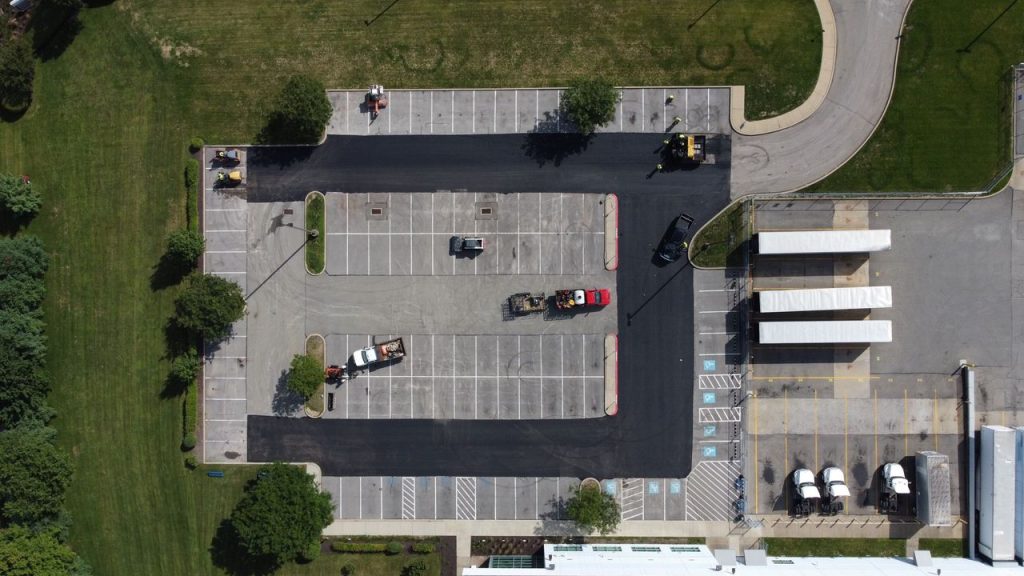
The asphalt itself is merely three or four inches thick, the amount that actually enables a parking lot to function. Beneath this visible layer there is a compacted base and subbase that carry out the main part of the structural work by spreading the weight of each vehicle down into the natural soil. A point the Asphalt Institute has for a long time made, namely, that the majority of serious pavement failures start below the surface rather than on it. This difference is of great importance to property owners since a contractor who fixes only the surface without dealing with a defective base is essentially just repainting a problem that will reappear, frequently within a few months.
We are the Pavement Group, and one of the most frequent calls we receive isn’t something like “There’s a pothole in our parking lot”—it”‘s “We’ve just patched this exact spot for the third time.” That situation is usually an indication that the base has failed, not the surface. Below are the ways in which property managers and owners can tell the difference, covering the physical and test-based signs that most guides never include.
Why the Base Matters More Than the Surface
A parking lot is a multi-layered structure rather than a single layer. At the bottom is the native soil (the subgrade), with a compacted base. Sometimes also including a subbase—placed above it, and the asphalt binder and the surface layers come on top. You drive on the top layer of asphalt, which protects against weather and delivers a smooth surface. The true support comes from the layer below. That base distributes the weight of every car and truck. If water penetrates the base or if crews compacted it improperly from day one, the pavement above sits on nothing solid. The finest surface material cannot make up for a weak foundation.
Visual Warning Signs of a Failing Base
- People call the pattern “alligator” or “crocodile cracking” because interconnected cracks look like reptile skin. It signals that the pavement beneath that area has lost its structural strength. This points to deep-layer failure, not simple surface wear.
- The condition known as rutting shows that the material beneath the surface is deforming under the effect of repeated loading rather than merely wearing away when the depressions in the wheel tracks are deeper than about half an inch.
- Edge cracking or the edge dropping off is a sign that the base material at the side edge has eroded or had no proper support.
- The same potholes keep appearing. If a pothole reappears in the exact same spot only weeks after you repair it, the material beneath the patch is still soft or wet.
- Pavement can heave or rise. Tree roots sometimes cause this issue, but frost action or shifting soil beneath the surface usually produces it.
Signs You Can Feel or Hear, Not Just See
This is the part most articles skip, and it’s often the most reliable evidence:
- The term is ‘deflection’ or ‘bounce.’ When a vehicle carrying a load—such as a goods truck or a waste collector—goes over a part of the road and the pavement visibly bends or gives way a little. This bending indicates that the layer underneath is no longer giving firm support.
- When a vehicle drives over a crack or joint and water or mud pumps out, you see a clear and highly reliable sign that the base material underneath holds too much moisture.
- When you strike the pavement, it produces a hollow or dull sound. In order to check for this, some contractors use a heavy chain or hammer technique. They listen to see if there is a void or separation between the asphalt and the base.
- The ground often feels soft and spongy, especially soon after rain. This happens because the base at that spot holds water instead of staying firm and compacted.
Surface Distress vs. Base Failure, at a Glance
| Symptom | Usually Surface-Level | Usually Base-Level (Structural) | Typical Next Step |
| Fine hairline cracking, evenly spread | Yes | No | Sealcoat / crack seal |
| Alligator cracking in a concentrated area | No | Yes | Evaluate base before repair |
| Rutting deeper than 1/2 inch | No | Yes | Base evaluation before resurfacing |
| Pothole reopening after a patch | Sometimes, once | Yes, if recurring | Investigate base, consider full-depth repair |
| Pumping or mud visible at cracks under load | No | Yes | Base evaluation required |
| Uniform surface fading or graying | Yes | No | Sealcoat |
How Professionals Confirm a Base Failure Diagnosis
You should treat a visual inspection only as the starting point, not the final step, especially before you carry out costly repairs.
If the indications suggest a structural problem, contractors usually check it by:
- Core sampling extracts a small cylindrical sample through the full depth of the pavement. This method lets you examine every layer and measure its condition directly. You rely on actual evidence rather than guesswork.
- Ground Penetrating Radar, or GPR, scans beneath the surface without damaging the pavement. It maps subsurface layers and helps you spot empty spaces or soaked areas. You do not need to cut into the pavement to gather this information.
- A Falling Weight Deflectometer, or FWD, uses a specialized machine to measure pavement deflection. It applies a simulated load and records how much the surface moves. This test gives you an objective measurement of structural strength, not just a visual opinion.
It’s not necessary to carry out this extent of testing in every case. A simple visual check is generally sufficient when there’s just one separate pothole. However, when there are many potholes displaying a number of widespread signs, testing eliminates the need for guessing before anyone decides on a full reconstruction budget.
Why Patching a Failed Base Doesn’t Work at Apartment Communities
It is here that the multifamily aspect makes all the difference. Continuously carrying out repairs on a failed base not only wastes money on maintenance. It also leads to the very kind of resident complaint that property managers most fear: “You’ve already fixed this.” A patch applied over a saturated or eroded base tends to fail more quickly than the original damage did. New asphalt does not bond well to a soft and unstable surface below it. Communities that continue to approve ‘just patch it’ requests for the same area almost always end up paying for the same repair several times rather than paying once for the proper repair.
The Bottom Line
A cracked or pothole-riddled parking lot is a symptom, not the diagnosis. It’s worth finding out before agreeing to another patch whether the damage is only on the surface or indicates the base below has already given way. That will determine whether the appropriate remedy costs a few hundred dollars or calls for a complete reconstruction. If the same area of your property keeps being sent back for repair, we would be happy to take a look. We will give you an honest answer about what you’re actually facing.
Detect Sub-Base Failure Before It Causes Complete Pavement Collapse
Deep depressions, spreading alligator cracking, soft spots, and recurring potholes are clear indicators that your parking lot’s aggregate sub-base has compromised structural integrity. Applying surface-level asphalt patches over a failing sub-base offers only temporary relief, as underlying water saturation and unstable soil will quickly push cracks right back to the surface.
The Pavement Group performs core testing and deep-patch repairs, replacing unstable base material to ensure your apartment parking lot retains structural integrity for the long haul.
- Full-Depth Structural Repairs: Excavation of soft, saturated sub-base soils and compaction of high-density crushed stone to restore foundational load capacity.
- Long-Term Cost Savings: Resolving base failures directly stops repeating surface failure cycles and protects your property against major liability hazards.
Frequently Asked Questions
What is the extra cost when repairing a parking lot with a defective base rather than carrying out a repair that only addresses the surface?
Repairs that only address the surface, such as crack sealing or a single-course overlay, usually cost one dollar or less per square foot. A genuine failure of the base involves removing and reconstructing the layers below the asphalt. It is a procedure that can make costs several times higher per square foot. Still, depending on how deep the reconstruction has to go. The exact amount by which the cost increases depends very much on the extent of the area affected. It includes how deep the failure goes. Carrying out full-depth reclamation over the whole of a drive aisle is much more expensive. It is worth taking the extra step of getting an accurate diagnosis before deciding on a repair plan. Paying for a base-level repair on what is in fact a surface issue — or paying for a surface repair when there is actually a base problem — will waste money in either case.
Can you repair a base without removing the whole thing?
Yes, in most cases, contractors can identify the failed section. They carry out a full-depth patch or partial reclamation only in that area, rather than rebuilding the whole parking lot from scratch. This approach works best when damage stays contained. For instance, around one low drainage spot or in a truck lane that repeated heavy loads have weakened.
Still, it becomes less economical when failures occur in scattered locations throughout the parking area. If failed sections begin to appear across a large part of the parking area, many contractors advise looking at the overall condition of the entire lot rather than dealing with each failure separately.
What is the usual time taken for a base failure to develop — is it something that happens suddenly or bit by bit?
Base failure is almost always a slow process, taking place over months or years as water continuously seeps into the same weak spot. It gradually wears away or soaks into the material beneath the asphalt. What appears sudden—such as a pothole that seems to appear all at once—is actually the last visible stage of a problem that had already been developing below the surface. It was finally triggered by heavy rain or a severe freeze that caused the weakened surface to break. This is one reason regular inspections matter. By catching early, gradual signs, you have more repair options than if you wait until the failure is visible on the surface.
Can a base that has failed be covered by the original installation warranty of a paving contractor?
The extent to which a defective base is covered will largely depend on the exact terms of the original installation warranty. Many paving warranties only provide coverage for defects in materials and workmanship for a limited time, usually between one and five years. They may expressly exclude damage resulting from drainage problems that arose after the work was completed. If the base failure can be linked to a construction defect—for example, insufficient compaction during the initial construction. If this occurs within the warranty period, then the original contractor may be liable for the repair at no cost or at a reduced cost. When property managers are facing a possible warranty claim, they should obtain the original contract and warranty documents and have a contractor or engineer put in writing the cause they suspect before deciding either way. The onus of proof is generally on the property to demonstrate that it was a defect and not just normal deterioration.
Can drainage improvements by themselves remedy a failing base, or is reconstruction always necessary?
Improving drainage can stop a failing base from getting worse by removing the ongoing source of water infiltration. Still, it generally can’t reverse damage that has already occurred to a saturated or eroded base layer. If the failure is caught early and the base hasn’t fully lost its structural integrity, correcting the drainage issue, combined with a surface repair, may be enough to extend the pavement’s life without full reconstruction. Once the base has lost significant load-bearing capacity, however, drainage correction becomes a necessary companion to reconstruction rather than a substitute for it. Fixing the water source doesn’t rebuild material that’s already been compromised.
How can property managers tell the difference between a failing base and normal settling after new construction?
Some settling is normal in the first one to two years after new construction, particularly over utility trenches or areas where fill soil was recently placed. It typically shows up as minor even dips rather than cracking or structural distress. A true base failure, by contrast, tends to show progressive cracking, pumping, or localized soft spots that get worse over time rather than stabilizing. It’s more likely to appear at drainage low points or heavy-traffic areas than uniformly across a newly built lot. If a dip or soft area hasn’t stabilized within the first year or two, or it’s accompanied by cracking rather than just a smooth depression. That’s a reasonable point to have it evaluated rather than assuming it will settle out on its own.
Does a failing base create a safety or liability risk beyond just looking bad?
Yes—a failing base often creates hazards that go well beyond appearance, including sudden potholes deep enough to damage vehicles, uneven pavement that creates trip hazards along walkways, and soft spots that can shift or collapse unexpectedly under a parked or moving vehicle. Because these hazards can develop faster than a routine inspection schedule might catch them. After a major storm, properties with known base issues should treat affected areas as an active safety concern rather than a line item for next quarter’s maintenance plan. Documenting known problem areas and addressing or barricading them promptly also matters from a liability standpoint. A property that knew of a hazard and didn’t act on it is in a much weaker position than one that responded promptly.
What should property managers ask before signing off on a “full base failure” diagnosis?
Before accepting a full base failure diagnosis, property managers should ask the contractor how the determination was made — whether it was based on visual inspection alone or supported by core samples or another testing method. A visual-only diagnosis carries more uncertainty than one backed by physical evidence. It’s also reasonable to ask for photos or samples from the affected area, along with an explanation of how far the failure extends and why the recommended repair matches that scope. For any project reaching a significant capital threshold, getting a second opinion from an independent contractor or geotechnical engineer is reasonable. This is important especially if the first assessment recommends full reconstruction rather than a more targeted repair.
See also: Why Are Potholes Forming in My Apartment Parking Lot?, How Can You Tell If an Apartment Parking Lot Needs Resurfacing?
About the Author
The Pavement Group specializes in asphalt engineering, pavement maintenance solutions, and data-driven asset management for commercial, retail, and multi-family residential properties. Utilizing advanced structural pavement evaluations and capital planning transparency, The Pavement Group works directly with property managers to extend pavement lifecycles, eliminate liability risks, and optimize long-term infrastructure investments.