The Federal Highway Administration (FHWA) explains that traffic volume, weather, marking materials, and location affect pavement-marking durability. FHWA also notes that pavement markings provide important guidance and information to drivers, meaning faded striping is more than an appearance issue.
So, how often should an apartment parking lot be repainted? No single interval works for every multi-family property. A 100-unit community with light traffic will not necessarily wear its markings at the same rate as a 500-unit apartment complex with constant vehicle movement, delivery trucks, rideshare traffic, and heavily used visitor spaces.
The better approach is to combine routine visual inspections with a property-specific repainting schedule.
The Short Answer: Don’t Let the Calendar Make the Decision
A calendar can remind you to inspect your parking lot. It should not be the only thing deciding when you repaint it. FHWA’s current guidance on maintaining pavement-marking visibility discusses service-life approaches based on historical data and emphasizes accounting for local conditions, marking type, pavement surface, traffic, and weather.
For apartment properties, this creates a useful distinction:
Inspection frequency and repainting frequency are not the same thing.
A property might be inspected twice a year but only require full restriping when the markings have deteriorated enough to affect their intended function.
This prevents two common mistakes:
- Repainting perfectly serviceable markings simply because a certain number of months have passed.
- Waiting until important markings are almost invisible before taking action.
Why Apartment Parking Lot Lines Don’t All Wear at the Same Rate
One of the biggest mistakes in parking-lot maintenance is treating every painted line as though it experiences identical conditions. It doesn’t.
Consider the difference between a parking stall behind a quiet apartment building and a directional arrow at the property’s main entrance. The first may see relatively little tire contact.
The second may be driven over hundreds of times each day.
High-wear markings often include:
| Entrance arrows | Constant vehicle movement |
| Stop bars | Repeated braking and acceleration |
| Main drive aisles | High traffic volume |
| Visitor spaces | Frequent turnover |
| Accessible-space markings | Regular use and maneuvering |
| Fire-lane markings | Exposure to traffic and weather |
| Loading areas | Larger vehicles and concentrated activity |
| Speed-hump markings | Repeated tire contact |
| Garage entrances | Tight turning movements |
FHWA research has found substantial variation in pavement-marking performance between locations, even when the same type of marking material is used. Traffic, roadway characteristics, application quality, and weather all contribute to that variation.
That finding has an important implication for apartment managers:
The parking lot itself should determine the maintenance strategy.
What Does “Faded” Actually Mean?
A line does not have to disappear completely before it needs attention.
There is a gradual progression:
Bright → slightly faded → visibly worn → difficult to distinguish → functionally ineffective
The problem is that property managers may notice the first three stages without realizing how different the markings look to someone driving through the property at night or during rain.
FHWA explains that well-maintained retroreflective pavement markings improve nighttime visibility, but pavement-marking visibility can deteriorate over time.
For an apartment community, this means an afternoon inspection may not tell the whole story.
Ask:
- Can residents easily see the lines after sunset?
- Are arrows still obvious when pavement is wet?
- Can visitors distinguish parking spaces quickly?
- Are pedestrian crossings clearly visible?
- Are fire-lane markings still prominent?
- Can drivers understand the intended traffic pattern without guessing?
If the answer is increasingly “no,” repainting may be warranted even if some paint remains visible.
Why Weather Changes the Repainting Equation
Weather is one reason a universal repainting interval can be misleading. Sun exposure, precipitation, humidity, temperature changes, and water accumulation can affect pavement markings and their visibility. The MUTCD notes that weather affects marking durability and that water, debris, and other conditions can limit visibility.
For North Carolina properties, consider the difference between:
A shaded parking area
Lines may receive less direct sunlight and may age at a different rate.
An exposed parking area
Continuous sun exposure can contribute to material aging and visual fading.
A low-lying parking area
Repeated water accumulation can create additional visibility and pavement-maintenance concerns.
This is why two parking lots just a few miles apart can require different maintenance decisions.
Heavy Traffic Can Shorten the Useful Life of Striping
Apartment parking lots experience more than ordinary passenger-vehicle traffic.
Depending on the property, markings may also encounter:
- Moving trucks
- Package-delivery vehicles
- Garbage trucks
- Landscaping equipment
- Maintenance vehicles
- Contractors
- Utility vehicles
- Emergency vehicles
Repeated tire contact can accelerate wear, particularly in turning zones. FHWA specifically identifies traffic volumes and vehicle-related conditions as factors affecting marking durability.
This makes traffic analysis particularly useful for multi-family properties. Instead of asking, “When should the whole lot be repainted?” property managers can ask:
“Which markings are wearing fastest, and why?”
That question can reveal whether a full restriping project is necessary or whether specific areas should receive priority.
The Main Entrance Is Often Your First Warning Sign
If a property manager wants a quick visual indicator of striping deterioration, start at the main entrance.
Why?
It typically combines several stressors:
- Heavy traffic
- Frequent turning
- Braking
- Visitor activity
- Delivery vehicles
- Daytime and nighttime use
If directional arrows, stop bars, or lane markings at the entrance are significantly more worn than markings elsewhere, that difference is useful information.
It suggests the property’s traffic pattern is influencing striping performance.
The same principle applies to leasing-office parking, visitor areas, clubhouse entrances, and busy intersections within the community.
Don’t Repaint Over a Pavement Problem
Fresh paint can make a parking lot look dramatically better. But paint cannot fix deteriorating asphalt.
Before scheduling a repainting project, inspect the pavement underneath the markings.
Look for:
- Alligator cracking
- Potholes
- Rutting
- Depressions
- Failed patches
- Drainage problems
- Loose aggregate
- Severe surface deterioration
If the pavement requires repair, those repairs may need to be coordinated with the striping project.
The Pavement Group provides both line striping and asphalt repair, along with sealcoating, crack sealing, milling and paving, ADA parking compliance, and catch-basin and drainage services.
That broader perspective matters because repainting should be part of pavement maintenance, not a substitute for it.
A Better Way to Decide When to Repaint
Instead of relying on one date, apartment managers can use a four-factor repainting test.
1. Visibility
Can drivers easily see the markings?
2. Function
Do the markings still communicate the intended parking or traffic pattern?
3. Wear
Are high-traffic areas noticeably more deteriorated?
4. Pavement Condition
Is the asphalt underneath the markings suitable for repainting? If all four factors remain favorable, immediate repainting may not be necessary.
If several are deteriorating at the same time, the property should be evaluated for restriping.
The 60-Second Parking Lot Test
Property managers can perform a simple preliminary test during routine inspections.
Drive slowly through the property and ask:
At the entrance:
Can you immediately understand where to go?
In the parking aisles:
Can you clearly identify individual stalls?
At intersections:
Are directional markings obvious?
At accessible spaces:
Are the markings visually distinct?
At fire lanes:
Are restricted areas clearly identified?
At night:
Are important markings still easy to recognize?
After rain:
Do water or debris obscure important markings?
This isn’t a substitute for a professional assessment. It is a practical way to identify whether the parking lot deserves closer attention.
What About Parking Lots With Recently Resurfaced Asphalt?
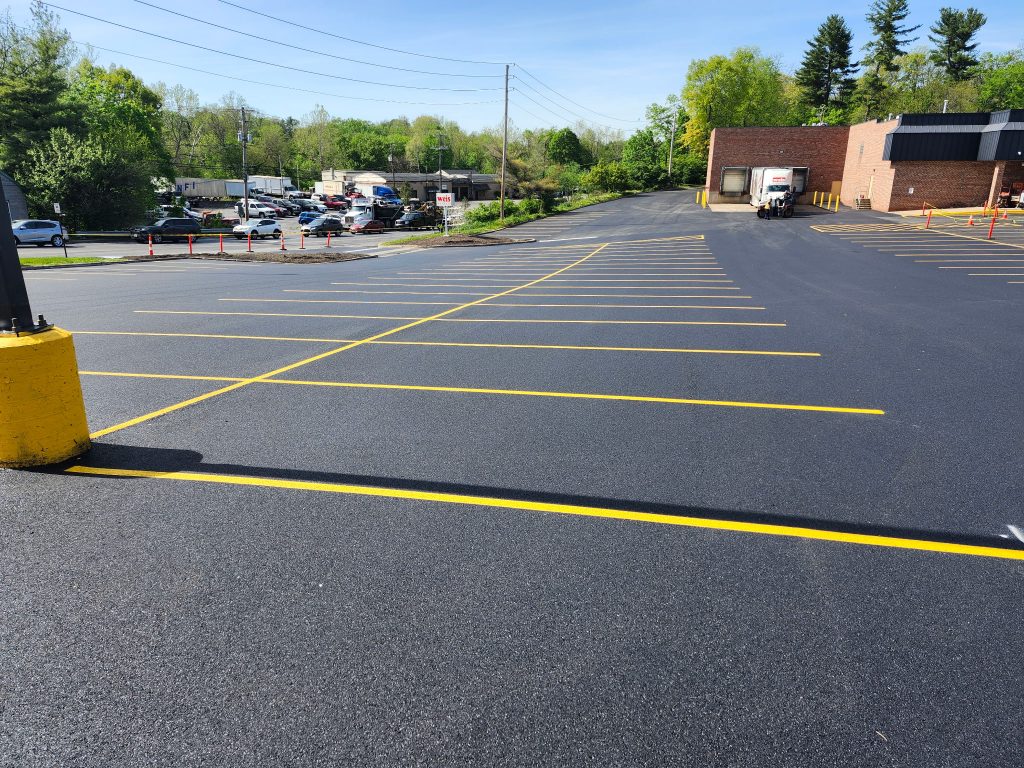
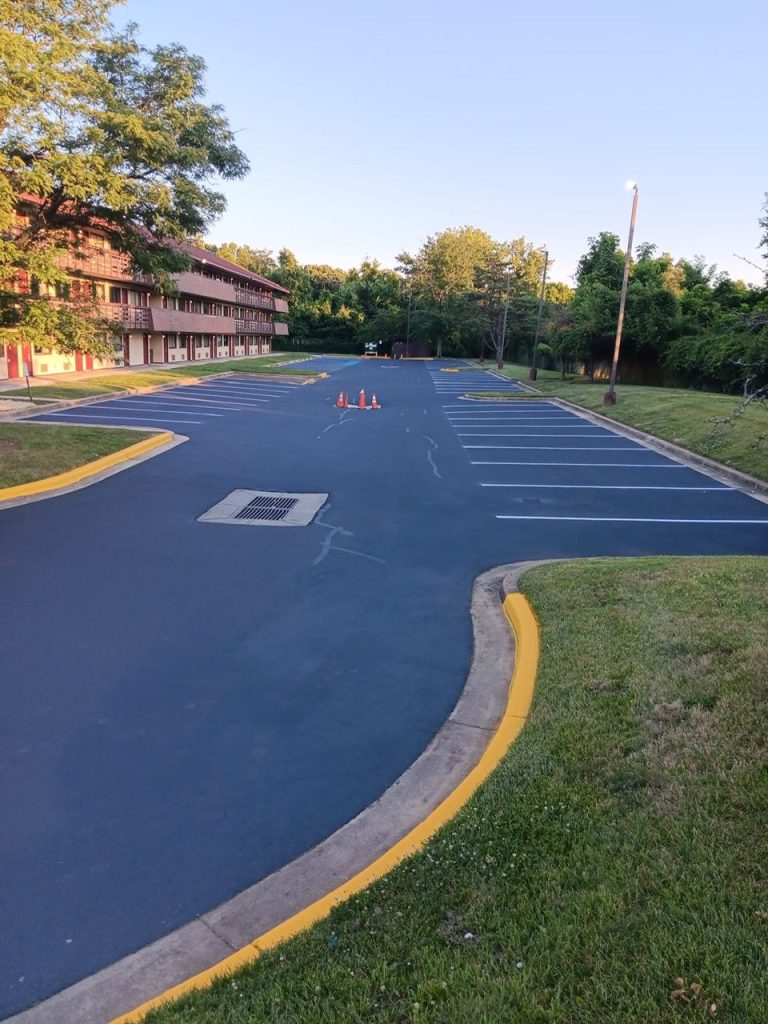
A resurfacing project changes the appearance of the entire property. Fresh asphalt provides strong contrast against new pavement markings, which can make striping particularly noticeable. However, resurfacing does not mean the property can forget about striping maintenance afterward.
The Pavement Group recommends coordinating pavement services so that line striping complements broader pavement improvements. Its services include asphalt paving, sealcoating, crack sealing, asphalt repair, and line striping. For property managers, the lesson is straightforward:
A new surface deserves a maintenance plan from day one.
When Should Apartment Managers Inspect Their Striping?
Instead of inspecting only when residents complain, set up recurring checkpoints.
Twice-yearly visual inspections
Spring and fall inspections can provide useful comparisons.
After major pavement work
Inspect markings after asphalt repairs, resurfacing, sealcoating, or drainage work.
After major construction
Renovations can expose parking lots to additional trucks and equipment.
After unusual traffic changes
A new building, amenity, tenant mix, or parking policy can change how residents use the lot.
After significant weather events
Heavy rainfall can reveal drainage and visibility issues that are difficult to see during dry weather.
FHWA’s pavement-marking maintenance methodology specifically recommends maintaining records such as installation date, marking type, pavement surface, traffic volume, and weather conditions when establishing service-life expectations.
For an apartment owner, that information can turn striping from a reactive expense into a trackable maintenance asset.
Create a Striping History for the Property
A simple striping record is a surprisingly effective maintenance tool.
For each project, record:
| Striping date | June 2026 |
| Marking material | Traffic paint |
| Areas completed | Entire parking lot |
| Number of stalls | 275 |
| Special markings | ADA, fire lanes, arrows |
| Pavement condition | Good |
| Traffic level | High |
| Weather exposure | High |
| Contractor | Documented in property file |
| Next inspection | Spring 2027 |
Over several projects, this information becomes valuable.
You can begin identifying patterns specific to your property.
For example, if the entrance markings consistently deteriorate sooner than the rear parking area, management has evidence that the entrance requires closer monitoring.
Why “Every X Years” Can Be the Wrong Question
The phrase “How often should lines be repainted?” sounds like it should have a simple numerical answer. But pavement markings don’t operate like a household filter that must be replaced on a predetermined date.
FHWA’s service-life guidance emphasizes that expected marking life depends on the marking type and local conditions. That historical service-life information should be relevant to similar weather and traffic conditions.
That means a better question is:
“How long do our markings remain effective under our property’s actual conditions?”
Once property managers begin documenting that information, future maintenance decisions become much easier.
Client Feedback: Why Maintenance Planning Matters
The Pavement Group publishes testimonials from clients discussing their experience with the company’s pavement-maintenance services.
Kyle McDaniel, whose testimonial is published by The Pavement Group, described how the company’s technology helped his organization make better maintenance decisions, control spending, and begin a preventive-maintenance program.
Edward Coyle, another client whose testimonial appears on The Pavement Group’s website, praised the company for completing work in a timely and transparent manner and highlighted the experience from initial contact through completion.
Still, the underlying lesson is relevant to apartment management:
A good pavement-maintenance relationship should make it easier to plan, document, prioritize, and execute work.
A Practical Repainting Decision Matrix
| Bright, clearly visible markings | Continue monitoring |
| Mild fading but good functionality | Inspect more frequently |
| High-traffic markings visibly worn | Schedule professional evaluation |
| Important arrows or stop bars difficult to see | Prioritize restriping |
| Accessible markings significantly faded | Evaluate promptly |
| Fire-lane markings unclear | Prioritize assessment |
| Markings worn and pavement damaged | Coordinate repair and striping |
| New asphalt or resurfacing completed | Establish new inspection baseline |
| Major layout changes planned | Review design before restriping |
This approach avoids pretending that every apartment property needs the same repainting interval.
How The Pavement Group Approaches Line Striping
The Pavement Group describes its line-striping service as a process that considers the parking lot’s layout, design, and traffic flow before applying markings. The company says it uses professional equipment and high-quality paint for durable, clear pavement markings.
That assessment-oriented approach is particularly useful for multi-family properties. An apartment parking lot is not simply a collection of rectangles. It is a transportation environment where residents, visitors, pedestrians, delivery vehicles, and service providers interact.
Good striping should reflect how the property actually functions.
The Bottom Line: Repaint Based on Performance, Not Just Age
So, how often should apartment parking lot lines be repainted?
As often as necessary to keep them functional, visible, and appropriate for the property’s traffic and pavement conditions—but not simply because a calendar says it is time.
The most reliable strategy is to:
- Inspect the parking lot regularly.
- Watch high-traffic areas closely.
- Evaluate markings during different conditions.
- Document when striping is installed.
- Track how quickly individual areas deteriorate.
- Address pavement problems before repainting.
- Coordinate striping with other pavement work.
- Schedule professional assessments when visibility or functionality declines.
The goal isn’t to have the newest-looking parking lot every year.
The goal is to maintain clear, functional markings without spending money prematurely or waiting until deterioration becomes a larger property-management problem.
For multi-family properties, that is a much smarter way to manage parking-lot striping.
Streamline Your Apartment Complex Restriping Project
Organizing a multi-family parking lot restriping project requires careful planning, tenant coordination, and seamless execution to avoid resident frustration and parking bottlenecks. From timing surface repairs and managing phased closures to ensuring complete ADA compliance, a well-executed plan keeps your property running smoothly throughout the process.
ProLine Parking Lot Maintenance handles every step of your project, delivering detailed execution strategies and fast-curing line striping to minimize inconvenience for your residents.
- Turnkey Project Coordination: Phased parking lot access plans and clear layouts to ensure zero downtime and minimal disruption to daily resident routines.
- Code & Layout Precision: Expert re-mapping to ensure fire lanes, stall dimensions, and ADA handicap spaces comply fully with local codes.
Frequently Asked Questions
Can parking lot lines be repainted in sections instead of restriping the entire apartment complex?
Yes, sectional restriping can be appropriate when deterioration is concentrated in specific areas. A property manager should first decide whether the difference in appearance between old and new markings is acceptable and whether a partial project makes operational and financial sense. A professional assessment can help determine whether spot restriping or a property-wide project provides the better long-term result.
What should apartment managers do if residents repeatedly park over faded lines?
Repeated parking problems may indicate that markings no longer clearly communicate the intended boundaries, but enforcement policies may also contribute. Management should document where problems occur and determine whether faded markings, insufficient space, poor layout, or resident behavior is causing the issue. Addressing the physical layout and the property’s parking-management policy together can produce a more sustainable solution.
Does parking lot lighting affect whether lines need to be repainted?
Lighting does not necessarily determine when paint must be replaced, but it can influence how easily residents perceive markings after dark. Poor lighting combined with faded pavement markings can make navigation more difficult than either issue alone. Property managers evaluating nighttime visibility should consider both the condition of the markings and the adequacy of the surrounding lighting.
Can parking lot striping be changed during a property renovation?
Yes, and renovation periods can offer a useful opportunity to reconsider the parking layout before installing new markings. However, review changes involving accessible parking, fire access, traffic circulation, or site capacity against applicable requirements before finalizing the layout. Coordinating striping with renovation work can also prevent construction traffic from damaging new markings.
What records should a property manager keep after repainting parking lines?
The property file should ideally include the project date, contractor, marking materials, areas completed, photographs, pavement condition, and any recommendations for future maintenance. Recording traffic conditions and unusual weather or construction activity can also help explain why markings may wear differently from one project to another. Over several years, these records can provide property-specific evidence for deciding when the next restriping project is appropriate.
Should apartment managers inspect parking lines at night?
A nighttime inspection can reveal visibility problems that are not obvious during daylight. This is particularly useful for entrances, intersections, directional arrows, pedestrian crossings, and other areas where residents need to make quick decisions after dark. FHWA emphasizes the importance of maintaining pavement-marking visibility for nighttime roadway guidance, making after-dark observations a useful supplement to daytime inspections.
Can dirty pavement make parking lines appear more worn than they actually are?
Yes, accumulated dirt, debris, tire residue, and other surface contamination can reduce the visual contrast between pavement and markings. Property managers should distinguish between a temporarily obscured marking and one whose material has genuinely deteriorated. If cleaning does not restore adequate visibility, have a professional evaluate the marking rather than assuming cleaning alone will solve the problem.
What happens if an apartment complex keeps delaying restriping after important markings become difficult to see?
Delaying maintenance can make parking organization increasingly dependent on signs, resident familiarity, and driver judgment rather than clear pavement guidance. It may also allow the property to overlook other underlying pavement or layout problems that become more obvious as markings disappear. When important markings are no longer performing their intended function, management should document the condition and obtain a professional assessment instead of waiting for complete paint loss.
See also: How Repainting Parking Lot Lines Improves Resident Satisfaction, The Importance of Reflective Pavement Markings in Apartment Communities
About the Author
The Pavement Group specializes in asphalt engineering, pavement maintenance solutions, and data-driven asset management for commercial, retail, and multi-family residential properties. Utilizing advanced structural pavement evaluations and capital planning transparency, The Pavement Group works directly with property managers to extend pavement lifecycles, eliminate liability risks, and optimize long-term infrastructure investments.