Potholes rarely appear without warning. In most apartment communities, they develop after smaller pavement problems—such as untreated cracks, standing water, weakened pavement edges, or localized settlement—have been allowed to progress.
The Federal Highway Administration (FHWA) distinguishes preventive maintenance from corrective maintenance. Its pavement-preservation guidance explains that preventive treatments work best when applied while pavement is still in good condition, before serious deterioration develops.
That distinction matters for multifamily property managers. Waiting until residents report a pothole means the property is already dealing with a visible pavement failure. A better strategy is to identify the conditions that create potholes and address them before asphalt begins breaking apart.
For apartment communities, effective pothole prevention involves much more than scheduling occasional asphalt repairs. It requires a coordinated approach involving drainage, inspections, crack management, pavement edges, traffic patterns, utility work, surface preservation, and documentation.
7 Ways Property Managers Can Prevent Potholes
1. Inspect the Parking Lot Before Residents Report Problems
A resident complaint is useful, but it should not be the property’s primary pavement inspection system.
Property managers can establish routine visual inspections that identify early warning signs such as:
- Hairline and widening cracks
- Small depressions
- Areas of ponding water
- Raveling asphalt
- Loose aggregate
- Edge deterioration
- Rutting
- Previous patches beginning to fail
- Settlement around drainage structures
- Repeated deterioration near utility covers
The objective is to catch the precursor to the pothole, not simply document the pothole after it appears. A useful inspection record should identify the location, approximate size, condition, surrounding drainage, and whether the same area has experienced previous repairs.
2. Track Water After Heavy Rain
One of the most practical pothole-prevention techniques requires nothing more complicated than observing the parking lot after significant rainfall.
Property managers should note where water remains after most of the surrounding pavement has dried. Persistent ponding can reveal drainage or grading issues that may not be obvious during dry weather.
Pay particular attention to:
- Low points
- Drain inlets
- Parking lot entrances
- Pavement transitions
- Areas beside curbs
- Dumpster enclosures
- Downspout discharge locations
- Areas around catch basins
A drainage issue that repeatedly saturates one section of pavement should be investigated rather than treated as an isolated asphalt defect.
3. Treat Cracks Before They Become Pathways for Water
A crack is not automatically a pothole, but an untreated crack can become part of the deterioration process.
Water and debris can enter pavement cracks, and repeated traffic can contribute to further deterioration. FHWA identifies crack sealing as a preventive treatment intended to reduce water infiltration and help preserve pavement condition.
However, not every crack should receive the same treatment.
Property managers should have a pavement professional determine whether cracks are suitable for filling or sealing, whether they indicate structural distress, or whether the surrounding pavement requires a more substantial repair.
4. Keep Drainage Infrastructure Functional
A parking lot’s drainage system should be treated as part of its pavement-maintenance program. Catch basins, grates, channels, and other drainage components can accumulate leaves, sediment, trash, and other debris. When these systems cannot move water efficiently, pavement may be exposed to unnecessary moisture.
FHWA specifically lists maintenance of drainage facilities among preventive pavement-maintenance strategies and emphasizes the early application of preservation treatments. For apartment communities, drainage inspections should be incorporated into routine property-maintenance schedules instead of being performed only after flooding occurs.
5. Pay Special Attention to Pavement Edges
Pavement edges are easy to overlook because most property managers naturally focus on driving lanes and parking stalls.
However, unsupported or deteriorated edges can allow asphalt to break away. Water flowing along pavement edges can also contribute to erosion or weakening when drainage is inadequate.
Managers should inspect areas next to:
- Curbs
- Landscaping
- Sidewalks
- Gravel or unpaved shoulders
- Drainage channels
- Dumpster pads
- Driveway connections
Early edge repairs can prevent localized deterioration from expanding into the travel area.
6. Investigate Recurring Pothole Locations
A pothole that returns in the same location should be treated as a diagnostic clue, not simply another maintenance ticket.
Repeated failure can indicate that the original repair did not address the underlying problem. Possible causes include inadequate base support, recurring water infiltration, settlement, utility-related disturbances, or unusually heavy traffic.
FHWA explains that corrective maintenance restores localized deficiencies, while rehabilitation and reconstruction may be necessary when pavement deterioration involves broader structural problems.
Property managers should therefore document repeat failures and ask contractors to investigate the cause rather than repeatedly applying temporary patches.
7. Build Pothole Prevention Into the Property’s Capital Plan
Pothole prevention works best when pavement maintenance is planned before emergency repairs become necessary.
Instead of budgeting only for unexpected repairs, property managers can establish a pavement-management plan that accounts for:
- Current pavement condition
- Areas requiring immediate attention
- Preventive maintenance needs
- Future resurfacing requirements
- Potential reconstruction areas
- Drainage improvements
- Annual maintenance funding
FHWA notes that systematic preservation treatments can slow pavement deterioration and postpone more expensive rehabilitation or reconstruction. This approach also makes pavement expenses easier to anticipate.
Don’t Treat Every Crack as a Pothole Problem
One important distinction can help property managers avoid unnecessary work. A parking lot with minor surface cracking may still be a good candidate for preventive maintenance. A parking lot with widespread alligator cracking, rutting, settlement, and recurring potholes may require a much more comprehensive pavement evaluation.
FHWA’s pavement-preservation guidance emphasizes that preventive treatments are intended for pavement that is still in sufficiently good condition; pavement with significant structural deficiencies may instead require rehabilitation or reconstruction.
In other words, the earlier the property identifies deterioration, the more treatment options it may have.
Waiting until the pavement is structurally compromised can limit those options.
Why Patching Alone Doesn’t Prevent Future Potholes
Pothole patching is important because open pavement failures can create safety and liability concerns. However, patching is generally a corrective measure rather than a complete pothole-prevention strategy.
FHWA categorizes pothole patching as corrective maintenance in its pavement-preservation terminology.
That means property managers should distinguish between:
Repairing the pothole:
Restores a damaged area after failure has occurred.
Preventing another pothole:
Addresses the conditions that caused the failure in the first place.
For example, if a pothole repeatedly develops beside a clogged drainage structure, repatching the asphalt without correcting the drainage problem may not solve the underlying issue.
Use Pavement Mapping to Find Problem Areas
A particularly effective strategy for larger apartment communities is to create a simple pavement condition map.
Property managers can divide the parking lot into sections and record:
- Cracks
- Potholes
- Drainage problems
- Patches
- Rutting
- Settlement
- High-traffic zones
- Previous repairs
- Areas requiring monitoring
For a property with several parking areas, pavement mapping can help managers recognize patterns that would otherwise be missed. If multiple failures consistently occur along one drainage line or traffic route, the pattern can point contractors toward an underlying cause.
This also makes conversations with ownership and asset managers more concrete because maintenance recommendations can be tied to specific pavement locations.
Coordinate Utility Work With Pavement Maintenance
Utility repairs can create another source of pavement weakness. When underground plumbing, electrical, telecommunications, or other utility work requires cutting through asphalt, the restored area becomes part of the parking lot’s pavement system. Poorly compacted backfill or inadequate restoration can eventually lead to settlement and cracking.
Apartment property managers should therefore ensure that utility contractors properly restore disturbed pavement and document the location of underground work. A pavement failure appearing months after utility work should not automatically be classified as ordinary asphalt aging. Its location and timing may provide important clues about the cause.
Create a Seasonal Pothole-Prevention Routine
Pothole prevention should not be limited to one annual inspection. A more effective approach is to monitor the parking lot throughout the year:
After major storms
Check for ponding, erosion, drainage blockage, and newly developed cracks.
During routine property inspections
Look for small pavement changes before they become obvious failures.
Before major maintenance work
Inspect areas scheduled for utility work, landscaping changes, dumpster relocation, or other construction.
Before and after heavy-use periods
Review entrances, loading areas, and traffic lanes that experience unusually high vehicle activity.
This recurring approach gives property managers more opportunities to catch deterioration while repairs remain localized.
Pothole Prevention Is Part of Long-Term Pavement Preservation
The most effective apartment parking lot maintenance programs do not wait for pavement failures to become emergencies. Instead, they combine routine inspections, drainage management, crack treatment, targeted repairs, pavement mapping, traffic awareness, and long-term budgeting.
FHWA’s pavement-preservation guidance supports this proactive philosophy, explaining that applying appropriate treatments before serious damage occurs can help extend pavement service life and postpone more expensive rehabilitation or reconstruction.
For multifamily properties, this approach can also make maintenance easier to coordinate. Rather than reacting to a growing list of resident complaints, property managers can prioritize pavement work based on condition, risk, and the likely consequences of delaying repairs.
The result is a parking lot that is easier to manage, safer for residents and visitors, and better positioned for long-term performance.
Prevent Costly Potholes Before They Disrupt Your Resident Parking
Potholes aren’t just an eyesore—they are vehicle-damaging liabilities caused when surface water seeps through minor cracks, erodes the sub-base, and expands during freeze-thaw cycles. Once water breaks down the underlying support, heavy daily traffic collapses the surface pavement. Proactive maintenance is the only way to stop minor surface fissures from becoming deep structural hazards.
The Pavement Group provides comprehensive preventative asphalt care—combining deep crack sealing, protective sealcoating, and proper drainage management—to keep your multi-family lot smooth and pothole-free.
- Water Intrusion Defense: Hot-rubberized crack filling and surface sealcoating that seal out moisture before sub-base erosion begins.
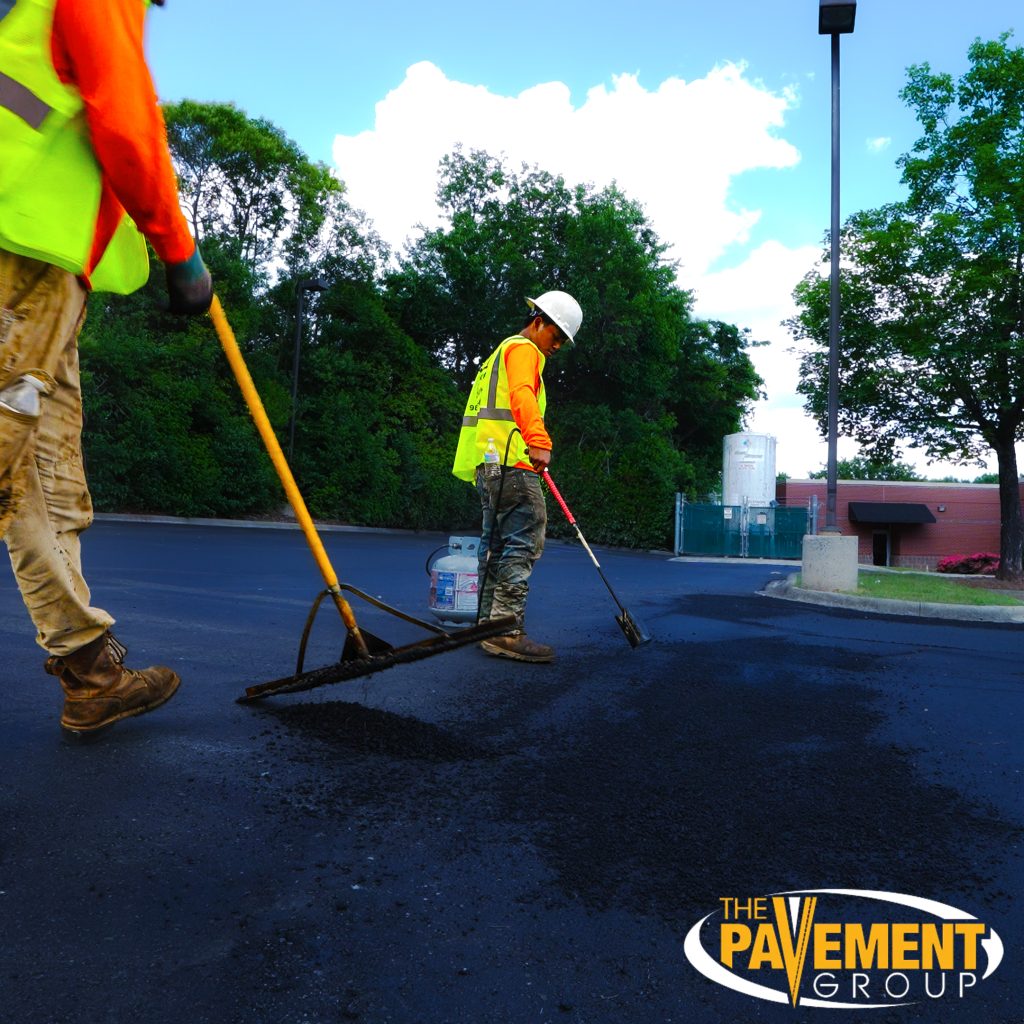
- Seamless Patching Repairs: Thermal infrared asphalt patching to repair early surface failures without leaving weak, porous seams behind.
Frequently Asked Questions
What is the biggest cause of potholes in apartment parking lots?
Water infiltration is one of the most important factors in pavement deterioration, particularly when water reaches cracks or weakens supporting layers. However, potholes usually result from several interacting factors, including traffic loads, pavement age, drainage, and underlying structural deficiencies. Identifying the specific cause at each property is more useful than assuming every pothole has the same origin.
Can sealcoating stop potholes from forming?
Sealcoating can help protect an asphalt surface from oxidation and environmental exposure, but it is not a solution for structural pavement failures. It should not be applied over pavement that already has significant structural deterioration and should be selected based on the pavement’s existing condition. Preventive treatments are most effective when they are matched to the pavement condition and applied before serious deterioration develops.
Should property managers repair small cracks immediately?
Small cracks should be monitored and evaluated because their significance depends on their type, width, pattern, and location. Some cracks may be suitable for crack filling or sealing, while others can indicate underlying structural movement or pavement failure. FHWA identifies crack sealing and filling as established asphalt maintenance practices, but treatment selection should depend on the pavement’s condition.
Why do potholes keep coming back after they are repaired?
Recurring potholes can indicate that the underlying cause has not been corrected. Possible contributing factors include drainage problems, weak base or subgrade conditions, settlement, utility-related disturbances, or unusually heavy traffic. When the same location repeatedly fails, property managers should request an assessment of the surrounding pavement rather than treating every occurrence as an isolated surface defect.
When should an apartment complex consider professional pavement assessment?
A professional assessment is particularly useful when potholes are recurring, pavement deterioration is widespread, drainage problems are present, or the property is preparing for major capital improvements. An assessment can help distinguish isolated maintenance issues from broader structural problems. This distinction matters because FHWA’s preservation guidance indicates that preventive treatments are most appropriate before serious structural deterioration occurs.
How can pavement maintenance fit into an apartment property’s annual budget?
Property managers can begin by documenting pavement conditions and separating immediate repairs from preventive maintenance and longer-term capital projects. Establishing priorities by pavement condition can make it easier to anticipate expenses instead of relying entirely on emergency repair budgets. A planned preservation strategy can also help delay more expensive rehabilitation when appropriate, which is consistent with FHWA’s approach to proactive pavement management.
See also: Standing Water in Apartment Parking Lots: Causes, Risks, and Repairs, How Poor Drainage Shortens the Life of Apartment Parking Lots
About the Author
The Pavement Group specializes in asphalt engineering, pavement maintenance solutions, and data-driven asset management for commercial, retail, and multi-family residential properties. Utilizing advanced structural pavement evaluations and capital planning transparency, The Pavement Group works directly with property managers to extend pavement lifecycles, eliminate liability risks, and optimize long-term infrastructure investments.